

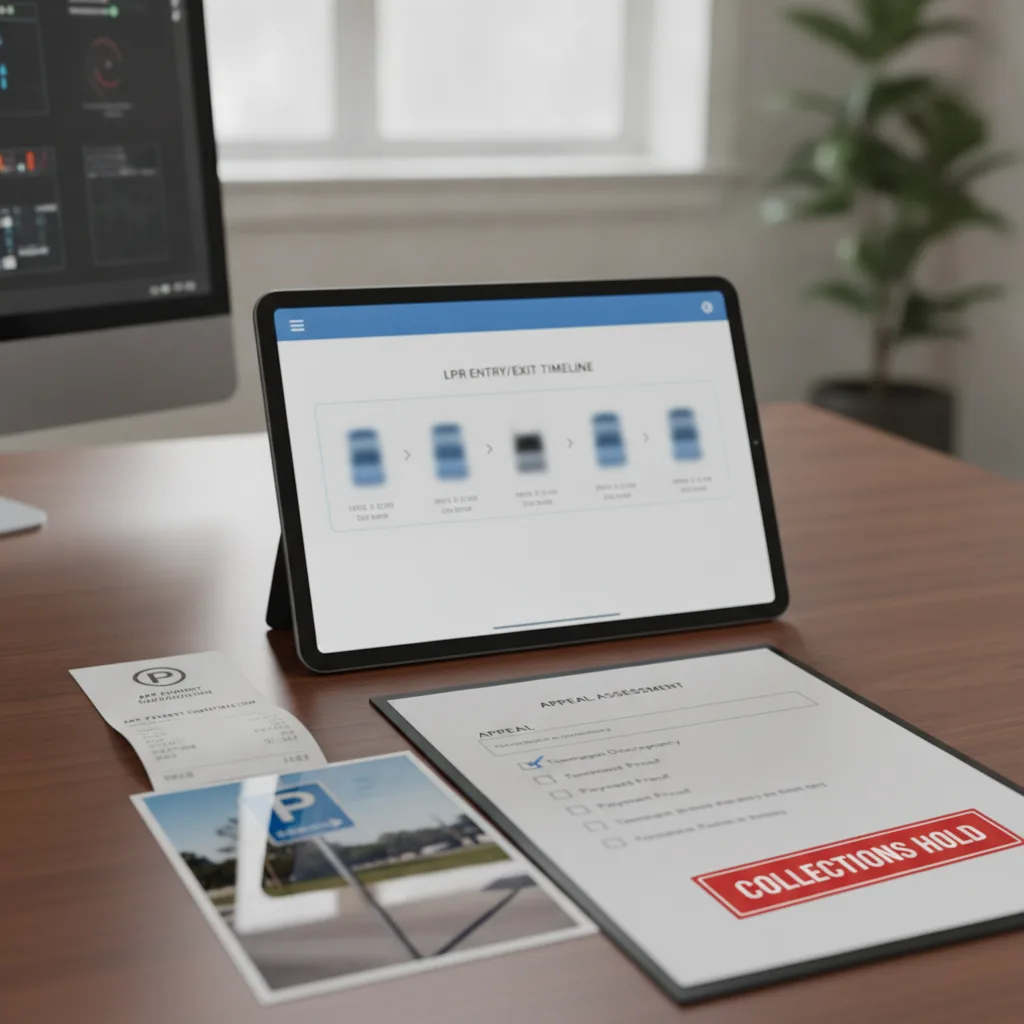
A paid parking ticket dispute evidence packet gives operators a defensible way to pause escalation when a driver shows a receipt but an LPR or enforcement system still issues a notice. Before denying the appeal or sending the balance to collections, reconcile the plate read, paid session, zone, rate, signage, timestamps, and human-review notes.
Key Takeaways
- A payment receipt and an LPR violation record can both exist, so the operator needs a reconciliation packet before escalation.
- The packet should separate payment-session errors, plate or zone mismatches, rate-selection confusion, signage problems, grace-period issues, delayed enforcement feeds, and true overstays.
- Current public reporting shows why a denied dispute can become a licensing, signage, consumer-trust, and collections problem.
- Community posts are useful only for question language; the factual basis should come from dated reporting, operator records, official rules, and support documentation.
- The goal is not to forgive every citation. The goal is to make valid enforcement easier to prove and questionable enforcement easier to correct early.
What This Workflow Involves
This workflow starts when a customer says, in effect, “I paid, so why did I get a ticket?” The right response is not a generic denial, a one-line screenshot request, or an immediate collections threat. It is a structured review that joins the payment system, LPR visit, rate table, posted terms, enforcement notice, support history, and appeal outcome into one case file.
The operator should be able to answer five questions before the notice moves forward. Was the plate read correctly at entry and exit? Did the paid session match the same plate, zone, facility, rate product, and time window? Did the posted terms and app flow tell the driver what they were buying? Did a human reviewer look at conflicting evidence? Has escalation been paused while the record is uncertain?
The packet does not replace local legal review, parking-office policy, or contract language. It gives the operations team a repeatable evidence path so disputed notices are not decided by whoever answers the inbox first.
Why This Problem Is Showing Up Now
CBS Colorado reported on September 14, 2026, that a Denver driver paid through a lot operator’s app, received an enforcement notice anyway, disputed the charge with payment evidence, and later faced a collections threat before the notice was voided. The report also raised questions about lot licensing, signage clarity, rate selection, and how cameras were used to track entry and exit.
That story is useful to parking operators because the operational issue is broader than one notice. LPR enforcement depends on a clean match between the physical visit and the commercial session. If a driver paid the wrong zone, selected a rate window that behaved unexpectedly, mistyped a plate, parked past a paid window, or encountered unclear signage, the case needs a different review path than a no-payment event.
Public discussion points in the same direction. Recent Reddit parking threads show drivers asking what to do when they paid in an app, picked the wrong zone, received an automated ticket, or needed proof beyond a mailed notice. Those posts are not factual authority and should not be used as evidence about any operator. They are language signals that show how quickly drivers frame these events as “paid but ticketed” disputes.
The Core Operational Problem
The core problem is that parking enforcement systems often treat the violation record as the final answer, while the customer sees the payment receipt as the final answer. Neither record is enough by itself. A receipt may belong to the wrong plate, wrong zone, wrong day, wrong rate, or expired session. A camera record may show a real stay but miss a payment feed, grace rule, correction, validation, or signage problem.
Without a packet, support teams drift into inconsistent decisions. One reviewer accepts a screenshot. Another asks for a bank statement. A vendor portal denies the appeal because the paid window ended twelve minutes earlier. A collections workflow proceeds while the operator is still checking the sign map. The customer hears several different explanations and loses confidence in the system.
A better process treats disputed paid sessions as reconciliation cases, not simple unpaid sessions. The operator should prove the match or explain the mismatch in plain language before late fees, collections, booting, towing, or account restrictions continue.
Paid Parking Ticket Dispute Evidence Packet Checklist
| Packet field | What it proves | Review question |
|---|---|---|
| LPR entry and exit events | The vehicle visit, timestamps, image quality, and read confidence. | Is the plate read clean enough to support enforcement? |
| Paid session record | Plate, zone, facility, rate product, start time, end time, amount, and receipt identifier. | Does the payment match the vehicle visit? |
| Rate-selection path | The choice the customer made in the app, kiosk, QR flow, or website. | Could the app have accepted a payment that looked valid but ended earlier than expected? |
| Signage and rate proof | Current sign photos, sign map, lighting notes, and rate table active on the date. | Would a reasonable driver understand the price, time limit, and penalty trigger? |
| Zone and facility mapping | The enforcement zone linked to the lot, garage, curb, or private property. | Was the driver charged under the same location they paid for? |
| Grace and processing rules | Allowed arrival, payment, feed-delay, and exit tolerance windows. | Should the case be enforced, warned, corrected, or voided? |
| Appeal review notes | Who reviewed the dispute, what evidence they considered, and the reason code. | Can a manager understand why the decision was made? |
| Escalation hold | Collections, late fee, boot, tow, or owner-lookup pause status. | Has escalation stopped while the evidence is unresolved? |
How To Sort Disputes Before Deciding Them
Use the packet to classify the dispute before making the appeal decision. A true overstay is different from a rate-selection problem. A wrong-zone payment is different from an app feed delay. A valid receipt with the wrong plate is different from a clean plate match and no paid session. The evidence packet should make those differences visible.
The highest-risk cases usually have one of four patterns. First, the payment exists but does not map cleanly to the LPR visit. Second, the rate table or sign does not explain why the app ended the session when it did. Third, the operator cannot show the rule the driver allegedly violated. Fourth, the review path moves to collections before a human can reconcile the conflict.
ParkMobile’s support documentation explains that enforcement typically checks active sessions by license plate and zone information. That is a useful reminder for operators: if the plate, zone, or session feed is wrong, the enforcement device may not see the payment even when the driver has a receipt.
When To Pause Collections Or Late Fees
Pause escalation when the dispute includes credible payment evidence, unclear signage, a rate product mismatch, a zone mapping question, a plate mismatch that could be corrected, or a system-feed delay. A pause is not an admission that the ticket is wrong. It prevents the operator from turning an evidence problem into a reputational problem while the facts are still being checked.
The pause rule should be documented. Support staff should know which evidence is enough to place a hold, how long the hold lasts, who can release it, and what happens if the customer does not provide the missing piece. Operators should also separate consumer-support holds from legal notice deadlines and local requirements.
The same logic applies before booting, towing, registered-owner lookup, or account restrictions. Once the operator adds a harsher consequence, the burden to show a clean evidence chain becomes higher.
What To Tell The Driver
The response should be specific enough to be useful without exposing unnecessary personal information. Tell the driver which plate, zone, date, entry time, exit time, paid session, rate product, and posted rule were reviewed. If the payment did not match, say why. If the sign or app flow was unclear, correct the case and tag the root cause.
Avoid vague language such as “our system confirmed the violation” when the customer submitted contrary payment evidence. It sounds dismissive and gives the operator little protection if a reporter, regulator, property owner, or card issuer later asks how the decision was made.
The best answer is plain: “We matched your receipt to a different zone,” “the session expired before exit and the grace rule did not apply,” “the plate was entered incorrectly but the visit was verified,” or “the signage record was incomplete, so we voided the notice and corrected the sign map.” Those explanations reduce uncertainty even when the driver still dislikes the outcome.
Risks And Limits
Parking rules vary by city, property type, contract, and enforcement model. A private lot, municipal curb program, university garage, hospital campus, mixed-use property, and event facility may all need different appeal timelines and notice language. Counsel should review any policy that affects collections, fees, owner lookup, booting, towing, or consumer disclosures.
Do not over-collect personal information during the appeal. In most cases, the operator needs the notice number, plate, payment receipt, date, location, contact path, and supporting explanation. It usually does not need unrelated account details, full bank statements, private travel history, or identity documents unless a specific legal or operational reason exists.
Also be honest about system limits. LPR reads can fail. Payment feeds can lag. Zone maps can be wrong. Sign photos can be out of date. Acknowledging those limits makes enforcement more credible because it shows the operator has a way to catch and correct edge cases.
How This Fits PLACA’s Parking Content
This topic belongs with PLACA’s parking operator LPR and payment workflows because the reader is deciding how to make plate-based enforcement defensible after a payment conflict. It is different from the parking grace period workflow for LPR and mobile payment lots, which sets timing rules before enforcement. It also differs from the registered owner parking notice workflow, which focuses on owner lookup and mailed notice governance.
For payment systems, the supporting article on mobile parking payment processing helps explain why plate, zone, receipt, and enforcement feeds must stay aligned. The dispute packet is the practical bridge between those systems and a support decision.
Frequently Asked Questions
Is a payment receipt enough to cancel a parking ticket?
Not always. The receipt has to match the vehicle, location, rate, and time window. It should trigger review, not automatic cancellation. If the receipt matches and the violation record does not hold up, the operator should void or correct the notice.
What evidence should a driver be asked to provide?
Ask for the receipt, notice number, plate, location, date, and a short explanation of the mismatch. Avoid asking for full bank statements or unrelated personal data when a transaction screenshot or app receipt is enough.
Should collections pause during a paid-session dispute?
Yes, when the driver provides credible payment evidence or the operator cannot yet reconcile the records. The hold should have a clear owner, time limit, and release rule so it does not become an unmanaged backlog.
How is this different from an unpaid parking session workflow?
An unpaid-session workflow starts from a missing or expired payment. This workflow starts from conflicting evidence: the operator has an enforcement record and the driver has a payment claim. The decision is about reconciliation before escalation.
What if the driver paid the wrong zone?
The operator should document the mismatch, check whether signage or app prompts contributed to the error, and apply the published correction rule. Some cases may remain enforceable; others may justify a warning, reduced fee, or void.
Who should own the packet internally?
Parking operations should own the evidence standard, support should own intake and communication, finance should own payment reconciliation, and legal or compliance should review escalation language. One named role should approve the final appeal outcome.
Next Step
Pull ten recent paid-session disputes and score each one against the packet: clean plate read, matching payment, clear zone, current sign photo, correct rate, documented human review, and escalation hold. If your team cannot answer those points quickly, fix the evidence workflow before the next notice moves to collections.