

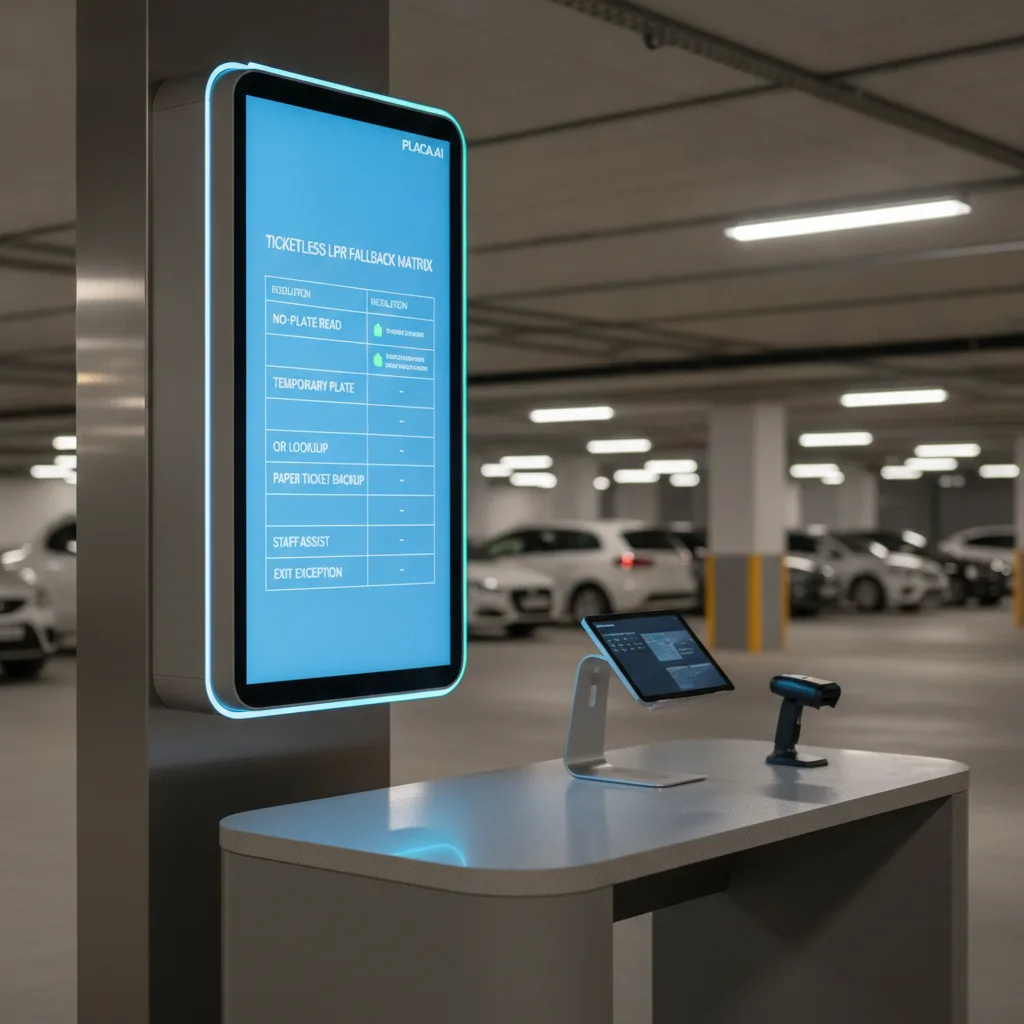
A ticketless LPR fallback matrix gives a parking garage a clear answer when the plate is missing, unreadable, temporary, blocked, or not matched at exit. Before a facility removes paper-ticket habits, the operator should decide which cases get a ticket, QR lookup, staff override, exception fee, manual image review, or enforcement hold.
Key Takeaways
- Ticketless parking is not just a faster lane; it is a different evidence model for entry, payment, validation, and exit.
- No-plate reads, temporary plates, damaged tags, wrong vehicle selection, and unreadable QR or barcode records should be designed as normal exceptions, not surprises.
- The fallback should be visible at the lane level: what the driver sees, what staff can override, what the payment system records, and what enforcement should not do yet.
- Fresh parking technology announcements show the market moving toward hybrid ticketless LPR, where physical tickets remain available when plate recognition is not enough.
- The goal is not to abandon automation. The goal is to make automation reliable enough that exceptions do not become exit backups, lost revenue, or unfair charges.
What This Workflow Involves
This workflow starts before the first ticketless lane goes live. The operator lists every way a vehicle session can fail to become a clean plate-based record, then assigns each failure to a fallback action: ticket, QR lookup, pay station, staff assist, image review, validation correction, exception fee, or enforcement hold.
The matrix should be built by the people who own the real vehicle journey: parking operations, PARCS or technology staff, customer support, finance, and the manager who approves lane overrides. It should also name what the driver sees on the display, what support can search, what evidence is saved, and when the exit lane should release the vehicle without turning the exception into a penalty.
Why This Problem Is Showing Up Now
Amano McGann announced ONEflex Ticketless LPR on September 23, 2026, with a hybrid lane configuration that can use a plate as a virtual ticket when the read succeeds and issue a physical ticket after a no-plate read when the operator-defined delay is reached. The same announcement describes QR payment lookup, no-plate alerts, image review, and configurable exception fees.
That matters because it treats fallback as part of the product design, not as an afterthought. A ticketless garage still has motorcycles, temporary tags, damaged plates, glare, snow, camera obstruction, validation records, QR payment paths, and people who reach an exit without the expected match. If those cases are not designed before launch, the exit lane becomes the customer support desk.
Current public instructions show the same operational split. Royal Hawaiian Center described a ticketless Metropolis rollout beginning August 25, 2026, where plates are recognized at arrival and departure and customers pay through QR or web lookup. Raleigh’s official parking deck guidance keeps a physical ticket in the workflow even though LPR captures the plate. Those are different operating choices, and both need fallback rules.
The Core Operational Problem
The problem is not that LPR sometimes misses a plate. Every parking system has edge cases. The problem is when the operator cannot tell staff and drivers what happens next. If the entry camera sees no plate, does the lane issue a paper ticket automatically? If the driver has a temporary tag, does staff capture an image, VIN alternative, ticket barcode, or account note? If the QR lookup cannot find the visit, does the driver pay at a station, press help, or receive a post-exit invoice?
A ticketless launch changes the definition of a complete parking record. In a traditional garage, the ticket is the transaction anchor. In a ticketless LPR garage, the plate often becomes that anchor. In a hybrid garage, the system may hold both records: plate and ticket. The fallback matrix tells the garage which anchor wins when the records disagree or one is missing.
Public discussion around QR-only parking and missing signs shows why drivers experience this as a fairness issue. A recent public Reddit discussion from Athens included questions about missing QR codes, zone confusion, and whether a driver could reasonably know how to pay. That thread is not factual authority about any operator, but it is useful language evidence: customers judge the system by the clarity of the fallback, not by the sophistication of the camera.
Ticketless LPR Fallback Matrix
| Exception | Primary fallback | Record to keep |
|---|---|---|
| No plate read at entry | Show the physical-ticket option after the configured delay or route to staffed assist. | Entry image, lane, time, ticket ID, reason code, and any staff note. |
| Temporary or paper plate | Capture image and allow ticket, QR, or account lookup depending on facility policy. | Plate image, temporary-tag note, ticket/payment ID, and exit match decision. |
| Plate read at entry but not exit | Search by ticket, payment receipt, QR session, validation, or entry image before charging an exception. | Entry plate, exit image, payment attempt, staff override, and final fee reason. |
| Physical ticket will not scan | Use pay station, staff assist, ticket number lookup, or standard payment option. | Ticket image, barcode/QR status, payment proof, and help-call outcome. |
| QR or web lookup cannot find session | Offer plate search, ticket search, staffed lookup, or pay-on-foot lane path. | Search terms used, plate normalization, zone or facility selection, and result. |
| Validation record missing | Apply published validation correction rules before charging the full rate. | Merchant, event, tenant, or customer validation evidence and override owner. |
| Customer reaches exit unpaid | Calculate normal fee if records are clean; route uncertain cases to assist rather than automatic penalty. | Fee basis, grace rule, entry-to-exit duration, and any exception-fee rule used. |
| Repeat no-match pattern by lane | Inspect camera angle, lighting, signage, QR placement, and lane hardware before blaming drivers. | Lane-level exception counts, image samples, repair ticket, and deployment change. |
How To Decide Between Ticket, QR, And Staff Assist
Use physical tickets when the facility needs a reliable transaction anchor that survives plate uncertainty. That is common when cameras face glare, tight turns, motorcycle traffic, temporary tags, mixed monthly and transient parkers, or heavy validation use. A ticket does not make the lane old-fashioned. It gives the system a second path when the plate record is not enough.
Use QR or mobile lookup when the driver can reasonably identify the correct facility, session, plate, and amount without help. PayByPhone’s Ticket Takeover support page is a useful example: it explains that some garages require a readable ticket barcode or QR, some may ask for a vehicle or plate, and a standard payment option should be used if the scan does not work.
Use staff assist when the error can create an unfair charge, a trapped vehicle, a disabled-access problem, or a lane backup. Staff assist should not be a mystery button. The operator should define what staff can see, what they can override, which evidence they must save, and which cases require manager approval.
Where Exception Fees Fit
Exception fees can be defensible only when the driver had a clear normal path, the fallback was available, and the operator can show why the ordinary record could not be matched. They are risky when signage is unclear, QR codes are missing, the lane display does not explain the next step, or staff cannot reconstruct the session.
The matrix should separate fee cases from support cases. A no-plate read caused by a covered or unreadable plate may be treated differently from a camera angle problem. A lost ticket may be treated differently from a QR code that will not scan. A validation mistake may be handled by the tenant or merchant workflow instead of a driver penalty.
Before launch, test exception fees against real scenarios: motorcycle, temporary tag, no front plate, plate entered with O versus zero, validation sticker, event prepaid parker, unreadable ticket, blocked camera, and a customer who presses help at exit. If the fee explanation sounds vague in any of those cases, the rule is not ready.
Privacy, Accessibility, And Customer Trust
Ticketless LPR can reduce lines and hardware touches, but it also asks drivers to trust that the garage understands their vehicle record. Keep the record minimal. Do not collect unrelated identity documents when a ticket ID, plate image, payment receipt, validation code, or staff note is enough to resolve the exception.
Accessibility should be part of the fallback. Drivers without smartphones, drivers who cannot scan QR codes, visitors with limited connectivity, older app versions, rental vehicles, and temporary plates all need a clear path. If the only payment path is a phone lookup, the operator should have a staffed, kiosk, pay-station, or help-button alternative that does not punish the customer for the system design.
Customer trust improves when the operator can explain the fallback in one sentence at the lane: “If your plate is not recognized, take a ticket and use it to pay or exit,” or “If the QR lookup fails, press help and we will search by ticket, plate, or entry time.” That language is boring in the best way. It prevents the system from feeling like a trick.
Worked Example
A mixed-use garage wants to replace most paper tickets with ticketless LPR. The main entry lane reads plates reliably during daytime but drops confidence at night for vehicles entering from a curved ramp. The operator keeps ticket hardware in the lane and configures the display to offer a ticket after a no-plate read delay. At exit, staff can search by plate, ticket ID, payment receipt, validation code, or entry image.
During the first month, reports show that one exit lane has twice the no-match rate of the others. The operator checks image samples and finds glare from an overhead fixture. Because the matrix preserved image and lane evidence, the fix is a lighting adjustment, not a policy argument with customers. The same report shows that temporary tags need a clearer sign near the entry display, so the operator updates the instruction before applying exception fees.
How This Fits PLACA’s Parking Content
This topic belongs with PLACA’s parking operator LPR workflows because the reader is choosing how ticketless parking should behave before enforcement and revenue controls depend on it. For the broader enforcement model, the guide to license plate recognition for parking enforcement explains why plate capture matters.
It is adjacent to the LPR exception queue before parking enforcement, but not the same article. The exception queue is a review step after an event is captured. The fallback matrix is the lane and payment design that decides whether the driver gets a ticket, QR lookup, staff assist, or clean exit. For payment planning, the article on mobile parking payment processing helps operators think about plate, zone, receipt, and enforcement feeds. If the whole payment stack fails, use the separate parking system outage workflow for LPR enforcement.
Frequently Asked Questions
Does ticketless LPR mean a garage should remove paper tickets completely?
Not always. Some garages can go fully ticketless, but many should keep a ticket or staffed fallback for no-plate reads, temporary plates, validations, QR lookup failures, and accessibility needs.
What should happen when the LPR system gets a no-plate read?
The lane should follow a written rule: issue a physical ticket after a delay, route to staff assist, capture an image for review, or apply another documented fallback. The driver should not have to guess.
Can a garage charge an exception fee when no plate is available?
Only if the fee is disclosed, the normal payment path was available, the operator can explain why the session could not be matched, and local rules allow it. Counsel should review fee language before launch.
How is this different from an LPR exception queue?
An exception queue reviews uncertain events before enforcement. A ticketless LPR fallback matrix designs what the lane, payment path, and support team do when the garage cannot create a clean plate-based visit in the first place.
What should be tested before launch?
Test no front plate, temporary tag, motorcycle, dirty or bent plate, unreadable ticket QR, failed mobile payment, validation, event prepaid parking, help button response, and exit search by plate, ticket, receipt, and entry time.
Who should own the fallback matrix?
Parking operations should own the matrix, technology or PARCS staff should own the lane configuration, finance should own fee and reconciliation rules, and customer support should own the scripts drivers hear at the gate.
Next Step
Before turning on ticketless LPR across every lane, run one week of exception testing. Count no-plate reads, unmatched exits, ticket scans, QR lookup failures, validation corrections, help-button calls, and staff overrides by lane. Then decide which lanes are ready for full ticketless flow and which need hybrid fallback.