

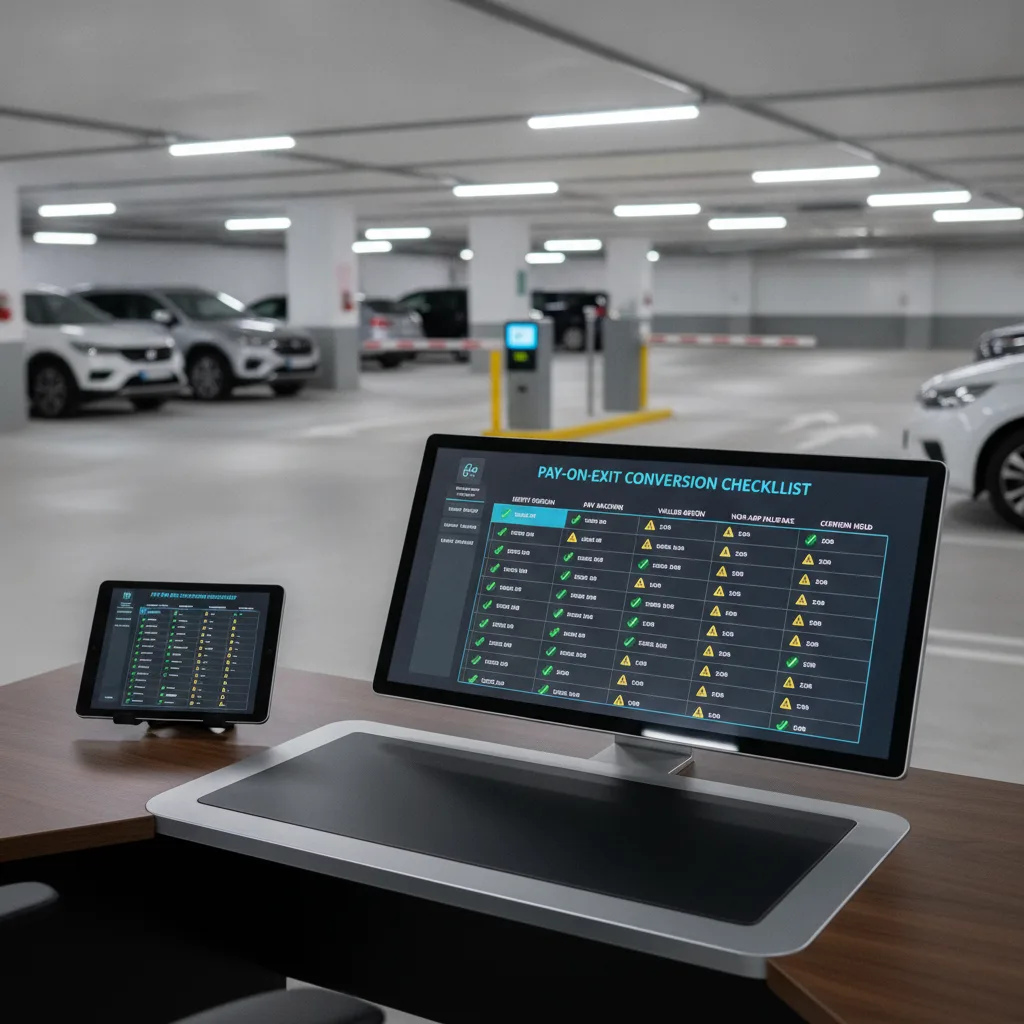
A pay-on-exit garage conversion checklist should define enrollment, signs, payment machines, mobile options, non-app fallback, validation, exit release, and citation holds before the first prepaid lane changes. The goal is simple: drivers pay for actual time parked without guessing duration, downloading an app under pressure, or being penalized for transition gaps.
Key Takeaways
- Switching a garage from prepaid or cashier-style payment to post-paid exit payment changes the evidence model, support model, and customer promise.
- The riskiest failures are not technical edge cases; they are unclear signs, missing non-app options, validation confusion, delayed text alerts, and citations issued before records can be reconciled.
- Operators should test pay machines, mobile payment, text notices, card-only lanes, resident or employee perks, validations, and exception holds before the public cutover.
- Recent municipal reforms show why customers prefer actual-time billing, but also why app requirements, cashless moves, and citation changes need careful explanation.
- The conversion should reduce punitive friction, not move it from the entry lane to the exit lane.
What This Workflow Involves
This workflow starts when a garage operator decides that drivers should pay after the stay instead of prepaying a guessed duration, paying a cashier, or relying on a meter-style session. The operator maps every step from entry to exit: how the session starts, how the driver is reminded, how the fee is calculated, how payment is accepted, how validations apply, how the gate or exit lane releases, and when enforcement is paused.
The work should include parking operations, finance, customer support, signage, the PARCS or payment vendor, enforcement supervisors, accessibility reviewers, and whoever approves citation waivers. A payment model change touches more than machines. It changes what the driver thinks is fair, what staff can prove, and what the operator can defend when a payment or appeal record is messy.
Why This Problem Is Showing Up Now
The City of Annapolis announced on September 9, 2026 that Mills Hillman Garage is targeted for conversion from prepaid parking to a post-pay, pay-on-exit model by late fall 2026. The city tied the change to a broader parking reform effort, including fewer punitive outcomes, clearer citation review, one future vendor model, text notifications, pay machines, and mobile payment options.
The city also published a public workgroup page that turns the customer problem into plain language: a driver prepays, dinner runs longer than expected, and a citation follows. That is exactly the operational pain a pay-at-exit garage is supposed to reduce. The question for operators is how to make the new model feel simpler at the curb, not just cleaner in a procurement memo.
Other current examples point in the same direction. Orlando’s parking modernization page describes a phased move to cashless operations that continued through September 30, 2026, with garage and facility conversions, updated signs, new customer instructions, and new rules taking effect October 1. Hawaii’s September 19, 2026 Makai Garage update describes automated pay stations, ticket insertion at exit, different permit and validation paths, and attendants on hand during the first two months. The University of Maryland Baltimore announced on October 1, 2026 that another garage would move to credit/debit-only exit payment after similar transitions elsewhere.
The Core Operational Problem
The central problem is that a garage conversion asks drivers to trust a new sequence while staff are still learning the records behind it. In a prepaid garage, the driver decides the duration up front and the violation often appears when the stay runs long. In a pay-at-exit garage, the operator has to prove the entry time, rate, validation, payment attempt, exit release, and any exception fee after the stay.
That sounds easier, but only if the records line up. If a driver enrolls but never receives the text reminder, is that a support case or a citation? If a pay station fails, does the exit lane accept card payment? If a visitor has a validation but the merchant code is not recognized, is the full rate charged automatically? If cash is removed, what happens to a driver without a card or working phone? Those decisions should be written before launch.
Public discussion around the Annapolis reform is useful as language evidence, not factual authority. Residents and visitors complained about lacking clear prepayment signs, guessing stay length, being forced into an app, and wanting a machine or card option. A garage operator does not need to accept every complaint as true to learn from the pattern: customers judge the system by the clearest path available when something does not go as expected.
Pay-on-Exit Garage Conversion Checklist
| Conversion area | Operating decision | Evidence to keep |
|---|---|---|
| Entry session start | Define whether the session starts by ticket, plate, QR, card-in, account enrollment, or staffed entry. | Entry timestamp, lane, session ID, image or ticket ID, and posted rule version. |
| Driver notification | Decide whether drivers receive text start notices, time reminders, rate notices, or payment links. | Enrollment status, message delivery status, opt-in language, and support script. |
| Payment channels | List the accepted methods: pay station, exit card payment, mobile web, app, text-to-pay, account charge, or staffed help. | Channel uptime, test receipt, payment attempt, decline reason, and fallback path. |
| Non-app fallback | Keep a practical option for drivers who will not install an app or cannot use a phone at exit. | Sign photo, pay-machine location, help-button log, and card/cashless policy notice. |
| Validations and perks | Map merchant, resident, employee, event, accessibility, and free-period benefits before conversion. | Validation code, account type, discount rule, expiration, and override owner. |
| Exit release | Define when the gate opens, when staff can release, and when a vehicle should not be trapped over an uncertain record. | Exit timestamp, release reason, paid amount, support note, and manager approval when needed. |
| Citation holds | Pause citation or notice escalation when conversion records, signs, or payment equipment are uncertain. | Entry/exit record, sign version, payment attempt, vendor ticket, and appeal reason code. |
| First-month reporting | Track confused-payment cases by lane, channel, sign, validation type, and support reason. | Daily exception report, root cause, repair/change log, refund or void outcome. |
Prepaid Versus Pay-at-Exit Operations
The old model asks the driver to estimate the future. That can work for short errands, but it breaks down for restaurants, medical visits, court, events, service appointments, and downtown trips where duration is uncertain. It also creates a support problem when the driver paid something but stayed beyond the purchased window.
The new model should charge the actual stay, but it creates a different support burden. Staff need a way to find the session by ticket, plate, card, phone number, validation code, or payment receipt. Finance needs a reconciliation rule for failed exits and delayed payments. Enforcement needs a hold rule for records created during the cutover period. Customer support needs language that explains the change without making the driver feel tricked.
That is why this article is different from PLACA’s ticketless LPR fallback matrix for no-plate exits. That article decides what a lane does when a plate or QR record cannot match cleanly. This conversion checklist decides how the whole garage changes its payment promise from prepaid guesswork to actual-time exit payment while keeping fallback and support paths intact.
Payment Fallbacks That Should Be Ready Before Launch
Do not make the phone the only support desk. App and web payment can be excellent, but a garage conversion should still define what happens when a driver has no smartphone, a dead battery, weak signal, a rental car, a corporate card restriction, a card decline, or a validation code that does not apply. A pay station, exit-card option, staffed help button, or documented billing workflow may be enough, but it must be visible before the driver reaches the gate.
ParkMobile’s garage support documentation is a useful reminder that gated facilities can use different app/payment flows depending on the equipment in place. Operators should not assume drivers understand whether they need a QR credential, ticket, app session, or exit payment unless the sign and lane display tell them.
Cashless policies need special attention. A card-only exit can reduce cash handling and speed transactions, but it should not surprise drivers after they have parked. If cash is removed, publish it at entry, at pay machines, online, and in event instructions. Define what staff do when a driver cannot use a card at exit. A conversion that saves cash handling but creates exit disputes has moved cost rather than removed it.
Signage, Rates, And Citation Holds
Signs should answer the driver’s practical questions in order: how the session starts, when payment is due, which payment methods work, where the pay machine is, how validation works, what happens without a phone, and how to get help before exit. If rates or citation fees are changing at the same time, separate those messages from the payment-model change so drivers do not confuse a new price with a new process.
During the first month, use citation holds for conversion-dependent cases. That does not mean forgiving every unpaid session. It means holding cases where the evidence depends on a new sign, new machine, new mobile option, delayed vendor configuration, validation mapping, or a support path the customer could not reasonably find. Clean nonpayment can proceed. Ambiguous conversion records should be reviewed.
For broader payment reliability planning, PLACA’s parking system outage workflow for LPR enforcement explains how to pause penalties when payment records cannot be trusted. The conversion period deserves a similar discipline even when there is no outage, because new processes can create local uncertainty while every component is technically online.
Worked Example
A municipal garage currently requires drivers to prepay by app shortly after entry. Local restaurants complain that customers guess wrong, overstays become citations, and visitors do not understand why a garage works like a meter. The operator decides to move to pay-at-exit with entry tickets, mobile payment links, pay machines near elevators, and card payment at exit.
Before launch, the team tests three validation paths: merchant coupon, resident daily benefit, and event parking. They publish signs at entry and by elevators, not only near the exit. Support gets a reason-code tree for no text received, pay-machine offline, validation missing, card declined, and driver cannot use app. Enforcement holds first-month notices when the record depends on unclear signs or equipment failures. After two weeks, reports show that most confusion comes from one elevator-bank sign, so the operator fixes that sign instead of treating every case as driver error.
How This Fits PLACA’s Parking Content
This topic belongs with PLACA’s parking operator LPR workflows because the reader is deciding how payment records, lane evidence, customer support, and enforcement should work together during a garage operating change. It is adjacent to mobile parking payment processing, but the main issue is not checkout speed. It is the conversion from one garage payment model to another.
It is also adjacent to the mobile parking app transition checklist, but that article is about changing official apps and zone feeds. This one is about changing when and how a garage collects payment. If the operator uses plate capture at entry or exit, the guide to license plate recognition for parking enforcement helps explain how vehicle records can support, but not replace, payment and support rules.
Frequently Asked Questions
What should operators test before a garage moves to pay-on-exit?
Test entry sessions, pay machines, mobile payment, text notices, card-only exits, validations, employee or resident perks, lost tickets, failed payments, help-button response, exit release, and appeal evidence.
Does pay-on-exit require license plate recognition?
No. A garage can use tickets, QR credentials, cards, account enrollment, or LPR. If LPR is used, it should support the payment record rather than become the only fallback for every exception.
Should a garage still offer a non-app payment option?
In most conversions, yes. A pay machine, web payment, card-at-exit option, or staffed help path reduces friction for drivers who cannot or will not download an app while parked.
When should citation escalation pause during a conversion?
Pause escalation when the case depends on unclear signs, newly configured payment equipment, validation mapping, vendor-feed delay, failed notification, or a support route the driver could not reasonably find.
How long should the transition period last?
Long enough to collect real exception data by lane, payment channel, validation type, and support reason. Many operators should plan a first-month review before treating conversion cases as ordinary enforcement.
Who should own the conversion checklist?
Parking operations should own the checklist, with finance, customer support, enforcement, signage, accessibility, and the payment or PARCS vendor approving the parts they control.
Next Step
Before the public cutover, run a live end-to-end test with a staff vehicle: enter, receive or skip enrollment, validate, pay at a machine, pay by mobile, attempt a card decline, press help, and exit. Save every record the support team would need if that same trip became a dispute.