

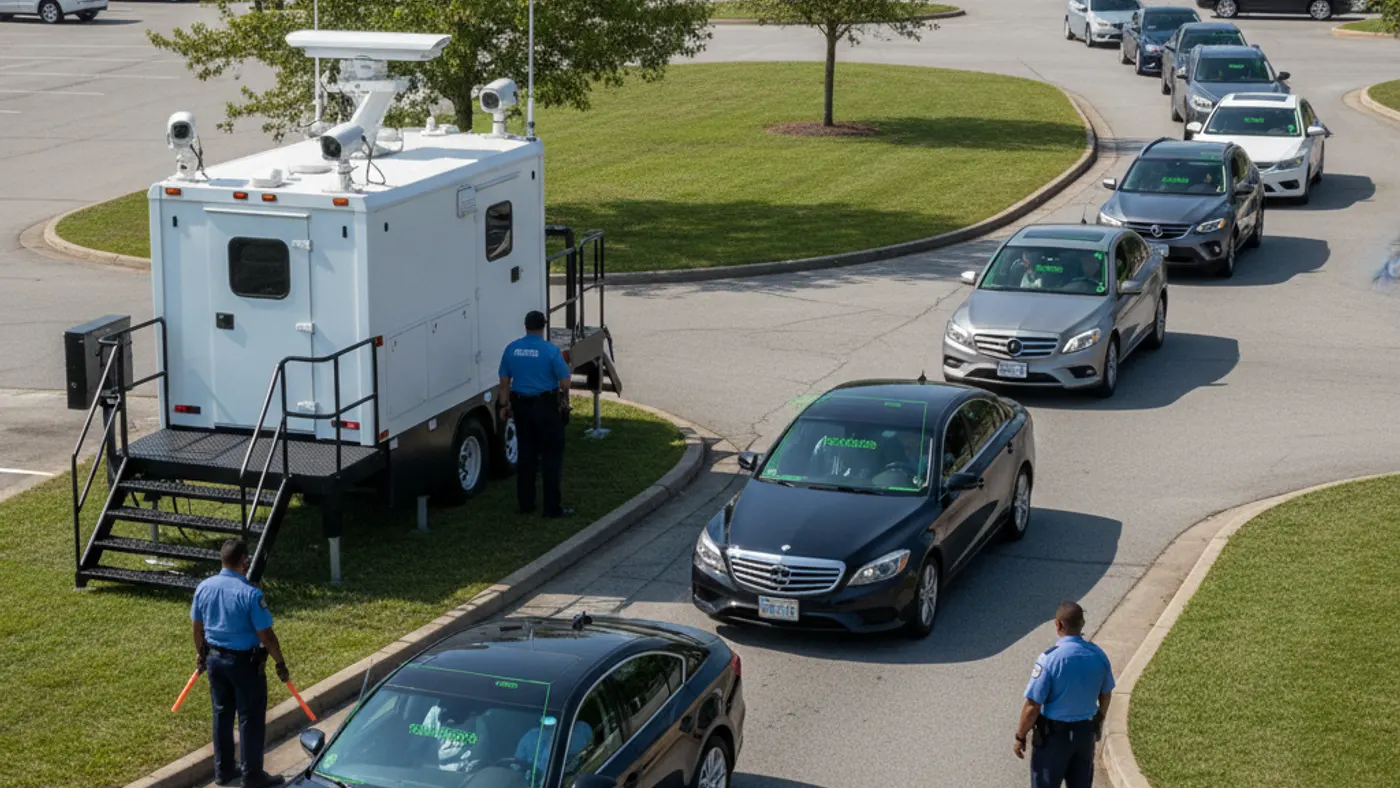
Direct answer: Add LPR to a mobile trailer only after validating plate geometry, illumination, vehicle speed, camera stream access, power, connectivity, event delivery, remote support, and trailer movement. A general surveillance view is not automatically an LPR view.
This guide is for security integrators, trailer operators, property owners, network teams, and LPR administrators and addresses adding LPR to a mobile surveillance trailer. Make the rule visible to the people who administer it and those affected by it.
The risk to remove
Trailer projects fail when a wide overview camera is expected to produce consistent plates or when bandwidth and power are sized for live video but not reliable event delivery.
Example: A construction entrance may need a dedicated plate view while the trailer’s overview camera continues to monitor the site. The two jobs should have separate acceptance tests.
Mobile-trailer LPR readiness test
| Decision point | Evidence or control | Required response |
|---|---|---|
| Plate scene | distance, angle, speed, illumination | capture day and night samples |
| Camera stream | resolution, frame behavior, credentials | verify supported access |
| Trailer infrastructure | power, network, mounting, movement | test under deployment conditions |
| Event operation | delivery, search, users, retention | simulate outage and recovery |
Sequence the daily work
- Step 1. Review plate scene: distance, angle, speed, illumination; then capture day and night samples.
- Step 2. Review camera stream: resolution, frame behavior, credentials; then verify supported access.
- Step 3. Review trailer infrastructure: power, network, mounting, movement; then test under deployment conditions.
- Step 4. Review event operation: delivery, search, users, retention; then simulate outage and recovery.
Close every case with an approved outcome or escalation.
Fallback and correction
Do not claim compatibility from a model name or one sample. Changes in firmware, lens, mounting, carrier, site geometry, or trailer position require renewed validation.
Correct the record, approve a bounded exception, deny under the documented rule, or escalate to the named authority; do not leave the case open-ended.
Test the hardest cases
Compare the pilot with a written baseline.
- test vehicles producing reviewable plates
- events delivered after connection loss
- power and bandwidth headroom
- repositioning checks completed
- remote recovery steps reproduced
Define who counts each measure, the observation period, and the result that prevents expansion.
What the owner verifies
- State the purpose and non-goals for adding LPR to a mobile surveillance trailer.
- Assign owners for the normal path, correction, exception, and final approval.
- Test live conditions with the people who administer and experience the workflow.
- Confirm contracts, pricing, integrations, support, data handling, and governing requirements independently.
- Retain the evidence needed to reproduce an approval, denial, correction, or escalation.
Related PLACA.AI planning resources
Implementation questions
What should be approved first for adding LPR to a mobile surveillance trailer?
Approve the purpose, responsible owner, decision rule, required evidence, and exception path before selecting a broad rollout.
What should the pilot prove?
The pilot should reproduce the normal path and the exception described above, while collecting test vehicles producing reviewable plates and the other named measures.
When should implementation stop?
Stop when the required evidence is unavailable, ownership is unclear, a serious exception has no safe route, or the actual result conflicts with the approved rule.
Plan a limited workflow review
Bring the current rule, process, exceptions, and success criteria for adding LPR to a mobile surveillance trailer. PLACA.AI can help evaluate a bounded pilot without assuming another property’s workflow is the right answer.
Editorial refresh: July 22, 2026. Independently confirm current product capabilities, third-party features, pricing, contracts, governing requirements, and local rules before acting.
Internal Resources
- How Casino Parking Teams Can Manage Peak Arrival Surges Using Ticketless Vehicle Recognition
- How Hospitality Groups Can Reduce Lost Valet Ticket Problems Using Ticketless Vehicle Recognition
- How Restaurant Valet Operators Can Speed Up Vehicle Retrieval Using Ticketless Vehicle Recognition
Data source: Electronic Frontier Foundation: License Plate Readers