
A Flock ALPR warrantless search became more than a privacy headline on October 1, 2026. In United States v. Kyle, U.S. District Judge Sara E. Hill granted a motion to suppress after a Tulsa County deputy searched historical license-plate-reader data through Flock and VehicleManager before a traffic stop and later detention.
The ruling does not ban Flock. It does not bind every court. It does not decide whether an HOA, apartment owner or parking operator may use LPR for a narrow site workflow. But it should change the questions a private-property buyer asks before joining, hosting or feeding data into a broader searchable ALPR network.
What the Flock ALPR warrantless search ruling actually decided
The direct answer is narrow but important: the court held that, on these facts, the deputy’s use of historical ALPR systems was an unconstitutional warrantless search, and the evidence that followed had to be suppressed. The opinion also held, on a separate ground, that the deputy unlawfully prolonged the stop after returning the driver’s license.
According to the court’s factual summary, Deputy Freddie Alaniz saw a Mazda SUV with a California plate, followed it for no apparent reason other than the out-of-state plate, and queried the plate in Flock. The opinion says Alaniz had access to at least two ALPR systems, Flock and VehicleManager, which gathered historical vehicle-location data for law-enforcement use across the country. The court also noted that he had access to at least 30 days of vehicle-location information in many states, though not California.
That distinction matters. A camera seeing a plate at a specific moment is one stage. A system reconstructing a month of travel history is another. A buyer who treats both as simply “camera data” will miss the operational and legal risk.
What did not happen
The ruling did not say every ALPR capture is unconstitutional. It did not say all Flock deployments are unlawful. It did not address private parking payment, resident gate access, school pickup or a site owner reviewing its own entrance records for a defined property purpose.
It also did not erase contrary precedent. Recording Law’s October 4 analysis notes that the opinion itself acknowledged nearly every court to reach the ALPR question had gone the other way, and that neither the Tenth Circuit nor the U.S. Supreme Court has decided the ALPR issue. A cautious buyer should therefore read the case as a live risk signal, not as settled national law.
The buyer lesson is still concrete: do not approve a plate-reader project until the proposal explains who can run a historical search, which legal threshold applies, who approves it, what reason must be recorded, and whether the search can cross beyond the property purpose that justified the camera.
The buyer matrix: capture is not search
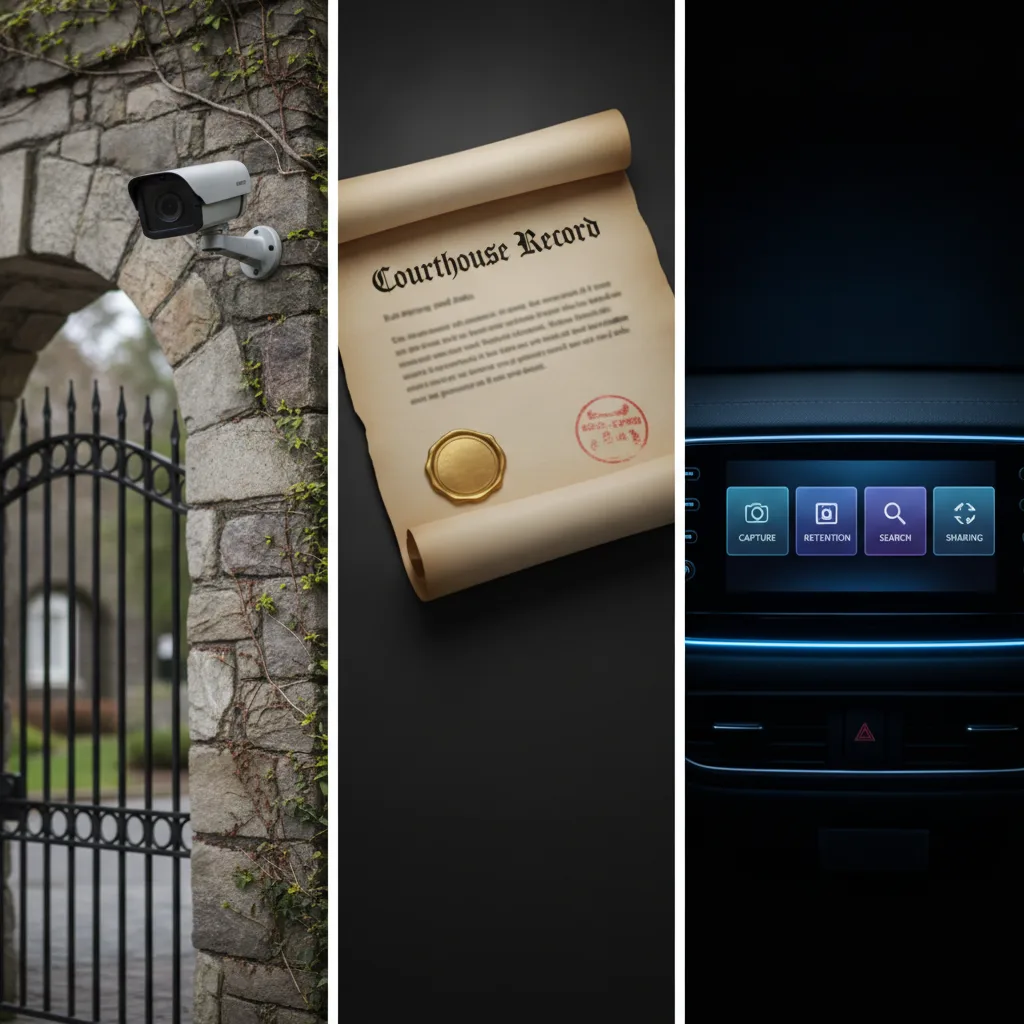
The court-risk question becomes clearer if buyers separate the data stages before signing:
| Stage | Buyer question | Why it matters after Kyle |
|---|---|---|
| Image capture | What camera view, vehicle image and timestamp are collected? | Capture alone does not answer who can later reconstruct travel history. |
| ALPR extraction | What plate characters, confidence scores and vehicle attributes are stored? | Extracted data can become searchable even when the original purpose was local. |
| Retention | How long are reads, images and audit trails kept, and who controls deletion? | Historical depth changes the privacy and evidence profile of a system. |
| Search access | Who may query past reads, by plate, time, location or vehicle description? | This is the stage the Kyle ruling makes impossible to ignore. |
| Sharing | Can outside agencies, vendors or network partners search or receive records? | A private camera can become part of a public-safety workflow through access rights. |
| Legal process | Is a warrant, subpoena, emergency policy or board approval required? | Audit logs after the search are not the same as a pre-search legal threshold. |
This matrix is the linkable asset for buyers. It helps a board or operator ask a better question than “is the camera accurate?” The harder question is whether a site-specific system can be turned into historical travel intelligence by someone outside the property workflow.
Audit logs are not a warrant boundary
Many ALPR proposals emphasize user logs, reason codes, training and audits. Those controls are useful, but they answer a different question. They can show who searched after the fact. They do not necessarily decide whether the search should have happened in the first place.
That distinction should appear in contracts and operating procedures. A private property that shares LPR data with a police agency should require named users, specific permitted purposes, prohibited purposes, query approval rules, legal-process language, emergency exceptions, retention limits, audit exports and a removal right. Those controls belong in the signed documents, not only in a sales conversation.
Recent events show why the details matter. On October 6, Henrico County said it would eliminate Flock cameras after residents raised concerns about Flock’s national camera footprint and whether collected data was sufficiently safeguarded. On October 5, WQCS reported that St. Lucie County found 14 unpermitted Flock cameras in county right-of-way while removing permitted cameras. Those are different stories from Kyle, but they point to the same procurement lesson: ownership, permission, search access and removal rights must be explicit.
Where Placa fits the decision
For private-property buyers, the strongest Placa comparison is not a blanket privacy promise. It is a narrower deployment question: do you need a site-specific property workflow, or are you joining a broader public-safety search network?
Placa’s current Flock Safety alternatives for HOA communities page frames Placa around property vehicle operations and site-specific deployment discussion. That is the right comparison lane for an HOA, apartment, school or parking operator that wants entrance review, parking control, resident or visitor workflows, or property-specific incident review rather than an open-ended historical travel-search tool.
That does not remove the need for diligence. Placa’s public legal terms put responsibility on customers to use LPR lawfully and include operational-data language that should be reviewed against the signed agreement for any deployment. A careful buyer should ask Placa, Flock or any other vendor the same written questions: who owns the hardware, who controls the account, who can search history, what is retained, who can receive records, and what happens when a government request arrives?
The buying standard after Kyle
The practical standard is simple: if a vendor or agency cannot separate capture, retention, search and sharing in writing, the buyer does not yet understand the system it is approving. A searchable ALPR network is not just a camera purchase. It is a data-access architecture.
That is also why public-safety ALPR and private-property LPR should be evaluated as different operating models. A private-property workflow should have a defined site purpose, limited users, visible retention rules and a documented exception path. If a public agency wants search access, the property should handle that as a separate decision, not as a hidden default.
Placa buyers evaluating a Flock alternative should use the Kyle ruling as a proposal test. Ask whether the system is designed around the property job to be done, then verify the data boundary in signed terms. Private-property ALPR host consent should include not only camera placement and removal rights, but also the search rules that decide whether local plate reads can become historical law-enforcement evidence.
Changing suppliers alone is not enough. As Placa has argued in its guide on why changing the ALPR vendor does not end the surveillance network, the real test is whether the collection, retention, users, integrations and oversight model changes. After United States v. Kyle, add one more line to that test: who can search the history, and what must they prove before they do?