

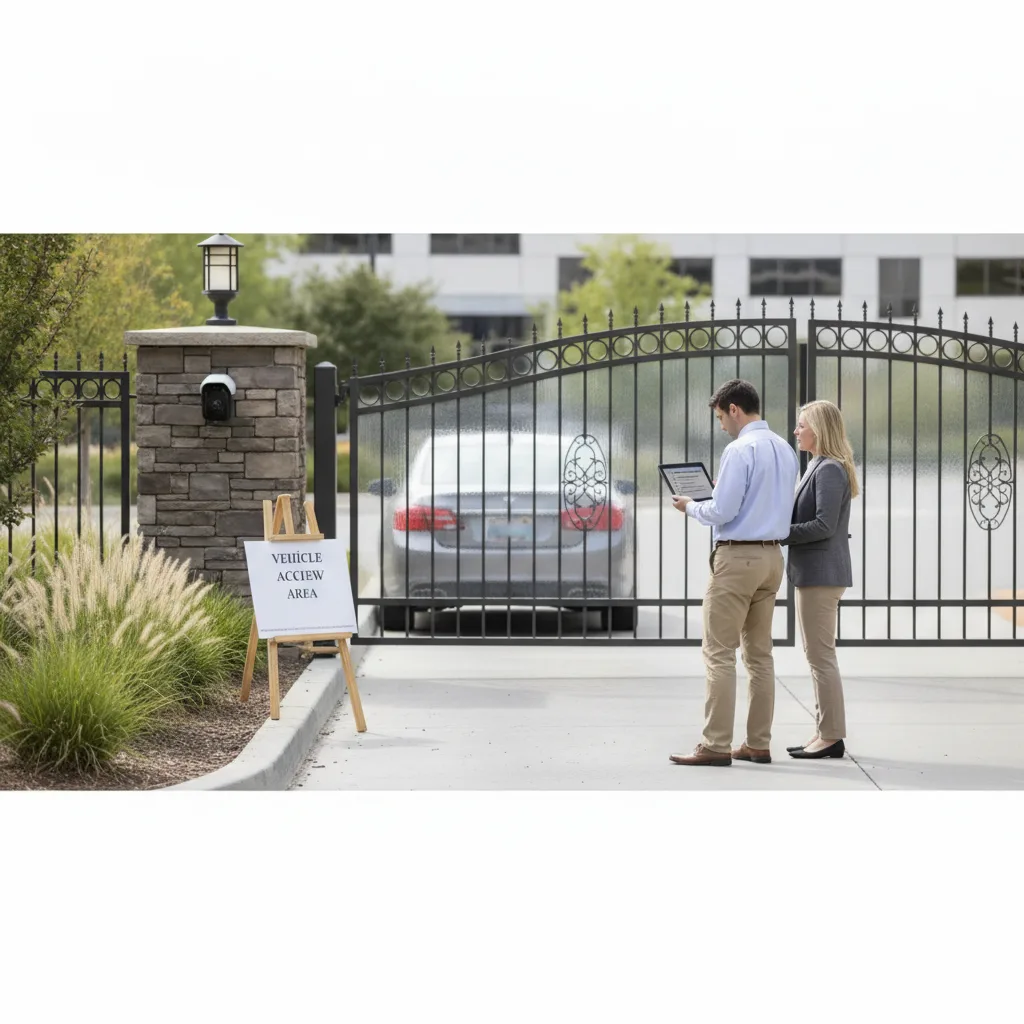
Private property ALPR host consent should require more than a verbal yes. Before letting a city or police agency place license plate readers on an HOA entrance, garage, hospital campus, or commercial lot, the owner should demand written limits on purpose, access, data sharing, retention, signage, audits, liability, costs, and removal rights.
Key Takeaways
- Hosting an ALPR camera on private land is an operating and governance decision, not just a facilities request.
- The owner should know whether the camera is privately owned, city owned, vendor owned, police searchable, or part of a broader sharing network.
- Consent should be documented in a host agreement or MOU that defines purpose, users, retention, data sharing, audit rights, signage, insurance, costs, and termination.
- Residents, tenants, patients, employees, visitors, and parkers may see the host property as responsible even when a public agency controls searches.
- If the owner cannot verify control, notice, auditability, and removal rights, the safer answer is to pause until counsel and stakeholders review the request.
What This Workflow Involves
A private-property ALPR host consent workflow turns an installation request into a reviewable governance record. The owner collects the agency request, proposed site plan, vendor terms, camera purpose, data settings, access roles, audit options, signage plan, resident or tenant notice language, insurance provisions, and removal rights before any mount, power, or network access is approved.
The workflow also separates three decisions that are often blurred together. First, does the property have authority to say yes? Second, should the property say yes under its own resident, tenant, visitor, brand, and risk standards? Third, if it says yes, what written limits are required so the camera does not become broader than the approved purpose?
That structure lets an owner support legitimate safety goals without accepting a blank check. A host can approve a narrow temporary placement, reject a broad sharing request, ask for audit exports, require signage, or insist that law-enforcement access happen only through a documented process. The point is not to make every ALPR request impossible. The point is to know what has been approved and who is accountable for it.
Why This Problem Is Showing Up Now
The question became more urgent after Florida moved against ALPR systems in state highway rights-of-way. WUSF reported on August 31, 2026 that the Florida Department of Transportation revoked permits for automated license plate recognition systems installed within state highway rights-of-way and gave agencies a removal timeline. The report also noted an important distinction for private owners: the removal did not apply the same way to privately owned and operated ALPR cameras on commercial properties and private developments.
That distinction quickly created a practical follow-up. Axios Miami reported on September 4, 2026 that Miami Beach officials were considering a proposal to place license plate readers on private property with owner permission after the state-road restriction. The same report described a competing proposal for a pause and interim safeguards while the city reviewed police use of the technology.
For a private-property owner, this is the moment where the decision can become muddy. A police agency may present the request as a public-safety partnership. A vendor may describe the installation as routine. Residents or tenants may experience it as a new surveillance point at an entrance they use every day. The owner needs a written answer to a specific question: what exactly are we consenting to host?
The Core Operational Problem
The operational problem is role confusion. A property owner may think it is only allowing a pole, power connection, camera mount, or network path. The public agency may think the owner has consented to ongoing camera operation. The vendor may control parts of storage, access, software settings, maintenance, and user permissions. Residents may assume the HOA, garage, hospital, or property manager controls every search because the device sits on private land.
That gap matters because ALPR systems are not ordinary fixed cameras. They usually capture plate reads, timestamps, vehicle images or attributes, location context, and search history. Depending on the system and configuration, data may be accessible to local police users, other agencies, vendor staff, investigators with shared access, or private-sector administrators. A camera placed on private property can still feed a larger search environment if the agreement allows it.
Current public concern is not only about where cameras are mounted. Axios reported on September 1, 2026 that Hollywood, Florida police license plate reader data had been shared with hundreds of agencies, while public scrutiny focused on data use, access, misuse allegations, and oversight. Private hosts do not need to resolve every public-policy dispute before making a property decision, but they do need to understand whether their site contributes data to that kind of access environment.
What Private Property ALPR Host Consent Should Require
A defensible consent packet starts with a written request. The owner should not approve camera placement from a site walk, phone call, or informal board email. The request should identify the public agency, vendor, camera location, power and network requirements, data controller, intended purpose, users, retention period, search tools, sharing settings, signage plan, costs, maintenance duties, and removal process.
The next step is legal and governance review. The owner should ask counsel whether the property has authority to consent, whether tenants or members must receive notice, whether a board vote or owner vote is required, whether the project affects leases or covenants, whether signage is mandatory, and whether public-records or subpoena obligations change. That review is jurisdiction-specific, so the article cannot treat Florida, California, Texas, Washington, or any HOA declaration as interchangeable.
Only then should the board or operator move to a consent matrix. The matrix should answer eight questions before approval:
| Consent area | Question to answer | Why it matters |
|---|---|---|
| Purpose | Is the camera for access control, parking enforcement, violent-crime investigation, stolen-vehicle alerts, or general agency search? | Purpose creep starts when a broad tool is approved for a narrow property need. |
| Ownership | Who owns the camera, pole, wiring, software account, and collected data? | Ownership affects maintenance, retrieval, deletion, insurance, and offboarding. |
| Access | Which named roles can search, export, share, or administrate the system? | Role clarity reduces unauthorized or informal use. |
| Sharing | Can data be shared with other agencies, task forces, federal users, vendors, or private partners? | Private hosts need to know whether a local camera becomes network-wide data. |
| Retention | How long are reads, images, search logs, exports, hotlists, and audit data kept? | Short plate retention means little if exports or search logs persist elsewhere. |
| Audit | Can the owner receive audit exports showing searches, users, reasons, shares, and policy exceptions? | Without audit access, the host cannot answer resident or tenant concerns credibly. |
| Notice | What signage, resident notice, tenant notice, visitor notice, and privacy-policy updates are required? | The property is the visible host and will receive questions first. |
| Exit | Can the owner suspend access, require deletion, remove the camera, or terminate hosting without penalty? | Exit rights prevent a temporary placement from becoming permanent by default. |
Separate Private Hosting From Public-Street Approval
This article is intentionally narrower than the HOA Flock public street approval checklist. Public-street placement asks whether an HOA or private board has authority to approve cameras in a public right-of-way and whether city permits, resident process, or removal duties apply. Private-property host consent asks a different question: if the landowner does have the power to say yes, what operating limits should be attached to that yes?
Those questions often meet at neighborhood entrances, mixed-use developments, parking garages, hospitals, retail centers, and apartment communities near public corridors. A camera can face an entrance, private drive, garage ramp, loading area, or perimeter lane while still capturing vehicles whose drivers did not choose to enter a residential security program. That is why the consent packet should include camera angle, field of view, retention, sharing, and signage, not just installation drawings.
Owners should also distinguish private LPR used for property operations from private property used as a public-agency camera site. PLACA.AI can support private-property workflows such as gated access, resident vehicle management, guest permissions, and parking enforcement. A police-searchable host arrangement is a different governance model. The Flock Safety alternatives for HOA communities hub is the right comparison point when a board wants private-property-first control rather than broad agency-network participation.
Questions To Ask The Agency And Vendor
Start with the agency. Ask who requested the camera, what problem it is meant to solve, what policy authorizes it, what crimes or alerts justify searches, who supervises use, how misuse is investigated, and whether the property owner can inspect aggregate use records. If the camera replaces a removed public-road device, ask directly whether the private placement is intended to preserve the same coverage, reduce the field of view, or support a different purpose.
Then ask the vendor. Official vendor guidance can be useful, but it is not a substitute for configuration proof. Flock’s September 1, 2026 private-sector customer guidance describes privacy and security updates for private-sector customers. A private host should still ask for the exact account settings that apply to this site: retention period, multi-factor authentication, data sharing permissions, user roles, law-enforcement access, audit exports, administrative overrides, and support access.
Ask the property-side questions last. Who pays for installation, power, cellular service, repairs, pole replacement, landscaping disruption, and removal? Who is liable if the device is damaged, misconfigured, searched improperly, or challenged by residents? Does the agency indemnify the owner? Does the owner’s insurer need notice? Is the camera covered under an easement, license agreement, lease amendment, revocable permit, or MOU?
Resident, Tenant, And Visitor Notice
Private host consent is not finished until the affected people know what changed. An HOA board may need to notify homeowners. An apartment owner may need tenant-facing language. A hospital or garage may need visitor signage. A retail center may need to brief tenants whose customers pass the camera. The exact requirement depends on law and contracts, but the operating principle is simple: people should not learn about police-searchable ALPR hosting from a small device they notice after installation.
Good notice avoids both extremes. It should not exaggerate the camera as a guarantee of safety. It also should not hide the function behind generic security-camera language if the system captures license plate data for searchable use. A practical notice should state who operates the system, what is captured, the reason for collection, how long data is retained, whether law enforcement can search it, whether data is shared beyond the local agency, where questions go, and how the property reviews the arrangement.
The resident privacy questions before Flock cameras article is useful for the resident-facing discussion. For host consent, the board or operator should go one step further and publish the decision record: what was requested, what limits were required, who reviewed it, when it will be re-evaluated, and what event would trigger suspension or removal.
Red Flags That Should Pause Approval
Some answers should stop the approval process until they are fixed. A verbal-only request is a red flag. So is an agreement that gives the property owner no audit access, no ability to remove the device, no clarity on data sharing, no retention limits, no signage plan, no insurance language, or no named administrator. Another red flag is a request framed as urgent public safety while refusing to define the exact search purpose and access boundary.
Owners should also pause when the public agency and vendor describe control differently. If the agency says the vendor controls retention but the vendor says customer policy controls retention, the host needs the written setting. If the vendor says data is private but the agency can share it broadly, the host needs the sharing map. If police users can export results, the owner should ask how exports are tracked and whether exported material follows the original retention limit.
This is where the Flock guardrails contract checklist for HOA boards can support review. Guardrails matter only when they are written into the applicable agreement, enabled in the account, visible in audit logs, and enforceable after an incident. Marketing descriptions are not enough for a private property that will be seen as the camera host.
A Practical Host-Consent Workflow
- Log the request. Record the agency, vendor, proposed location, requested purpose, date, and decision deadline.
- Freeze informal approval. Tell staff, board members, and facilities vendors that no installation, access, power, or mounting work may begin until written review is complete.
- Collect documents. Request the proposed MOU, camera diagram, privacy policy, data-sharing settings, retention schedule, audit policy, insurance language, and removal terms.
- Run counsel review. Check owner authority, tenant or member notice, signage, public-record exposure, lease or covenant obligations, and jurisdiction-specific ALPR rules.
- Score operational fit. Decide whether the camera supports a property need, a public-agency need, or both. Require tighter limits when the benefit mainly flows to the agency.
- Hold stakeholder review. Give the board, ownership group, tenants, or residents a clear summary of the proposed purpose, controls, and unresolved risks.
- Approve with conditions or decline. If approved, attach conditions in writing. If declined, explain the control gaps rather than debating the entire ALPR category.
- Schedule re-review. Revisit the placement after the first 90 days, after any policy change, after any misuse allegation, and before renewal.
Worked Example: HOA Entrance Request
Imagine a police department asks an HOA to host an ALPR camera near a neighborhood entrance because nearby public-road placements are being removed. The board’s first instinct may be to help, especially if residents are worried about vehicle-related crime. The better first move is to slow the request into a documented consent review.
The board asks for the field of view and learns the camera would capture both residents and through traffic near the entrance. It asks for the purpose and learns the agency wants stolen-vehicle and investigative search access. It asks for settings and learns retention, agency sharing, user roles, and audit exports are not yet documented in the host packet. At that point, the board has not rejected safety. It has identified missing governance.
A board-ready response might say: the HOA will consider hosting only if the agreement limits the camera to a defined purpose, names the public-agency administrator, prohibits onward sharing without written approval or legal process, sets a retention limit, provides quarterly audit summaries, requires signage, indemnifies the HOA, gives the HOA suspension rights, and includes a removal deadline if the arrangement is not renewed. If the agency cannot accept those terms, the board can compare private LPR alternatives through the PLACA.AI vs Flock Safety comparison and broader license plate recognition system comparison.
Frequently Asked Questions
Can a private property owner simply say yes to a police ALPR camera?
Maybe, but that is a legal and governance question for counsel. Even when an owner has authority to consent, the approval should be written and should define purpose, access, retention, sharing, signage, costs, liability, audit rights, and removal.
Is private-property ALPR hosting the same as using LPR for HOA gate access?
No. Gate access or parking enforcement is usually a property-operated workflow for residents, guests, tenants, or parkers. Hosting a police-searchable camera may give a public agency access to plate data from the property and needs a separate review.
What should the board ask about data sharing?
Ask who can search the data, whether other agencies can access it, whether federal users or task forces are included, whether exports are tracked, whether sharing can be disabled, and whether the property can receive audit summaries.
Should residents or tenants receive notice before installation?
In most governance settings, notice is prudent even when the exact legal requirement varies. The notice should explain the operator, purpose, data captured, retention period, law-enforcement access, sharing limits, and contact point for questions.
What if the city says the camera is urgent for public safety?
Urgency can justify a fast review, not a blank approval. The owner can ask for a short temporary agreement with strict limits, a defined re-review date, and immediate suspension rights if required documents or safeguards are missing.
When should a private owner decline the request?
Decline or pause when the request lacks written terms, clear authority, audit access, retention limits, data-sharing controls, signage, insurance language, or removal rights. Those gaps create property risk even if the public-safety goal is legitimate.
Next Step
Before approving any private property ALPR host consent request, build a one-page decision file with the proposed location, purpose, data controller, user roles, sharing settings, retention period, audit rights, notice plan, insurance terms, costs, and exit rights. Then have counsel and the responsible board or ownership group review that file before installation.