

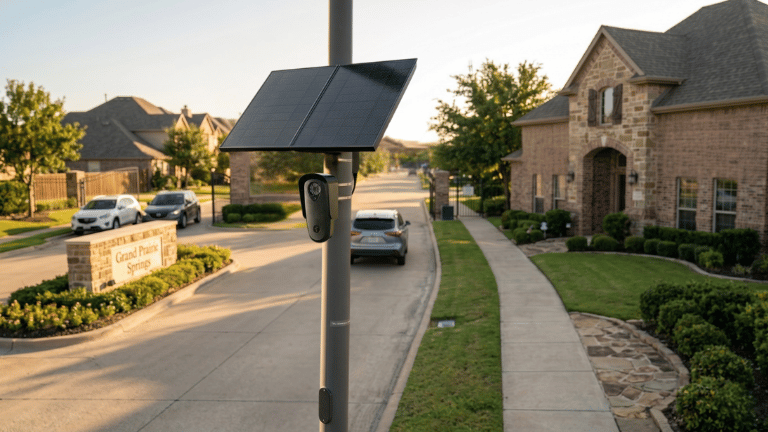
If you’re on an HOA board—or living in a neighborhood where the board is voting on cameras at the entrance—there’s a conversation happening across the country that you need to be part of before the contract gets signed.
Across Texas, California, Florida, Georgia, Virginia, and dozens of other states, homeowners associations have been the single largest pipeline for private license plate reader (LPR) deployments. The dominant vendor in that space — Flock Safety — built its early growth specifically by selling into HOAs and then partnering those HOAs with local police. As one Flock marketing email obtained by The Intercept put it: “Typically, when we work with agencies, we start with neighborhood HOAs.”
That model has run into serious trouble. And if your HOA board LPR is mid-contract, mid-pilot, or mid-decision, the trouble is worth understanding before you commit residents’ money—and residents’ privacy—for the next two to five years.
What’s Actually Gone Wrong
A short, factual list of what 2024–2026 has surfaced about Flock-style HOA deployments:
- Texas DPS Cease and Desist (2024). The Texas Department of Public Safety formally ordered Flock Safety to stop operating in private homes, businesses, and HOAs in the state without a private security license. The DPS letter warned that continued operation could result in legal action and criminal charges. Many Texas HOAs only learned about the licensing dispute after they had already signed multi-year contracts.
- The “Side Door” to ICE (May 2025). 404 Media obtained data showing that local police across the country had performed roughly 4,000 immigration-related searches in Flock’s national network on behalf of ICE — even though ICE had no contract with Flock. Once an HOA’s cameras feed into that shared search network, your neighborhood’s data is one query away from federal immigration enforcement, regardless of what’s printed in the brochure.
- California’s SB 34 Violations (June 2025). CalMatters and Oakland Privacy reported that Southern California police departments had illegally shared plate reader data — including HOA-fed data — with ICE and Border Patrol over 100 times in roughly a single month, in direct violation of California state law.
- Cheviot Hills, Los Angeles (2024–2025). A homeowners association donated $200,000 to the LAPD specifically to install Flock cameras around the neighborhood. Community groups across LA later filed formal complaints arguing the donation effectively privatized public surveillance and bypassed community consent.
- Forest Brooke, Georgia. An HOA board signed a two-year, ~$9,000 Flock contract without consulting residents. The neighborhood organized a public-facing rebuttal site, citing the lack of homeowner consent, the data-sharing scope, and the absence of any documented crime-reduction effect.
- Coral Gate, Florida. A single resident drove the installation of 10 Flock cameras in 2018 without HOA backing. According to former residents, opt-out requests were refused outright, internal Facebook groups erupted, and the neighborhood was destabilized for months.
- City Cancellations. Cambridge, MA; Eugene, OR; Flagstaff, AZ; and Charlottesville, VA, have all cancelled Flock contracts in the past 12 months. The HOA-level cancellation wave is now following the same pattern, just slower and quieter because there’s no city council vote making the news.
The Three HOA-Specific Risks Boards Don’t See Coming
A municipal police department deploying LPR has lawyers, public records officers, retention policies, and accountability structures. An HOA does not. That asymmetry creates risks that are unique to the HOA context.
1. Your data is in a national pool you didn’t agree to. When an HOA installs Flock cameras, the plates captured at the entrance can — depending on settings the board often doesn’t fully control — flow into a shared network where law enforcement agencies in other states can run searches against them. The HOA bought “neighborhood watch.” The product delivered a “nationwide searchable database that includes our neighborhood.” Those are not the same thing.
2. Your residents — and their guests — get caught up in things that have nothing to do with your neighborhood. Your housekeeper’s plate is in the system. Your kid’s tutor. The contractor is finishing the kitchen remodel. The aunt is visiting from out of state. The Uber driver who dropped off a package. None of them consented. None of them committed a crime. All of them now have a movement record tied to your community’s camera, retrievable on request.
3. The HOA board becomes a surveillance operator without surveillance training. As the Electronic Frontier Foundation has put it bluntly: HOAs and neighborhood associations are rarely equipped or trained to make responsible decisions about invasive surveillance technology. There are documented cases of police officers — trained operators — abusing LPR data to track estranged spouses. There is no reason to expect a volunteer HOA board with no data-handling training to do better. And when it goes wrong, the lawsuit names the HOA, not the vendor.
What a Privacy-First HOA LPR Actually Looks Like
PLACA AI’s neighborhood and HOA LPR platform was built specifically for residential perimeter use—private streets, gated entrances, common-area parking, clubhouse lots—with a deliberately different architecture than the one that’s gotten Flock-style deployments into trouble.
What that means for an HOA board:
Your data stays yours. Plates captured at your entrance live in your tenant. There is no shared national pool that out-of-state agencies can search. There is no nationwide TALON-style network behind the camera. If your HOA wants to share specific data with your local police department on a specific incident, you can—on your terms, in your audit trail, with your decision. The default is not shared.
No automatic law enforcement portal. We do not provide self-service search access to police departments. We do not sell “law enforcement data sharing” as a feature. We comply with valid judicial process directed at us, the way every U.S. company must. But responding to a specific subpoena that’s been through judicial review is fundamentally different from operating an always-on portal that thousands of agencies can search at will.
No federal pilot programs. We do not run, and have not run, pilot agreements with ICE, CBP, or any other federal enforcement agency. Your residents’ data is not test material for a federal contract.
Short, configurable retention. Default retention windows are short and configurable by your board. The longer plate data is held, the more it stops being a theft-prevention tool and starts being a movement-history database. Hold it long enough and you’re not running a neighborhood watch — you’re running a private-sector surveillance archive.
Real audit logs, accessible to the board. Every query against your camera data is logged. Your HOA board — not a vendor support team in another state — can review who searched what, when, and why. If a board member or property manager misuses the system, you’ll see it.
Built to comply with state-level licensing and data laws. Including Texas DPS private security licensing requirements, California’s SB 34 restrictions on out-of-state and federal data sharing, and the new wave of ALPR retention laws now passing in Connecticut, Virginia, Illinois, and elsewhere.
It’s actually for catching the things HOAs care about. A repeated package thief. A car that’s been seen in your community right before three burglaries on the same street. A vehicle the resident reported as casing the cul-de-sac. Targeted alerts on plates already tied to documented neighborhood incidents. That is what residential LPR is genuinely good at — and you do not need a 5,000-agency surveillance network to do it.
Questions Every HOA Board Should Ask Before Signing
If your board is in a vendor evaluation right now—or considering renewing a contract that’s coming up—get written answers to these before you sign:
- Where is our captured data physically stored, and who legally owns it?
- Is our data part of any shared, multi-tenant search network? If yes, who can search it?
- What is your relationship with ICE, CBP, DHS, or any federal enforcement agency? Including past pilot programs.
- What happens when a non-local police agency requests a lookup on our data?
- What does our audit log show, and can the board access it directly without going through your support team?
- What is the default retention period, and can we shorten it?
- Are you properly licensed under our state’s private security or surveillance laws? (In Texas, this is a specific question with a specific recent history—ask it.)
- What is your incident-disclosure policy if our data is breached, leaked, or accessed inappropriately?
If the vendor can’t give a clear, written, contractual answer to any of these, the board is signing a privacy liability into a multi-year contract on behalf of every resident, every guest, and every contractor who drives through the entrance.
The Bottom Line for HOA Boards
Most HOA boards installing LPR cameras genuinely want what they’re told the cameras deliver: a quieter neighborhood, fewer break-ins, and a faster path to identifying the truck that hit a mailbox at 2 AM. Those are reasonable goals. They’re achievable goals. They do not require feeding your neighborhood into a national surveillance network with documented federal backdoors.
The vendor question is not “Can the camera read a plate?” — every modern LPR can.
The vendor question is, “After the plate is read, where does it go, who else can see it, and what does the board control?”
If you’re on an HOA board, a property management company, or a master-planned community evaluating LPR options—or quietly looking to exit a Flock contract before renewal—talk to us at placa.ai. We’d rather help your community get this right the first time than read about another HOA lawsuit, another state cease-and-desist, or another ICE-access story in next month’s news cycle.
Board Decision Framework: Should the HOA Install LPR Cameras?
The right question is not simply whether LPR cameras are useful. The board should ask whether the community has a defined vehicle problem, whether LPR is the least-intrusive practical tool for that problem, and whether the vendor contract gives the association control over data access, retention, exports, and sharing.
| Question | Why It Matters |
|---|---|
| What problem are we solving? | Prevents cameras from becoming general surveillance without a clear purpose. |
| Who owns and controls the data? | Determines whether the HOA, vendor, or outside network can use plate records. |
| What is the retention period? | Limits privacy exposure and reduces unnecessary historical tracking. |
| When can data be shared externally? | Creates board-level governance for police requests, vendor access, and towing workflows. |
Resident Privacy Rights Questions Boards Should Expect
Residents may ask what the HOA records, how long plate data is kept, whether footage or plate reads are shared with law enforcement, and how the board prevents misuse. Boards should answer those questions before installation, not after a dispute.
For the commercial system overview, see HOA license plate recognition cameras. For privacy-first positioning, see privacy-first HOA security systems.