

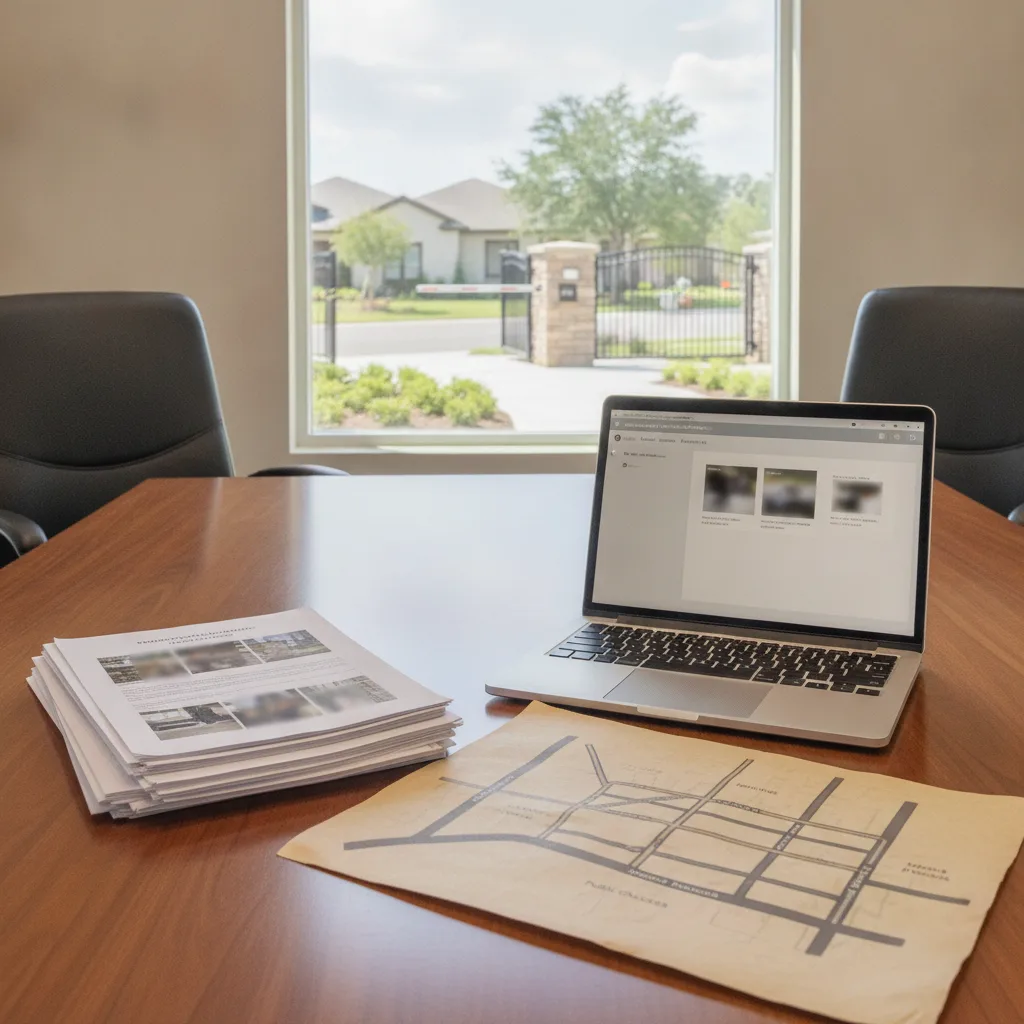
An HOA Flock public street approval checklist should come before any private association installs or controls Flock-style cameras on public streets. Verify road ownership, right-of-way permission, pole or infrastructure authority, resident notice, data-access limits, police-program status, and a written removal plan before a camera order becomes an installation.
Key Takeaways
- A private community camera project can fail even when the board believes the security goal is reasonable if the association does not control the road or installation point.
- Public-street, public-right-of-way, city-pole, and non-gated deployments need a separate approval packet from private gate or clubhouse-lot cameras.
- Fresh August 2026 Brentwood reporting shows why boards should verify permits, access roles, and removal authority before relying on a vendor or manager’s installation path.
- Data access is part of the approval question: the board should know whether management, directors, police, vendors, or outside networks can search or receive plate records.
- The cleanest next step is not a rushed yes or no. It is a written road-control, permit, data, notice, and fallback review before launch or renewal.
What This Workflow Involves
This workflow gives a board a practical way to separate five decisions that are often bundled into one camera quote. The first decision is road control: is the device on association property, a private road, a public street, a utility easement, a city pole, a developer-controlled parcel, or a state or county right-of-way?
The second decision is installation authority. A board motion may approve association spending, but it does not automatically authorize attachment to public infrastructure or monitoring of a public road segment. Management should collect the permit, encroachment approval, easement permission, pole-owner approval, or written no-permit memo before a device is installed.
The third decision is data control. The board should document who administers the system, who can search the database, whether directors can access records, whether a management company acts as the operator, whether police access is direct or request-based, and whether broader sharing is disabled or allowed. The final deliverable is an approval packet, not just meeting minutes.
Why This Problem Is Showing Up Now
On August 18, 2026, Realtor.com reported that Brentwood, California had pulled approval for a homeowners association’s Flock cameras after officials said the approval had been issued under a mistaken understanding of the project. The reported issue was not simply whether cameras are useful; it was whether a private HOA camera project belonged on public streets and who should control the resulting access.
The San Francisco Chronicle also reported on August 18 that the city had rescinded a permit for Shadow Lakes HOA cameras after the devices were placed in the public right-of-way and after officials said the permit was approved under the belief that the project was part of the police department’s camera program. Local civic coverage from ContraCosta.news on August 13 described the council’s future review of privately operated Flock cameras, including standards for approvals and control over collected data.
ABC7’s August 12 coverage captured the resident-facing version of the same question: people wanted to know what had been installed, whether they had been informed, who could look at the data, and how long it would be retained. Those are not abstract objections. They are the exact fields a board should be able to answer before a private camera watches a road used by more than association members.
The Core Operational Problem
The core problem is authority mismatch. A board may have authority to buy security equipment for association property, but that does not prove authority over a public street, a city-owned pole, a public right-of-way, or a road serving nonmembers. If the installation is later challenged, the board needs more than a vendor proposal and a security rationale.
The second problem is access mismatch. A resident may hear that only management can view data while another stakeholder believes directors, police, or other users can search it. That uncertainty is a governance failure even before anyone misuses the system. Searchable plate data requires written roles, permitted purposes, retention settings, audit records, and a complaint path.
Use the HOA license plate recognition camera planning guide for private-community use cases, camera fit, and resident communication. Use this article’s approval packet when any proposed device touches a street, pole, easement, or access point the association may not fully control.
Evidence And Source Context
The fresh public question comes from current Brentwood coverage. Realtor.com reported on August 18, 2026 that the city was forcing removal after a mistaken approval involving HOA-controlled Flock cameras on public streets. The San Francisco Chronicle’s August 18 report tied the reversal to public right-of-way placement and the distinction between a private HOA project and a police-department program.
ContraCosta.news reported on August 13, 2026 that Brentwood’s council agreed to revisit privately owned Flock cameras and consider standards for approving installations, access to collected data, and removal authority. ABC7 reported on August 12, 2026 that residents raised concerns about notice, surveillance, access, and retention after the cameras appeared.
The legal backdrop must be checked locally. California DOJ’s Automated License Plate Reader Data Guidance explains that California ALPR operators and end-users must maintain usage and privacy policies, protect ALPR information, and keep access records when access is provided. Epsten’s March 2026 California community-association commentary applies those policy duties to associations and stresses public written policies. These sources support review discipline; they do not replace counsel’s advice for a specific association.
HOA Flock Public Street Approval Checklist
| Checkpoint | Board question | Record to keep |
|---|---|---|
| Road ownership | Is the camera watching or sitting on an association road, private road, public street, alley, utility easement, or state/county route? | Road map, parcel or easement note, counsel or road-owner memo |
| Installation point | Who owns the pole, sign, curb, landscape strip, trailer location, power source, or structure? | Owner approval, pole agreement, utility clearance, location photo |
| Permit path | Is an encroachment permit, city agreement, DOT approval, police-program agreement, or board-only approval required? | Permit, agency email, no-permit memo, approval expiration date |
| Program identity | Is this a private HOA system, a police-department system, a shared public-private deployment, or a vendor-administered account? | Program summary, contract role map, agency contact |
| Data access | Who can search, export, share, or change settings: board, manager, vendor, police, neighboring agencies, or others? | User roster, role permissions, audit-log export |
| Resident notice | What will residents and nonresident road users be told about purpose, retention, access, and complaint path? | Notice, FAQ, signage text, meeting record |
| Fallback | Who removes, relocates, restores, or pays if the approval was mistaken or the road owner objects? | Removal clause, restoration duty, cost owner, deadline |
How To Classify The Installation Before A Vote
Classify every camera location before approving the vendor order. A camera mounted on a private gatehouse that only reads vehicles entering association property is one category. A camera on a standalone pole in a public right-of-way is another. A camera facing a public street from private property may be a third. A city-approved police camera that the HOA helps fund may be a fourth.
Each category needs a different answer. Private-property cameras still need privacy, access, retention, and resident notice rules. Public right-of-way installations need road-owner approval and a clear permit path. Shared police-program cameras need a written description of who owns the data, who can search it, and whether the HOA has any administrative access at all.
Do not rely on the phrase the city gave us a permit unless the board has reviewed what the permit actually covers. A permit to place equipment may not authorize private data access. A police-program agreement may not authorize an HOA-operated account. A vendor-submitted application may not prove that the board, city, and residents understood the same scope.
Data Access Questions To Resolve Before Launch
The board should adopt a simple rule: no ambiguous access. If management is the only administrator, say whether that means the community manager, the management company, vendor support, a board officer, or a named security contractor. If directors cannot search data, say so. If they can approve searches, define the reason and audit process.
Flock’s August 2026 public update says the company is recommending shorter ALPR retention for law-enforcement customers and adding or requiring tools such as Audit Assistance, proactive lockouts, case codes, offense filtering, stronger authentication, and Evidence Mode. Those changes are useful context, but a private community should still verify the exact settings in its own contract and account.
For vendor comparison, use Flock Safety alternatives for HOA communities after the board has written its access policy. A vendor conversation is much clearer when the board can say whether it wants private-property access control, parking records, incident review, direct police sharing, no police sharing, or a hybrid model.
Risks, Limits, And Exceptions
This article is not legal advice. Public-street authority depends on state law, municipal code, public works rules, transportation-agency rules, utility agreements, private-road ownership, easements, governing documents, and the signed vendor contract. Ask counsel and the road owner before treating a public-facing installation as a routine HOA security expense.
A public-street mistake can create several costs: removal, right-of-way restoration, resident trust damage, board meeting conflict, vendor change orders, and uncertainty over previously collected records. The point of the checklist is to reduce that uncertainty before the cameras are live, not to imply that every private-community camera project should be abandoned.
Also separate this topic from physical mounting safety. The ALPR camera mounting and right-of-way safety checklist addresses clear zones, breakaway supports, visibility, and inspection. This approval workflow asks whether the association had authority to put or aim the device there in the first place.
Worked Example: Non-Gated Community Entrance
A non-gated HOA wants four plate-reader cameras at neighborhood entrances after package thefts and car break-ins. The streets are city-maintained and used by delivery drivers, visitors, nearby residents, and people cutting through the neighborhood. The vendor proposal shows cameras on poles near the entrances, and the board assumes the manager can handle permits.
Before approving, the board builds an approval packet. Public works confirms whether the poles sit in a public right-of-way. Counsel reviews whether the association can fund cameras watching city streets. The city explains whether the project must be part of the police department’s ALPR program or whether private operation is allowed. The board asks the vendor to identify who owns the account, who can search records, and what happens if the city later orders removal.
The board may still decide to proceed, but only after the scope is clear. It might move cameras to association-controlled property, disable board access, fund a city-managed program instead, choose a private-property workflow for amenity lots only, or postpone the project. That decision is more defensible than discovering after launch that the road, pole, permit, and data roles were all assumed.
Frequently Asked Questions
Can an HOA install license plate readers on public streets?
Sometimes the answer may be no, and sometimes it may require a city, county, DOT, utility, or police-program agreement. A board should not assume its private security authority extends to public streets or public right-of-way locations.
What is the first document the board should request?
Start with a location authority memo for each camera. It should identify the road owner, installation-point owner, permit path, approval expiration, and whether the camera is private, public-agency, or shared-program equipment.
Does resident notice solve a public-right-of-way problem?
No. Notice is important, but it does not create road ownership or permit authority. Treat resident notice, road approval, data policy, and vendor contract review as separate gates.
Should board members be able to search plate records?
Only if the association has a written policy, valid purpose, role limit, audit trail, and counsel-reviewed reason for board access. Many communities should limit routine access to trained management or a narrower approved role.
What if the city approved the permit by mistake?
The board should have a removal and restoration plan before installation. The plan should say who pays, who contacts the road owner, how data is preserved or deleted, and what replacement location or workflow will be reviewed.
Related PLACA Resources
- Use the HOA license plate recognition camera planning guide when defining private-community use cases and resident communication.
- Compare Flock Safety alternatives for HOA communities after the board has written its road-control and access requirements.
- Review the ALPR camera mounting and right-of-way safety checklist when a proposed location creates physical fixture or roadside exposure questions.
- Use resident vehicle registration and access workflows when the goal is private-property gate, parking, or visitor management rather than public-street monitoring.
Next Step
Before the next vote, ask management for a one-page approval packet for every proposed camera: road owner, installation-point owner, permit or agreement, program identity, access roster, retention setting, resident notice, and removal owner. If any field is blank, hold that location until the missing authority is documented.
Internal Resources
- ALPR vs Speed Cameras Checklist for Resident Questions
- How Apartment Guest Parking Managers Can Handle Unpaid Parking Sessions Without Adding More Hardware
- How Hospitality Groups Can Document Vehicle Condition Issues Using Ticketless Vehicle Recognition
- How Night Patrol Teams Can Document Parking Violations With Mobile LPR Workflows