

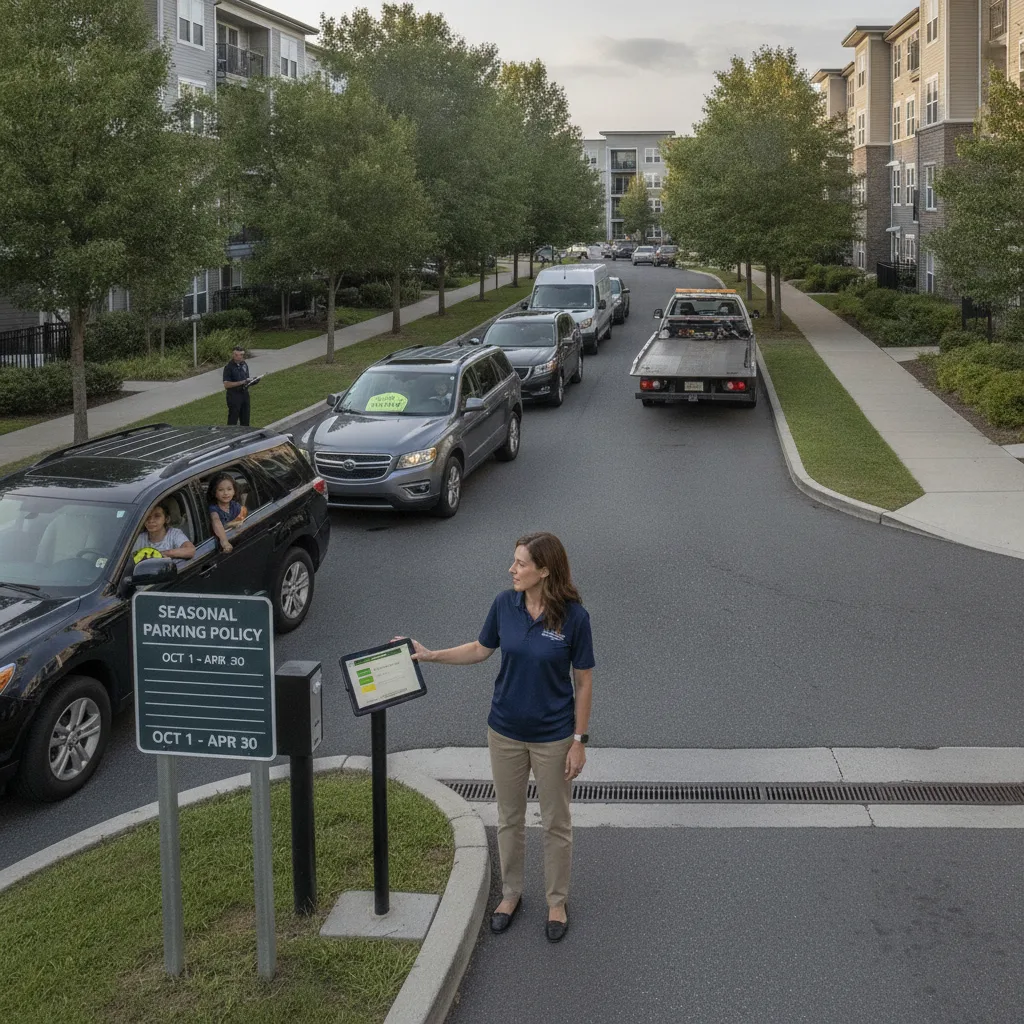
Direct answer: Community managers overseeing multiple associations rarely deal with one seasonal turnover — they’re tracking a dozen different departure and arrival calendars at once, each tied to a different community’s snowbird, vacation, or seasonal-rental pattern. The fix isn’t remembering every property’s dates; it’s a system that tracks each community’s seasonal window independently while using one consistent process to open, extend, and close resident parking records.
This guide is for community management company staff who handle seasonal parking changes across a portfolio, where no two communities empty out or fill back up on the same schedule, and where the real risk is a manual process that only works when someone remembers to run it.
The problem isn’t seasonality — it’s running it at scale
A single self-managed community can handle seasonal turnover with a spreadsheet and a calendar reminder, because there’s one departure window and one staff person who knows it. A management company running parking enforcement for a dozen or more associations doesn’t have that luxury: one community’s seasonal residents leave in April, another’s arrive in November, a third has a rolling pattern with no clean start or end date at all. Every property has its own mix of active vehicles, seasonal vehicles, and vehicles that should already be inactive but never got processed after last year’s departure.
The failure pattern is predictable: a staff member who personally remembers Community A’s typical departure timing moves to a different role, and the next person covering that property either processes the seasonal change too early (flagging vehicles that are still legitimately on-site) or too late (leaving departed residents’ guest privileges and parking authorizations active for months after they’ve left). Neither error is really about the parking rule — it’s about the process depending on one person’s memory of one property’s calendar.
Building a system that scales across calendars
| What varies by property | What should stay the same across the portfolio |
|---|---|
| Seasonal window (arrival/departure dates) | The process for opening a seasonal record before arrival and closing one after departure |
| Which vehicles count as “seasonal” vs. year-round | The evidence standard for confirming a vehicle is actually active vs. left behind |
| Local renewal and notice requirements | The reminder cadence and who owns follow-up when a resident doesn’t respond |
| Guest and rental permissions tied to seasonal units | The rule that guest privileges close automatically when the sponsoring resident’s record closes |
Where seasonal records go stale
The most common gap across a portfolio isn’t the departure itself — it’s what happens to everything tied to that resident’s record after they leave. Guest authorizations sponsored by a now-departed seasonal resident should close automatically, not linger until someone notices a stale visitor pass being used months later. Vehicles left behind in storage need their own classification, separate from active seasonal parking, since a car sitting in a seasonal resident’s space for eight months while they’re gone is a different problem than an active vehicle rotating in and out. Renewal reminders that go out on a fixed calendar date rather than relative to each property’s actual season will either arrive too early to be useful or too late to give residents time to respond.
Sequencing the work across many properties
- Store each community’s seasonal window as data, not as something staff memorize per property, so coverage changes don’t create knowledge gaps.
- Trigger renewal reminders relative to each property’s actual departure and arrival dates, not a single portfolio-wide calendar.
- Close dependent records automatically — guest sponsorships, temporary permits — when the seasonal resident’s own record closes, rather than relying on a separate manual step.
- Flag vehicles left behind past the departure window for a distinct storage-classification review, not silent inactivity.
Our resident parking report workflow guide covers how to structure intake so seasonal changes, complaints, and standard registration updates all land in the same reviewable system rather than separate per-property processes.
Cross-property consistency without one-size-fits-all rules
Standardizing the process doesn’t mean standardizing the policy. A ski-town community’s season and a golf-course retirement community’s season don’t overlap and shouldn’t be forced into the same reminder schedule. What should be identical is the checklist a staff member runs through at any property when a seasonal window opens or closes — confirm current vehicles, close dependent guest records, flag anything left behind, and log the disposition — regardless of which community or which month it happens to be. Our guide to resident vehicle registration for large master-planned communities covers a related standardization problem at the registration level.
Running a bounded pilot before scaling the process
Test the standardized seasonal-turnover checklist on two properties with genuinely different calendars — ideally one with a sharp, well-defined season and one with a rolling or ambiguous pattern — before rolling it across the rest of the portfolio. Track how many seasonal records close cleanly with dependent guest permissions closed automatically, how many vehicles get correctly flagged as left-behind rather than silently ignored, and how many renewal reminders actually reach residents with enough lead time to respond. If a property’s ambiguous season keeps breaking the standard checklist, that’s a sign the checklist needs a defined fallback for non-standard patterns, not that the property should be handled entirely outside the system.
Related PLACA.AI planning resources
Practical questions
How do we manage a dozen different seasonal calendars without missing one?
Store each property’s seasonal window as data the system tracks automatically, rather than relying on staff to remember which community’s season starts when. Coverage changes shouldn’t create a knowledge gap.
What happens to a seasonal resident’s guest authorizations after they leave?
They should close automatically when the resident’s own seasonal record closes, not remain active until someone happens to notice a stale guest pass still being used.
Should every property use the same reminder schedule?
No. The reminder timing should be relative to each property’s actual arrival and departure dates; the checklist staff follow when running the process should be the same everywhere.
Plan a limited workflow review
Bring the current rule, process, exceptions, and success criteria for managing seasonal resident parking changes for community managers. PLACA.AI can help evaluate a bounded pilot without assuming another property’s workflow is the right answer.
Editorial refresh: September 18, 2026. Independently confirm current product capabilities, third-party features, pricing, contracts, governing requirements, and local rules before acting.
Data source: Community Associations Institute