

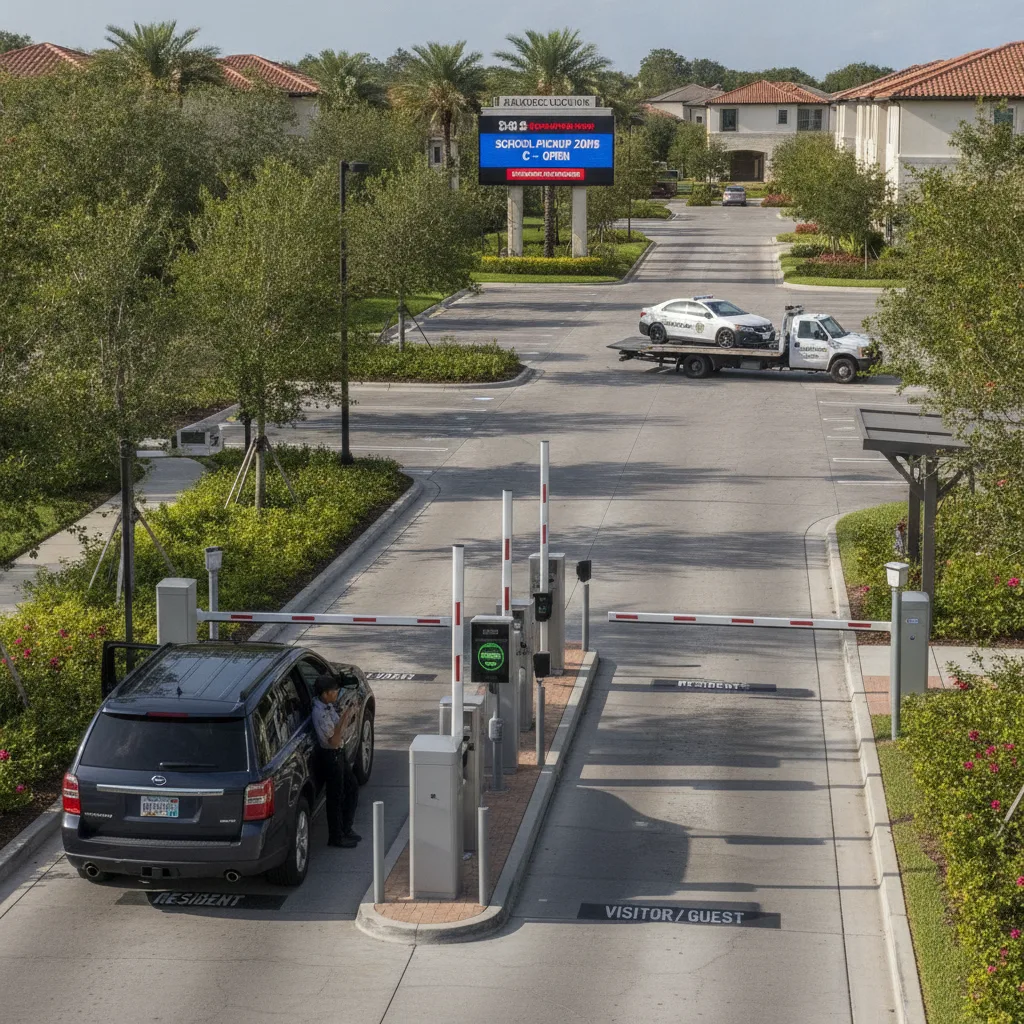
Direct answer: Large master-planned communities improve resident vehicle registration by treating it as a shared data problem across every sub-association and amenity a resident touches – not just a gate list. A registration system that only lives at the main entrance breaks down the moment a resident’s plate also needs to work at the village gate, the clubhouse lot, and the pool. The fix is one registration record that every access point reads from, with a clear process for the community’s two hardest cases: the seasonal resident who’s only there part of the year, and the sub-association with its own parking rule layered on top of the master association’s.
This guide is for the staff running vehicle registration in large, professionally managed master-planned communities – typically thousands of units organized into multiple villages or sub-associations, each with its own board and sometimes its own parking rules, under one master association that controls the main gates and shared amenities.
Why scale changes the registration problem
A 40-unit HOA can manage vehicle registration with a spreadsheet and a gate list. A master-planned community with several thousand units across a dozen villages can’t – not because the rule is more complicated, but because the same resident’s vehicle needs to be recognized correctly at multiple, differently-governed access points. A plate registered at the main gate has to also work at the village entrance, and if the sub-association changes its own guest policy without telling the master association’s front office, residents get turned away from amenities their dues already pay for.
The practical fix is a single source-of-truth registration record – one plate, one resident, one status – that every gate, clubhouse, and amenity checkpoint reads from, even when the villages themselves are governed separately. Sub-associations can still set their own rules on top of that (visitor limits, RV restrictions, resident parking hours), but the underlying vehicle-to-resident match shouldn’t have to be re-entered at every gate.
The two cases that break most registration systems
- Seasonal and part-time residents. Communities with a significant snowbird or seasonal population have residents whose vehicles are legitimately absent for months at a time. A registration system that auto-expires plates after a fixed period of no gate activity will incorrectly flag a snowbird’s car as unregistered the day they return, creating an entry dispute at the exact moment staffing is thinnest.
- Rental turnover. Large communities with a meaningful rental percentage see vehicle records go stale fast – a leased unit changes tenants and nobody updates the plate on file. The front office needs a routine trigger (lease change, new resident onboarding) that forces a registration refresh, rather than relying on the resident to remember.
Coordinating master and sub-association rules
| Layer | Who controls it | What it typically governs |
|---|---|---|
| Master association | Master board / management company | Main gate access, shared amenities, community-wide guest policy floor |
| Sub-association / village | Village board | Village-specific street parking, RV or trailer restrictions, visitor time limits |
| Individual resident | Owner or tenant | Registering their own and their household’s vehicles, updating on turnover |
Conflicts show up when a sub-association tightens a rule the master association’s system doesn’t know about – a resident registered correctly at the front gate still gets cited in their own village for a rule the master database never captured. Keeping village-level rules as an overlay on the shared registration record, rather than a separate parallel system, is what prevents that gap.
Registering vendors and contractors at community scale
Communities this size run a constant stream of landscaping crews, pool service, home renovation contractors, and delivery vehicles – traffic volume that a small HOA rarely deals with. Treating vendor vehicles as a distinct registration category, with its own expiration tied to the service contract rather than a resident’s annual renewal, keeps that volume from diluting the accuracy of the resident vehicle list.
Related PLACA.AI planning resources
Questions before expanding registration community-wide
Should every village use the same registration rule?
The underlying vehicle-to-resident record should be shared, but villages can still layer their own restrictions on top – the goal is one accurate data source, not one identical policy everywhere.
How should seasonal residents be handled?
Flag them as a distinct status rather than letting their record lapse from inactivity, so a returning snowbird isn’t treated as an unregistered vehicle on arrival.
What blocks expansion to a new village or amenity?
An access point that can’t read the shared registration record, a sub-association rule that was never entered into the system, or vendor traffic that hasn’t been separated from resident vehicle counts.
Plan a limited workflow review
Bring your current gate list, one sub-association’s parking rule, and a sample of seasonal-resident cases. PLACA.AI can help evaluate a bounded pilot without assuming another property’s workflow is the right answer.
Editorial refresh: September 18, 2026. Independently confirm current product capabilities, third-party features, pricing, contracts, governing requirements, and local rules before acting.
Internal Resources
- How Repo and Tow Operators Can Reduce Disputed Tows With Mobile LPR Workflows
- How Texas HOAs Can Document Overnight Parking Violations Without Creating Resident Friction
- How Tow Dispatch Managers Can Reduce Disputed Tows With Mobile LPR Workflows
- How Florida Associations Can Improve Resident Vehicle Registration Without Creating Resident Friction
- How Venue Parking Managers Can Handle Liability Questions Using Ticketless Vehicle Recognition
Data source: Community Associations Institute