

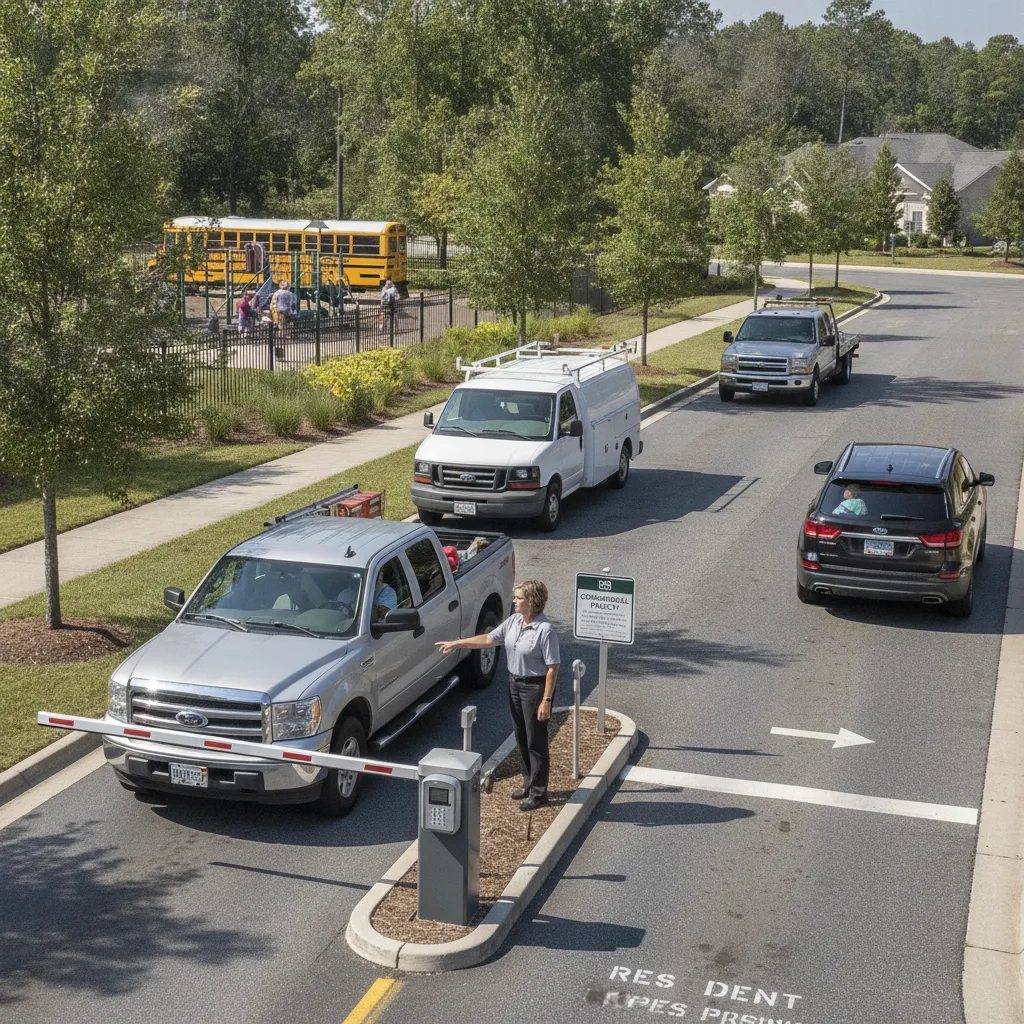
Direct answer: Community managers should sort commercial-vehicle complaints by purpose before touching enforcement: an active service call, a resident’s own work vehicle, and overnight commercial storage are three different problems with three different rules, and most covenant disputes come from treating them as one.
This guide is for community managers running the day-to-day complaint queue across one or more properties — the person who actually opens the email, checks the covenant language, and decides whether tonight’s warning letter goes out, not the board that approved the policy months ago.
The volume problem is different from the judgment problem
If you manage more than one community, commercial-vehicle complaints don’t arrive one at a time with context attached. They show up as a photo forwarded from a resident, a note left at the office, or a line item in a weekly walk report, usually with no indication of whether the vehicle belongs to a resident, a contractor, or someone who doesn’t live there at all. The actual judgment call — is this covenant violation or not — is rarely hard once you have the facts. The hard part is getting the facts fast enough to respond before the complaint sits for two weeks and the resident escalates to the board.
Most covenants restricting “commercial vehicles” were written to stop fleet storage and business advertising in a residential neighborhood, not to catch a resident who drives a personal pickup for a landscaping business or an HVAC tech who parks their company van at home between jobs because that’s what the job requires. A logo on a door panel isn’t the same violation as six months of overnight parking by someone who doesn’t live in the community. Community managers who don’t separate these upfront end up either under-enforcing (letting genuine storage violations slide because the file looks like every other complaint) or over-enforcing (sending a violation notice to a resident who works for a living and is now furious at the association).
Sorting the queue: what actually distinguishes these cases
| What you’re looking at | What settles it | Typical outcome |
|---|---|---|
| Marked van, mid-day, at a specific unit | Is there a matching service request or gate log entry? | Not a violation — active service call |
| Resident’s own pickup or van, parked at their unit | Does the covenant restrict resident-owned work vehicles by size/class, or only by commercial use/signage? | Often permitted; check the actual covenant text, not the general rule of thumb |
| Unfamiliar commercial vehicle, same spot for multiple days/nights | No resident match, no service record, no visitor log entry | Likely storage violation — document and send notice |
| Contractor vehicle overnight during a known project | Board-approved contractor exception on file? | Temporary, time-boxed exception if documented |
A workflow that survives a busy portfolio
- Log the vehicle, unit, and time before deciding anything. A plate, a location, and a timestamp are the minimum you need to check against anything else later. Without this, you’re relying on memory two weeks from now when the resident appeals.
- Check for a matching reason before assuming violation. Cross-reference against work orders, gate logs, or resident-reported service visits. A five-minute check here prevents a large share of unnecessary warning letters.
- Apply the covenant text, not the neighborhood assumption. Pull the actual restriction — many older governing documents define “commercial vehicle” by weight class, signage, or vehicle type, and those definitions don’t always match what residents (or managers) assume the rule says.
- Escalate storage cases with a paper trail, not a guess. A vehicle that’s been in the same spot for multiple consecutive observations, with no resident match, is where a documented notice and a board-approved escalation path matter — this is the case category most likely to end up in a dispute.
Where this needs to go past you
Accessibility-related vehicle accommodations, situations involving a resident’s employment or caregiver arrangement, and any case where the vehicle owner disputes the covenant’s applicability belong with the board or the association’s attorney, not a unilateral manager decision. Community managers don’t have (and shouldn’t want) final enforcement authority on contested cases; your job is a clean, documented handoff, not a ruling.
Making this manageable across a multi-property portfolio
The realistic test isn’t a single community’s policy — it’s whether the same triage logic holds up when you’re covering five or six properties with different covenant language and different resident populations. Run it against a recent batch of real complaints from more than one property: one clear service-call dismissal, one covenant text lookup that surprised you, and one storage case that actually needed a notice. If checking work orders or gate logs takes a phone call and a wait every time, that step will get skipped under volume, and skipped steps are how inconsistent enforcement across a portfolio turns into a board complaint about you rather than the resident. Automated plate logging at community entrances — see the HOA LPR camera planning guide — gives you a timestamped record to check against without needing a phone call, which matters more the more properties you’re responsible for. For guest and overflow parking issues that often get tangled up with commercial-vehicle complaints on the same walk report, see reducing visitor parking abuse without creating resident friction.
What to confirm before standardizing this across your portfolio
- Whether each property’s covenant defines “commercial vehicle” the same way — many don’t.
- A consistent, low-effort way to check for a matching service reason before issuing a notice.
- Who at the board level signs off on contractor and caregiver exceptions, and how long those last.
- That storage-violation notices carry a documented history, not just a photo, if the case goes to a hearing.
- How disputed or accessibility-related cases get routed off your desk and to the right owner.
Related PLACA.AI planning resources
Practical questions
How do I tell a resident’s personal work truck from a real “commercial vehicle” violation?
Check the actual covenant definition first — most restrict by signage, weight class, or vehicle type, not by whether the owner uses the vehicle for work. A personal pickup with a magnetic sign is usually a different case than a marked box truck stored overnight.
What’s the fastest way to rule out a false complaint?
Cross-check against work orders, gate logs, or a resident’s own service request before drafting a notice. Most “unauthorized commercial vehicle” complaints turn out to be an active, legitimate service call.
When should I stop and hand a case to the board?
When the covenant’s applicability is disputed, when an accessibility or employment accommodation is involved, or when a case has enough history that it’s headed to a formal hearing.
Plan a limited workflow review
Bring the current rule, process, exceptions, and success criteria for managing unauthorized commercial vehicles in communities. PLACA.AI can help evaluate a bounded pilot without assuming another property’s workflow is the right answer.
Editorial refresh: September 18, 2026. Independently confirm current product capabilities, third-party features, pricing, contracts, governing requirements, and local rules before acting.
Data source: Community Associations Institute