

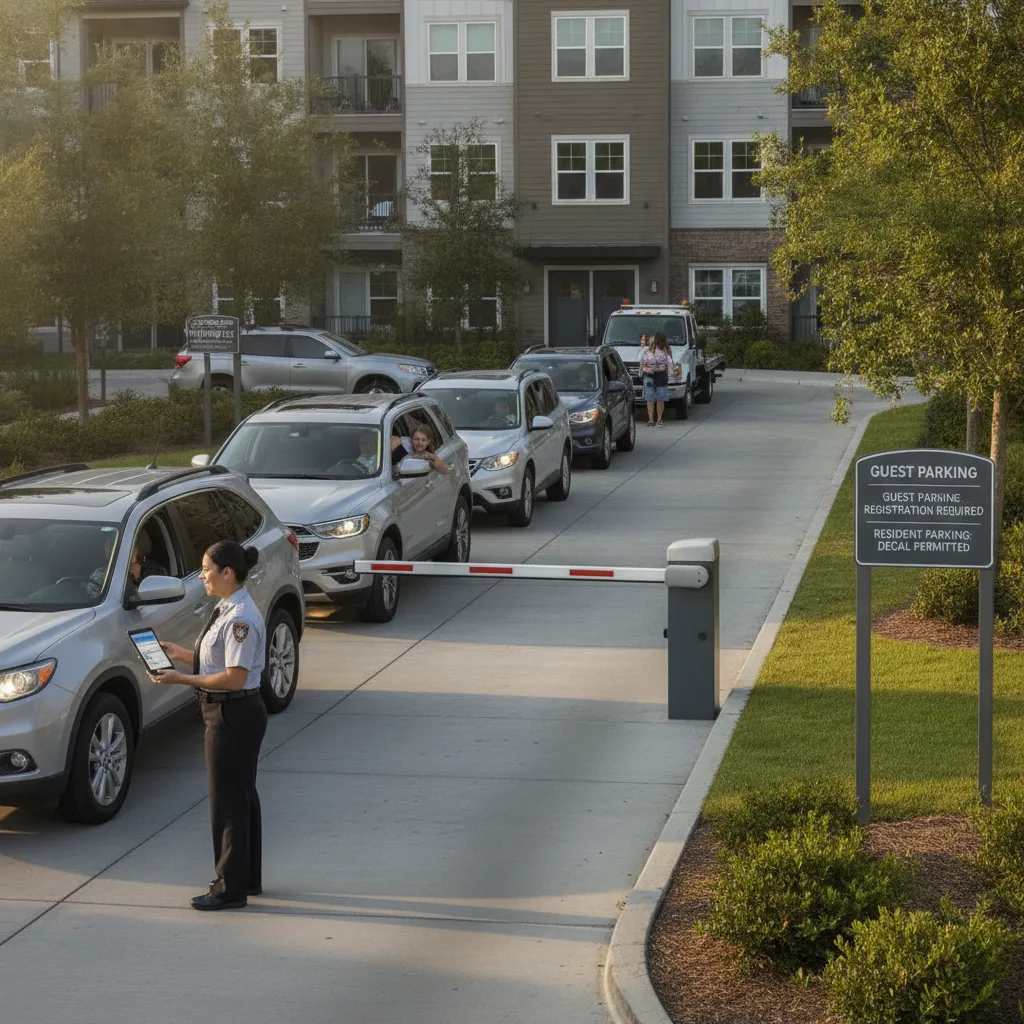
Direct answer: Community managers protect scarce guest parking by keeping three categories separate and handling each with a different tool: real short-term guests get a fast, low-friction authorization; recurring visitors like caregivers get a time-boxed standing exception; and resident overflow gets redirected to the resident rule instead of quietly absorbing guest inventory.
This guide is for community managers handling guest parking across a portfolio of properties, where the volume of small day-to-day decisions — not any single hard judgment call — is what actually strains the process.
The real failure mode is death by a thousand small exceptions
Guest parking scarcity rarely fails all at once. It erodes complaint by complaint: a resident asks for “just one night” for a visitor and it becomes a standing habit, a caregiver’s car sits in a guest spot for months because nobody set an expiry, or a resident’s own second vehicle ends up permanently parked in guest inventory because enforcing the resident rule feels like more of a fight than it’s worth. None of these individually looks like a violation worth a confrontation. Collectively, they’re why a community with technically enough guest spaces still runs out of them by Friday evening.
The manager’s actual job here isn’t detecting bad actors — it’s resisting the daily pressure to grant one more informal exception, because each one you grant becomes the precedent the next resident cites. A guest-parking policy that exists only as a general rule, with no record of who’s been granted what exception and for how long, gives you nothing to point to when a resident asks why their neighbor got an exception and they didn’t.
Sorting the request before deciding
| What’s being requested | What to check | Typical response |
|---|---|---|
| Short visit, 1–3 nights | Sponsoring resident, vehicle, expected departure | Standard guest authorization, self-expiring |
| Recurring caregiver or in-home service | Schedule, purpose, how long the arrangement will last | Time-boxed standing exception with a review date |
| Resident’s own second/third vehicle | Household relationship, resident parking policy status | Redirect to resident overflow rule, not guest inventory |
| Occupancy is already near capacity | Peak-period status, available overflow lot if any | Communicate the alternative before denying outright |
A workflow built for volume, not for the hard cases
- Log every exception with an expiry date, not just a yes. A verbal “sure, just this once” with no record is what turns into an indefinite occupancy six months later. Every granted exception should have a start date, an end date, and a reason on file.
- Give caregivers and recurring service visits their own category. These are legitimate, common, and predictable — treat them as a standing exception type with a periodic review, not a one-off favor renegotiated every visit.
- Redirect resident overflow instead of absorbing it. When a resident’s own vehicle is the issue, the answer is the resident parking policy, not an indefinite guest-spot loan. Conflating the two is the single biggest reason guest inventory quietly disappears.
- Communicate capacity honestly during peak periods. Holidays and move-in weekends will strain guest inventory regardless of policy. Telling residents in advance what the overflow option is prevents the frustrated calls that come from finding out at the curb.
Where this goes past a routine call
Accessibility accommodations, medical situations, and any case where a resident disputes the classification of their own vehicle belong with the board, not a manager’s discretionary call. Those decisions carry legal weight that a routine guest-parking judgment doesn’t.
Keeping this consistent across a portfolio
If you manage multiple properties, the test isn’t whether the policy works at your best-run community — it’s whether the exception log stays accurate at the property where you’re least often on-site. Pull a recent sample of granted exceptions across your portfolio and check whether each still has an active reason and expiry date, or whether some have quietly become permanent. Properties that pair guest-space tracking with automated plate logging at entrances get a record that doesn’t depend on a manager remembering who they verbally approved three weeks ago; see the HOA LPR camera planning guide for how that fits into a guest-authorization workflow. The same overflow-and-scarcity dynamic often shows up alongside broader visitor-parking complaints — see reducing visitor parking abuse without creating resident friction for the related enforcement side of this problem.
What to confirm before standardizing this
- A consistent, portfolio-wide definition of what counts as a “guest” versus resident overflow.
- That every granted exception has a logged reason, start date, and expiry — not just a verbal yes.
- A standing category and review cadence for recurring caregivers and service visits.
- A communicated overflow plan for peak periods, before residents find out at the curb.
- Who signs off on accessibility or accommodation-related exceptions outside the standard process.
Related PLACA.AI planning resources
Operational FAQs
How do I stop informal guest exceptions from becoming permanent?
Log every exception with a start date, reason, and expiry at the time it’s granted, and review the log periodically. A verbal exception with no record is what quietly turns into indefinite occupancy.
Should a resident’s second car ever use a guest space?
Generally no — redirect it to the resident overflow policy. Letting resident vehicles absorb guest inventory is one of the fastest ways to run out of space for actual visitors.
What should I hand off instead of deciding myself?
Any accessibility accommodation, medical situation, or a resident’s formal dispute over how their vehicle was classified. Those need board or documented policy involvement, not a discretionary manager call.
Plan a limited workflow review
Bring the current rule, process, exceptions, and success criteria for protecting limited guest spaces through community management. PLACA.AI can help evaluate a bounded pilot without assuming another property’s workflow is the right answer.
Editorial refresh: September 18, 2026. Independently confirm current product capabilities, third-party features, pricing, contracts, governing requirements, and local rules before acting.
Data source: Community Associations Institute