

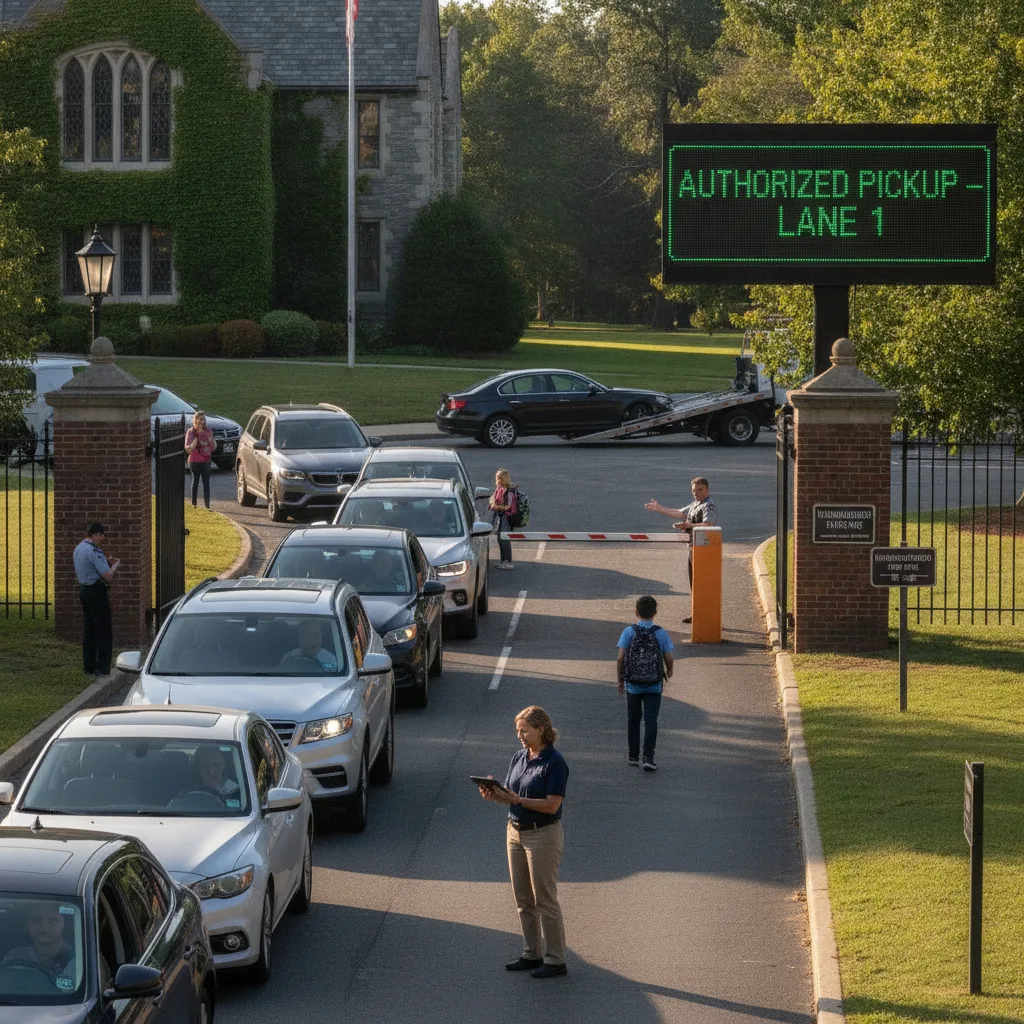
When something goes wrong at school dismissal — a child released to the wrong person, a custody order not enforced, a student left waiting without explanation — the first question from parents, attorneys, and district administrators is always the same: who approved this, and when?
Most schools cannot answer that question with any precision. They have a paper sign-out sheet, maybe a note in the student information system, and the recollection of a staff member who managed 300 pickups that afternoon.
PLACA.AI’s patent-pending student release system changes this with a hash-chained, tamper-evident audit log that records every dismissal event — automatically, in real time, permanently.
What Gets Recorded
- Vehicle detection event — camera frame, license plate read, confidence score, timestamp
- Authorization Request Object construction — which identification modality was used
- Rule evaluation result — which rule level produced the outcome and what that outcome was
- Staff dismissal card presented — which staff member received it, on which device
- Staff approval action — approving staff member’s identity, timestamp, and cryptographic signature
- Teacher notification sent — which teacher, at what time, for which student
- Student staged and released — exact timestamps for each transition
- Pickup confirmed — when the vehicle exited the pickup zone
Why Tamper-Evidence Matters
The audit log uses a hash-chain architecture: each entry contains a cryptographic hash computed from the previous entry’s hash plus the current entry’s data. Any modification, deletion, or reordering of entries causes the chain to break — and that break is detectable by any auditor who recomputes the chain.
Staff Approval Is Cryptographically Signed
A staff approval is not a tap on a screen — it is a cryptographically signed token containing the staff member’s identity, their active session key, the student identifier, the ARO reference, and the timestamp. The token is generated only after authenticated staff action and stored permanently in the audit log.
Unresolved Pickups Are Flagged Automatically
If a student has not been picked up by the end of the configured dismissal window, the system automatically flags the unresolved status and generates a front office alert — logged in the audit trail with the dismissal window close time and triggering condition.
Schedule a walkthrough to see the audit log interface and how dismissal records are reviewed after each session.
Frequently Asked Questions
How do schools document student pickup for liability purposes?
Schools using PLACA.AI automatically generate a timestamped, tamper-evident audit record for every dismissal event — including vehicle detection, rule evaluation, staff approval identity, student staging, and pickup confirmation. This record can be produced in response to a parent inquiry, legal challenge, or district audit without relying on staff recollection or paper logs.
What records should a school keep for student dismissal compliance?
At minimum, schools should maintain records showing who was authorized to pick up each student, who actually picked them up, which staff member approved the release, and when each event occurred. PLACA.AI’s audit log captures all of this automatically for every dismissal session.
Can dismissal records be tampered with or deleted?
In PLACA.AI’s hash-chained audit architecture, each log entry is cryptographically bound to the previous one. Any modification, deletion, or reordering of entries breaks the chain in a way that is mathematically detectable. This makes retroactive tampering evident to any auditor who verifies the chain.
What is FERPA and how does it apply to school dismissal records?
FERPA (Family Educational Rights and Privacy Act) protects the privacy of student education records. Dismissal records that link student identities to pickup events, vehicle data, and authorization history are associated with student PII and fall within FERPA’s scope. PLACA.AI’s system is designed to support FERPA-aligned access controls, data retention policies, and role-based data access restrictions.
What happens if a student is not picked up at dismissal?
PLACA.AI’s system monitors each student’s dismissal status through the end of the configured pickup window. Students with no completed pickup event are automatically flagged and generate a front office alert so staff can follow up. The unresolved status is logged with a timestamp — providing documentation of the school’s response.
Who can access school dismissal audit records?
Access to dismissal audit records in PLACA.AI’s system is governed by role-based permissions. School administrators have full access. Staff see only the events relevant to their role. Parent access to their own child’s records is configurable by the school. Records can be exported for district administrators, legal counsel, or regulators as needed.
How long should schools retain student pickup records?
Retention requirements vary by state and district policy. Most school attorneys recommend retaining dismissal records for a minimum of three years, with longer retention for any sessions involving a documented incident, custody dispute, or safety event. PLACA.AI’s system supports configurable retention policies set at the school or district level.
Data source: National Center for Education Statistics