

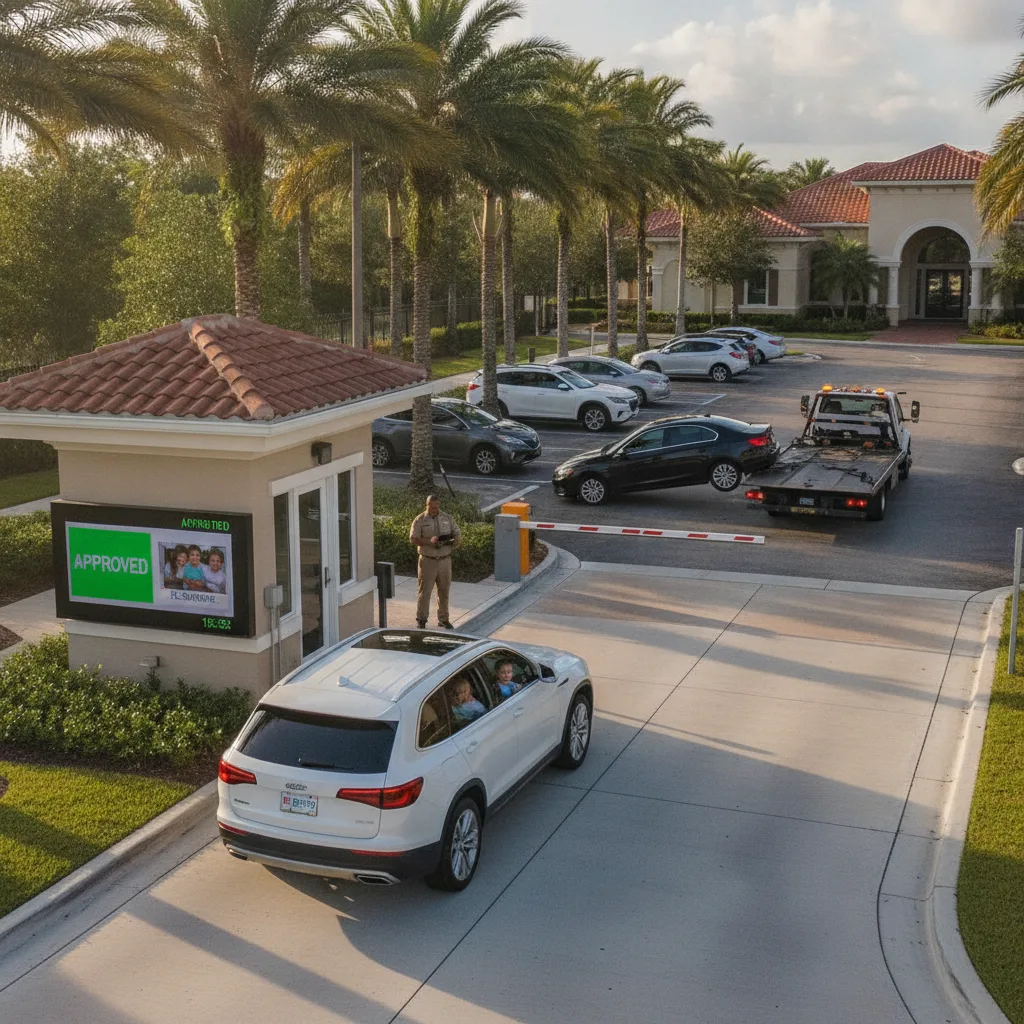
Direct answer: In Florida associations, visitor parking abuse is often a tenant or short-term-guest problem wearing a “visitor” label — an investor-owned unit’s renter treating a friend’s extended stay as a guest visit, or a property manager for an absentee owner not knowing the community’s visitor rules at all. Tie visitor authorization to the actual resident of record for that unit, not just to whoever is physically present to sponsor a guest, and keep a documented exception path for hurricane-season evacuee overflow.
This guide is for Florida association boards, managers, and parking committees dealing with a resident mix that includes seasonal owners, investor-owned rentals, and short-term occupants — a pattern that’s more common in Florida than in most other states and changes how visitor parking actually gets abused.
Why “visitor” is a harder category in Florida
A large share of Florida association units are owned by people who aren’t the day-to-day resident — long-term tenants, seasonal owners, or short-term rental guests where local rules allow it. That changes the visitor-parking problem in a specific way: the person sponsoring a “guest” may not be the owner on file, may not know the community’s visitor limits, and may be gone by the time a dispute needs resolving. A tenant’s out-of-town friend staying two weeks gets logged as a guest, but there’s no clear sponsor accountable for that vehicle once the tenant’s lease ends or the owner is unreachable.
Example: A unit is leased to a tenant who allows a relative to stay in the unit’s second bedroom “temporarily.” The relative’s car sits in guest parking for six weeks. Is this a guest, a co-occupant who should be registered as a resident, or an unauthorized long-term parker? The answer depends on the lease and the association’s occupancy rules, not on how long the car has been parked — and getting that answer requires knowing who the unit’s actual resident of record is, which starts with the owner or property manager, not the tenant.
Building the classification around the unit, not the vehicle
| Decision point | Evidence or control | Required response |
|---|---|---|
| Unit status | owner-occupied, tenant-occupied, seasonal-vacant, short-term rental (if permitted) | determines who can sponsor and who’s accountable |
| Visit type | short guest, recurring caregiver, co-occupant, resident overflow | classify use before applying a fine |
| Authorization | sponsor of record, vehicle, dates, expiry | confirm against current owner or property-manager contact, not just the tenant |
| Outcome | exception, notice to owner (not just occupant), reviewer | close the case with the accountable party notified |
The hurricane-season exception
Florida associations need a documented, pre-approved exception path for evacuee overflow parking during storm events — family members or neighbors from elsewhere in the state temporarily parking in a community ahead of or after a storm. Deciding this policy in the middle of an active evacuation is how good-faith exceptions turn into precedent disputes later (“you let them park for free in September, why not us in November”). Set the trigger conditions, duration, and required documentation before hurricane season, not during it.
Sequencing daily enforcement
- Confirm unit status before classifying a vehicle — owner-occupied, tenant, or vacant seasonal changes who the accountable sponsor is.
- Classify the visit using consistent categories, independent of how the resident describes it themselves.
- Validate against the owner or property manager of record, not just whoever is on-site, especially for tenant-occupied and investor-owned units.
- Notify the accountable party — typically the owner, per most Florida governing documents, even when the violation involves a tenant’s guest.
What still needs qualified review
Florida’s condominium and homeowners’ association statutes, along with each community’s declaration, govern notice requirements, hearing rights, towing procedures, and how violations by tenants get charged back to owners. These vary by community type and get updated by the legislature periodically. Treat this page as an operational framework for building the classification and evidence process — confirm current notice and towing requirements with the association’s counsel before finalizing enforcement policy. Our guide on managing unauthorized commercial vehicles in Florida associations covers a closely related enforcement category worth aligning with the same policy.
Running a bounded pilot
Test the unit-status-first classification approach on a mix of owner-occupied and tenant-occupied units before rolling it community-wide, since that’s where the real complexity is. Track how many visitor cases correctly identify the accountable sponsor on the first pass, how many require chasing down an absentee owner or property manager, and how many recurring visits (caregivers, co-occupants) get misclassified as short-term guests. If accountable-party lookups keep stalling enforcement, that’s the process gap to fix before expanding.
Related PLACA.AI planning resources
Practical questions
Who is accountable when a tenant’s guest violates visitor parking rules?
Most Florida governing documents hold the unit owner accountable even when a tenant’s guest caused the violation, so notice should typically go to the owner or property manager of record, not just the occupant. Confirm the specific requirement in your declaration with counsel.
How should we handle a co-occupant who isn’t on the lease or deed?
Treat it as a registration question first — is this person actually living there and should be registered as a resident — rather than defaulting to “guest” for someone who has effectively moved in.
Should hurricane evacuee parking be handled case by case?
No. Set the trigger conditions, allowed duration, and documentation requirements before hurricane season so the exception is applied consistently and doesn’t become an ad hoc precedent dispute later.
Plan a limited workflow review
Bring the current rule, process, exceptions, and success criteria for reducing visitor parking abuse in Florida associations. PLACA.AI can help evaluate a bounded pilot without assuming another property’s workflow is the right answer.
Editorial refresh: September 18, 2026. Independently confirm current product capabilities, third-party features, pricing, contracts, governing requirements, and local rules before acting.
Data source: Community Associations Institute