

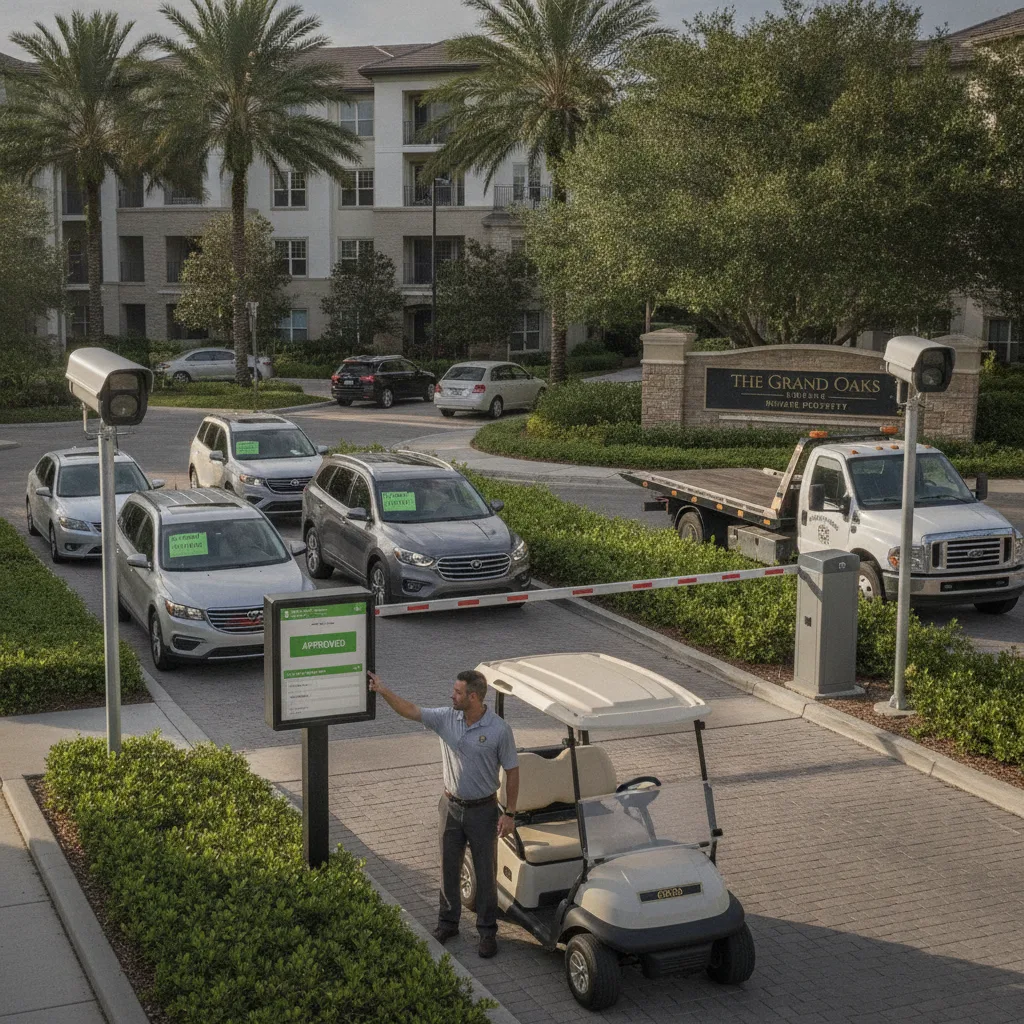
Direct answer: In a gated community, an overnight parking file is only as strong as the connection between the guard-gate log and the parking observation itself. Pair every overnight violation with the gate entry (or lack of one) for that plate, and reconcile guard shift handoffs so a vehicle that entered on one shift isn’t documented as a fresh violation by the next.
This guide is for gated-community boards, on-site or contracted guard staff, and patrol teams who document overnight parking violations where entry is already gated and logged. The extra step here, compared to an open community, is that you already have an access record — the question is whether anyone is actually using it.
A gate log and a parking violation are two different records
Gated communities generate a resource most open HOAs don’t have: a timestamped entry log tied to a plate, a resident sponsor, or a call-ahead authorization. The mistake is treating gate entry and parking legality as the same fact. A vehicle waved through at 9 p.m. by a guard on a call-ahead list has permission to be inside the gate — it doesn’t automatically have permission to occupy a specific overnight space, a fire lane, or a spot reserved for a different unit. Overnight parking enforcement in a gated community has to join two separate records: the gate event and the space-level observation, with both timestamps and the guard or sponsor who authorized entry.
Where the guard-shift handoff breaks the record
The most common documentation gap in gated communities isn’t a missing photo — it’s a shift change. A vehicle that entered at 11 p.m. under first-shift guard notes can get logged as an unexplained overnight presence by the second-shift patrol at 3 a.m. if the handoff notes weren’t passed along or weren’t checked. Before treating any overnight case as unauthorized, cross-reference the gate log for that plate across the full window, not just the shift during which the violation was observed. If the gate system and the parking-enforcement log are two different tools that don’t talk to each other, someone on your team has to manually reconcile them every morning, and that reconciliation step is exactly where cases get either wrongly excused or wrongly escalated.
LPR cameras positioned at the gate itself can close this gap by tying every entry event to the same plate record used for overnight space monitoring, which is the core advantage gated communities have over open developments if the systems are actually connected rather than run in parallel. Our gate access control overview and guide to LPR cameras for gated communities go deeper on hardware placement for this specific use case.
What the overnight case file needs
- Gate entry timestamp, sponsoring resident (if applicable), and the guard or system that authorized access.
- Two space-level observations of the vehicle inside the restricted overnight window, with wide-context images showing the actual space, not just the plate.
- Confirmation that the gate log and the parking log were reconciled for that shift — not assumed to match.
- Permit or unit-assignment status for that space at the time of the violation.
- The disposition and who signed off, since gated communities often have contracted guard staff who aren’t authorized to make the final enforcement call themselves.
Building the process
- Confirm gate authorization. Pull the entry record for the plate before assuming the vehicle is unauthorized — it may simply be misparked, not uninvited.
- Establish the overnight event. Two timestamped observations in the specific space, correlated against the gate timestamp.
- Reconcile shift handoffs. Confirm the case wasn’t already noted or excused by the prior shift before escalating.
- Route to a named reviewer. Guard staff document; a manager or board-delegated reviewer decides, since contracted guards typically shouldn’t be the final word on a resident fine.
When to stop and hand off
Stop before escalating when the gate log is missing, the shift handoff wasn’t confirmed, the space boundary is disputed, or the vehicle belongs to a documented service provider whose visit wasn’t logged correctly at the gate. Those go to a reviewer who can pull both records side by side, not to whoever is on patrol that night. Where the case involves a vendor or contractor with recurring gate access, our guide on stopping guest permit sharing in gated communities covers a closely related authorization problem worth solving alongside this one.
Running a bounded trial
Before rolling a joined gate-and-parking process out across the whole community, run it for a defined window and track how many overnight cases came with a complete, reconciled file on the first pass; how many required manually pulling gate logs after the fact; and how many appeals were resolved from the record instead of a guard’s memory of the night. If reconciliation is still a manual, error-prone step after the trial, that’s the signal to connect the gate and parking systems before expanding enforcement, not after.
Related PLACA.AI planning resources
Operational FAQs
Does a valid gate entry excuse an overnight parking violation?
No. Gate entry proves the vehicle was authorized to be inside the community; it doesn’t prove the vehicle was authorized to occupy a specific overnight space. The two need to be documented and reviewed separately, then joined in the case file.
How do we handle a case that spans a guard shift change?
Reconcile both shifts’ notes and the gate log for that plate before treating it as a fresh violation. A vehicle noted or excused on the prior shift shouldn’t be re-escalated by the next shift without checking.
Who should make the final enforcement decision?
A manager or board-delegated reviewer, not the guard on duty. Guard staff are well positioned to document; final disposition on a resident fine typically needs someone with that authority under the community’s governing documents.
Plan a limited workflow review
Bring the current rule, process, exceptions, and success criteria for documenting overnight parking violations for gated communities. PLACA.AI can help evaluate a bounded pilot without assuming another property’s workflow is the right answer.
Editorial refresh: September 18, 2026. Independently confirm current product capabilities, third-party features, pricing, contracts, governing requirements, and local rules before acting.
Data source: Community Associations Institute