

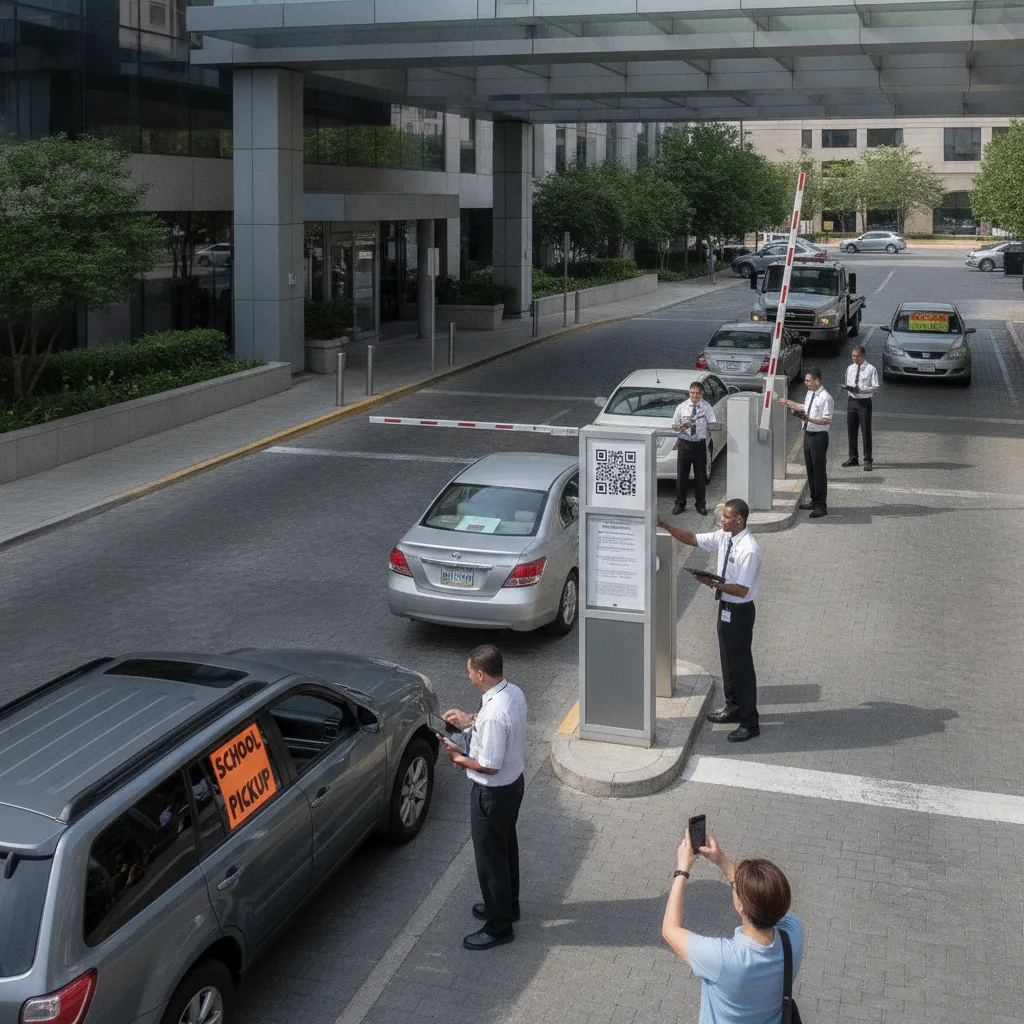
Direct answer: Launch scan-and-pay by connecting every QR sign to the correct parking area, rate, validation rule, plate field, receipt, and enforcement entitlement. Test the journey as a first-time guest before removing another payment option.
This guide is for hotel parking managers, finance teams, front-desk staff, guests, and enforcement providers and addresses launching scan-and-pay parking at a hotel. Use actual site conditions, current records, and responsible roles.
Locate the real bottleneck
A QR code can open a payment page while still failing the operating journey through wrong zones, weak connectivity, confusing validations, or delayed enforcement data.
Example: A guest scans in a garage, applies a front-desk validation, and enters a rental-car plate. Each step must resolve to the same stay and enforcement record.
Hotel scan-and-pay journey test
| Decision point | Evidence or control | Required response |
|---|---|---|
| Discovery | sign placement, lighting, language, accessibility | make the correct code obvious |
| Checkout | zone, rate, duration, plate, payment | prevent silent entry errors |
| Validation | hotel eligibility and discount rule | confirm before payment completes |
| Enforcement and receipt | entitlement timing and proof | support correction and review |
Document the handoffs
- Step 1. Review discovery: sign placement, lighting, language, accessibility; then make the correct code obvious.
- Step 2. Review checkout: zone, rate, duration, plate, payment; then prevent silent entry errors.
- Step 3. Review validation: hotel eligibility and discount rule; then confirm before payment completes.
- Step 4. Review enforcement and receipt: entitlement timing and proof; then support correction and review.
Keep changes and exceptions in the same accountable history.
Exception route
Offer a documented alternative when the guest lacks a compatible phone, payment method, signal, accessibility path, or ability to complete the flow.
Correct the record, approve a bounded exception, deny under the documented rule, or escalate to the named authority; do not leave the case open-ended.
Pilot measurement plan
Choose measurements before seeing the result.
- scans reaching successful payment
- zone or plate corrections
- validation failures
- paid sessions visible to enforcement
- front-desk support cases
Define who counts each measure, the observation period, and the result that prevents expansion.
Sign-off criteria
- State the purpose and non-goals for launching scan-and-pay parking at a hotel.
- Assign owners for the normal path, correction, exception, and final approval.
- Test live conditions with the people who administer and experience the workflow.
- Confirm contracts, pricing, integrations, support, data handling, and governing requirements independently.
- Retain the evidence needed to reproduce an approval, denial, correction, or escalation.
Related PLACA.AI planning resources
Questions to resolve
What should be approved first for launching scan-and-pay parking at a hotel?
Approve the purpose, responsible owner, decision rule, required evidence, and exception path before selecting a broad rollout.
What should the pilot prove?
The pilot should reproduce the normal path and the exception described above, while collecting scans reaching successful payment and the other named measures.
When should implementation stop?
Stop when the required evidence is unavailable, ownership is unclear, a serious exception has no safe route, or the actual result conflicts with the approved rule.
Plan a limited workflow review
Bring the current rule, process, exceptions, and success criteria for launching scan-and-pay parking at a hotel. PLACA.AI can help evaluate a bounded pilot without assuming another property’s workflow is the right answer.
Editorial refresh: July 22, 2026. Independently confirm current product capabilities, third-party features, pricing, contracts, governing requirements, and local rules before acting.
Data source: U.S. Department of Transportation