
Direct answer: Most of what goes out over a school’s dismissal radio channel is not urgent — it’s routine status (“car’s here for Emma,” “lane two is backed up,” “ready at the curb”) that could move to a shared, silent system instead. The fix isn’t buying more radios or telling staff to talk less; it’s separating the two kinds of information that dismissal actually produces. Routine arrival-and-release status belongs in a system everyone can glance at. Radio should be reserved for the handful of things that genuinely need a human voice right now — a hazard, an unrecognized adult, a missing student, a safety call.
This guide is written for any K-12 campus — elementary, middle, or high school — where dismissal runs on a mix of radios, walkie-talkies, and staff shouting across a parking lot. The specific fix will look different at a 300-student elementary campus than at a 1,800-student high school, but the underlying problem and the underlying solution are the same.
Why dismissal radio traffic gets loud everywhere
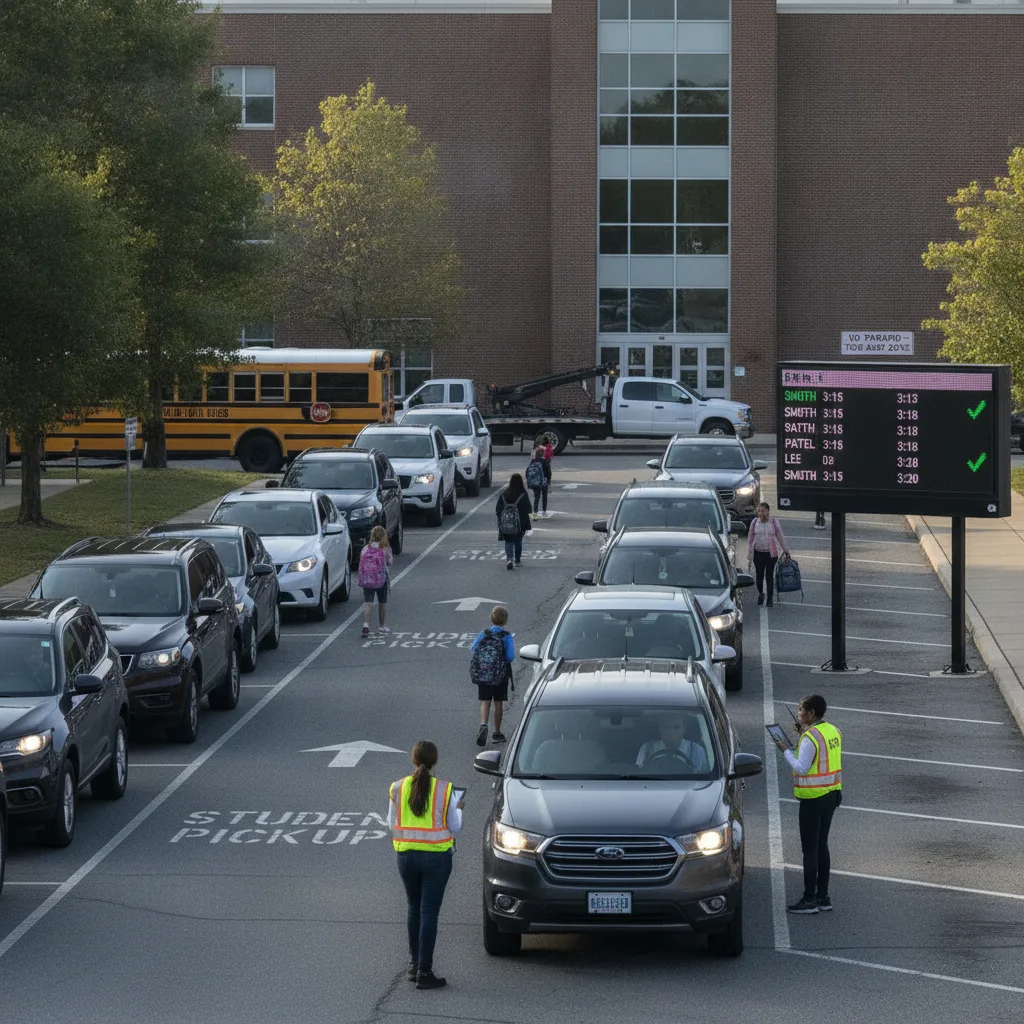
Dismissal compresses a lot of small decisions into a short window: which student is being released to which car, whether a lane is clear to move, whether a particular child has been located yet, whether a bus is running late. At most schools, all of that gets narrated on the same radio channel that would also carry a real emergency — a fight, a medical event, an unfamiliar adult near the building, a student who can’t be found. When routine narration and emergency traffic share one channel, two things happen. Staff start talking over each other or waiting their turn to report something mundane, and the channel gets noisy enough that an important call is easy to miss or slow to react to.
Example: A dismissal monitor keys the radio to say a car has arrived for a student in room 12. Thirty seconds later, another staff member needs the channel to report a student wandering away from the pickup line toward the street. If the first call is still tying up the channel, or if the second call sounds routine because everything on that channel usually is, the response is slower than it needs to be.
Separate the routine from the real exception
| Type of event | Examples | Where it should go |
|---|---|---|
| Routine status | Vehicle arrived, student ready, lane clear, car released | Shared system or sign, updated silently as it happens |
| Operational exception | Wrong lane, duplicate pickup attempt, delayed student, vehicle not on file | Routed to the staff member who owns that decision, not broadcast to everyone |
| Safety escalation | Unknown or unauthorized adult, missing student, hazard, medical event | Radio, immediately, with priority over everything else on the channel |
What this looks like at different school sizes
A smaller elementary campus usually has one or two dismissal lanes and a handful of staff, so the fix can be as simple as a shared clipboard app or a quiet visual signal at the curb that tells a monitor a student is confirmed and ready — no radio call needed unless something’s wrong. A larger middle or high school with multiple lanes, a bus loop, and dozens of staff spread across a bigger footprint needs the same principle applied more formally: a shared system that every lane monitor can check, so a routine “ready” doesn’t have to travel by voice across a much bigger campus. The carline automation overview covers what replacing radio-based coordination with a shared system typically involves at either scale. Comparing plate-based verification specifically against QR-code or app check-in systems, which some campuses use for the same problem, is covered in the plate recognition vs. QR code comparison.
Don’t automate away the parts that actually need a person
The failure mode on the other side is just as common: a school moves everything to an app or a silent system and loses the ability to react fast when something is genuinely wrong. Automating routine status is not the same as automating judgment. A staff member still needs to be the one who decides a vehicle is legitimately unrecognized, that a student hasn’t shown up where expected, or that a situation needs an immediate radio call rather than a system note. Build the process so the shared system handles the paperwork of dismissal and radio stays reserved for decisions a person actually has to make in the moment.
A practical starting point
- For one week, have staff tag every radio call during dismissal as routine, exception, or safety — no other change yet. Most schools find the majority fall into the first category.
- Move only the routine category to a shared system or visual signal first. Leave exceptions and safety calls on radio.
- Run at least one dismissal with a real exception (a lane blockage, a delayed student, a vehicle mismatch) and one drill or tabletop safety scenario to confirm the radio channel is still fast and clear when it matters.
- Expand to additional lanes or grade levels only after that test, not before.
What to check before expanding campus-wide
- routine transmissions actually removed from the radio channel, not just reduced
- exceptions reaching the right staff member without a full-channel broadcast
- a genuine safety call getting immediate priority, verified with a real test, not just a policy statement
- staff at every dismissal role — teachers, aides, volunteers, office staff — actually trained on the new signal, not just the people who designed it
- no student left unaccounted for at the final bell because a routine status update got lost in the change
Related PLACA.AI planning resources
Implementation questions
What’s the first decision for reducing radio overload at a K-12 campus?
Sort current radio traffic into routine, exception, and safety categories for one real dismissal before changing anything, so the fix targets what’s actually clogging the channel instead of a guess.
What belongs in the pilot?
A normal dismissal, one operational exception (a delayed student or a lane problem), and one safety scenario or drill, so the channel is tested under both ordinary and urgent conditions before wider rollout.
When should rollout pause?
If a genuine safety call is slowed down, delayed, or missed during testing, if staff can’t reliably tell routine from urgent under the new system, or if any student’s status becomes unclear at dismissal close.
Plan a limited workflow review
Bring the current radio habits, staffing, and dismissal layout for your campus. PLACA.AI can help evaluate a bounded pilot for separating routine dismissal status from radio-worthy exceptions, without assuming your campus needs the same setup as a different school.
Editorial refresh: September 18, 2026. Independently confirm current product capabilities, third-party features, pricing, contracts, governing requirements, and local rules before acting.
Data source: National Center for Education Statistics