

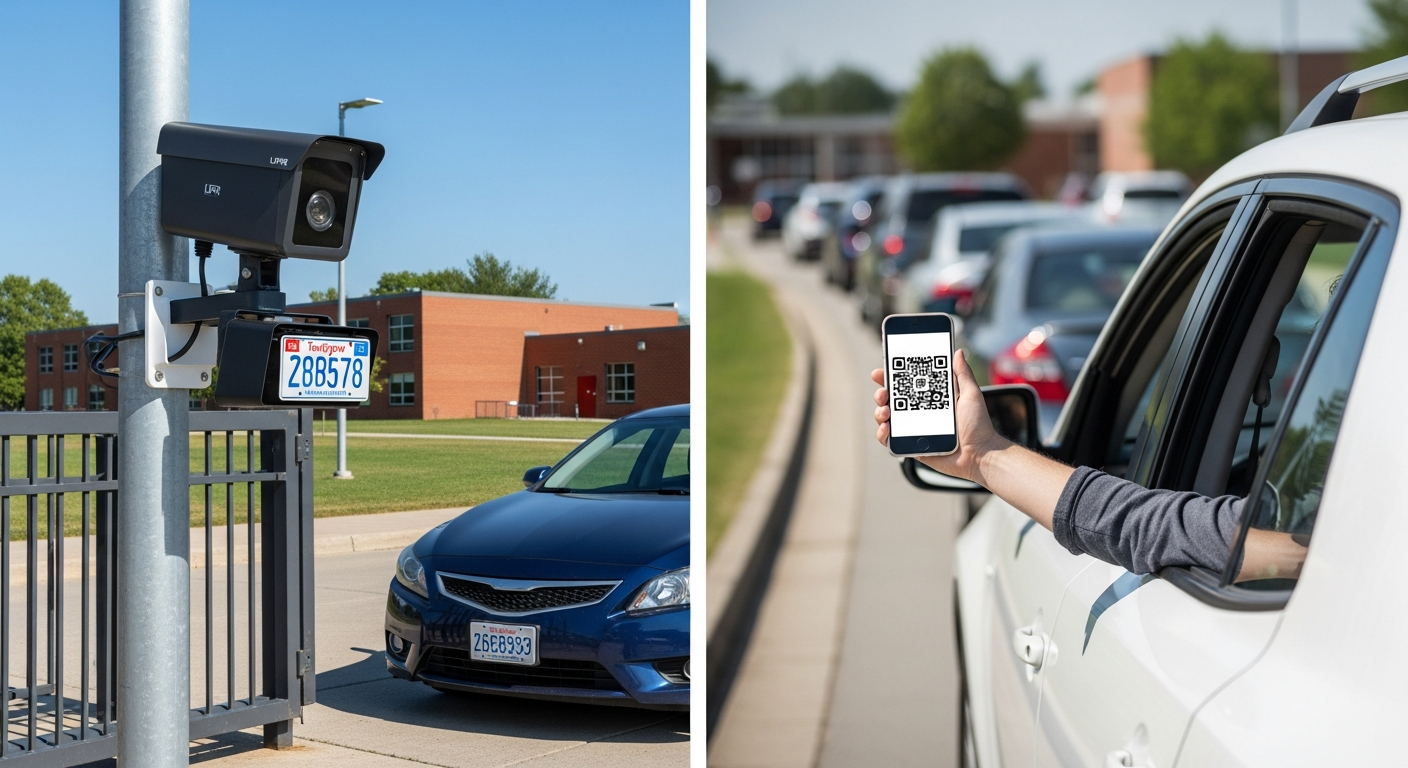
license plate recognition vs QR code school pickup
License Plate Recognition vs QR Code School Pickup Systems
Both technologies work. The right one depends on your school’s budget, infrastructure, and parent population. Here’s the honest comparison.
Compare Pickup Options for Your School
In This Article
When schools evaluate modern pickup systems, two identification technologies dominate the conversation: license plate recognition (LPR) and QR codes. Both can replace paper carline lists and radio calls. Both can feed a staff-controlled approval workflow. Both are in active use at K-12 schools today.
But they are not the same, and the differences matter – for your budget, your infrastructure, your parent population, and your staff workflows.
This guide gives you a straight comparison so you can make the right call for your school, or understand why a modern pickup platform may offer both options and let you choose.
How Each Technology Works
License Plate Recognition (LPR)
A fixed or mounted camera captures the vehicle’s license plate as it enters the pickup zone. Computer vision software reads the plate characters and matches them against a database of registered vehicles linked to authorized students.
QR Code Pickup
A parent or authorized adult displays a unique QR code on their phone or printed card. A staff member or kiosk scanner reads the code, which is linked to the authorized pickup record in the system’s database.
In both cases, the underlying goal is the same: identify the arriving vehicle or person, surface the linked student and authorization data, and enable a staff member to approve the release. The difference is entirely in how identification happens and what’s required to make it work.
Head-to-Head Comparison: 12 Dimensions
| Dimension | LPR | QR Code |
|---|---|---|
| Hardware Required | Fixed camera(s), mounting, weatherproofing, power | Staff handheld scanner or kiosk; no fixed infrastructure |
| Parent Action | Register plate(s) once; no action needed at pickup | Open app or display card at pickup window each time |
| Speed in Line | Fastest – identification before the car reaches staff | Slightly slower – requires a scan interaction |
| Works Without Smartphone | Yes – plate is always on the car | Partially – printed QR cards available as fallback |
| Handles Rental / Borrowed Cars | Challenging – unregistered plates trigger exceptions | Yes – QR is tied to the person, not the vehicle |
| Privacy Footprint | Captures and stores vehicle plate data (see FERPA note) | No passive data capture; scan is initiated by user |
| Setup Complexity | Higher – requires physical installation and calibration | Lower – software-only; app download or card print |
| Works in Rain / Low Light | Quality varies by camera; IR cameras handle low light better | Yes – scan works regardless of lighting conditions |
| Handles Multiple Vehicles Per Family | Each plate must be registered separately | One QR per authorized adult, any vehicle |
| One-Time Guest Authorization | Limited – plate must be pre-registered | Yes – parent sends a single-use QR digitally |
| Audit Trail Detail | Plate, timestamp, matched student, staff approval | QR identity, timestamp, matched student, staff approval |
| Upfront Cost | Higher – hardware investment per lane | Lower – app and web-based, minimal hardware |
When LPR Is the Better Choice
License plate recognition is the right primary technology when:
- Volume is high and speed is critical. If you’re dismissing 600+ students in 25 minutes across 4+ lanes, LPR’s pre-identification capability – where the system has already matched the plate before the car reaches the attendant – saves 5-8 seconds per vehicle that add up to significant throughput gains.
- You want zero parent action required at pickup. LPR is the most seamless experience for parents. No app to open, no card to display. Drive in, and the system handles everything.
- Your parent population has low smartphone adoption. LPR works regardless of whether the parent has a smartphone – the plate is always on the car.
- You have secure infrastructure funding. Camera installation, mounting, weatherproofing, and calibration involve upfront cost. Title I schools or those with constrained capital budgets may find QR more accessible as an entry point.
- You want passive monitoring capability. LPR cameras capture every vehicle in the zone, giving administrators a visual and data record of all traffic – not just authorized pickups.
High-quality LPR systems achieve 95-99% read accuracy under normal conditions. Accuracy drops with damaged, obscured, or specialty plates. Any LPR deployment should have a clear exception workflow for unread plates – typically a manual staff override or QR fallback.
When QR Codes Are the Better Choice
QR code identification is the right primary or supplementary technology when:
- Budget is a primary constraint. QR-based systems typically require no fixed hardware beyond a handheld scanner. This makes them accessible for schools with limited capital budgets or that need a system in weeks, not months.
- Your families use many different vehicles. Ride-sharing pickups, grandparent cars, neighbor cars, carpool arrangements – if a high percentage of your pickups involve vehicles that aren’t the parent’s primary car, QR codes handle this natively since the code travels with the person, not the plate.
- One-time guest authorizations are frequent. Parents can send a single-use QR to a grandparent for a one-time pickup, which the grandparent displays at the window. No pre-registration of a vehicle plate required.
- Privacy concerns are elevated. Some districts and states are increasingly attentive to vehicle data capture and retention. QR systems have a smaller passive data footprint – no data is captured unless the adult initiates a scan.
- You need rapid deployment. A QR system can be live school-wide in a week. An LPR deployment may take 4-8 weeks including site survey, camera installation, and calibration.
Learn more about how parents interact with QR-based authorization in the parent pickup request app overview.
The Case for a Hybrid Approach
Most schools that have deployed pickup technology for more than a year end up in the same place: they want both.
Regular Pickup Flow (LPR)
The 85% of pickups that happen in the parent’s registered vehicle are handled automatically via plate recognition. Fast. Zero friction. No parent action.
Exception and Guest Flow (QR)
Grandparent pickups, borrowed cars, carpool adults – all handled via QR. Parent sends a digital code or the adult displays their registered QR. Staff scans and approves.
A well-designed platform supports both identification modes on the same staff dashboard. The staff member sees the same approval interface regardless of how the vehicle was identified – the underlying workflow, audit trail, and parent notification are identical. Explore the full feature set in the school pickup line platform overview.
When LPR is your primary method and QR is your fallback, you eliminate the two biggest failure modes: unregistered vehicles (handled by QR exception flow) and forgotten QR codes (handled by LPR reading the plate). Your dismissal system has no single point of failure.
Cost Comparison and ROI
| Cost Factor | LPR | QR Code |
|---|---|---|
| Hardware (per lane) | $800-$3,000+ (camera, mount, cabling) | $50-$200 (handheld scanner or tablet) |
| Installation | $500-$2,000 per site | Minimal; plug-and-play devices |
| Software / SaaS | Annual subscription (varies by vendor) | Annual subscription (typically lower base) |
| Parent Onboarding Time | 5 min (register plate once) | 5 min (download app / receive card) |
| Staff Training | 2-4 hours (dashboard + exception flows) | 1-2 hours (scan workflow) |
| Maintenance | Camera cleaning, calibration checks | Minimal |
| ROI Timeline | 12-18 months (staff time saved on line management) | 4-8 months (lower hardware cost) |
When evaluating ROI, include the cost of the current system: radio equipment, printed lists, staff hours spent manually calling classrooms, and the exposure from incidents that occur without a documented release record. Most schools find the net cost of modernization is lower than they expect when these factors are included.
The school pickup pilot program provides a structured way to evaluate both technologies with real data from your school before committing to a full deployment.
Not Sure Which Fits Your School?
Get a comparison walkthrough tailored to your school’s size, budget, and current process. We’ll help you determine whether LPR, QR, or a hybrid deployment makes the most sense.
Frequently Asked Questions
Related Resources
Data reference: National Center for Education Statistics
Related School Pickup Planning Resource
If you are still deciding whether your current process is ready for LPR, QR codes, or a hybrid model, review the 10 signs your school pickup line needs a better system before choosing technology.
Related planning resource: one-lane pilot to compare pickup technology options.
Related planning resource: accountability benefits of LPR in school pickup.
Related planning resource: how schools verify authorized vehicles during pickup.
Related planning resources: LPR for school car lines, camera placement for school pickup lines and paper car tags versus modern dismissal.