

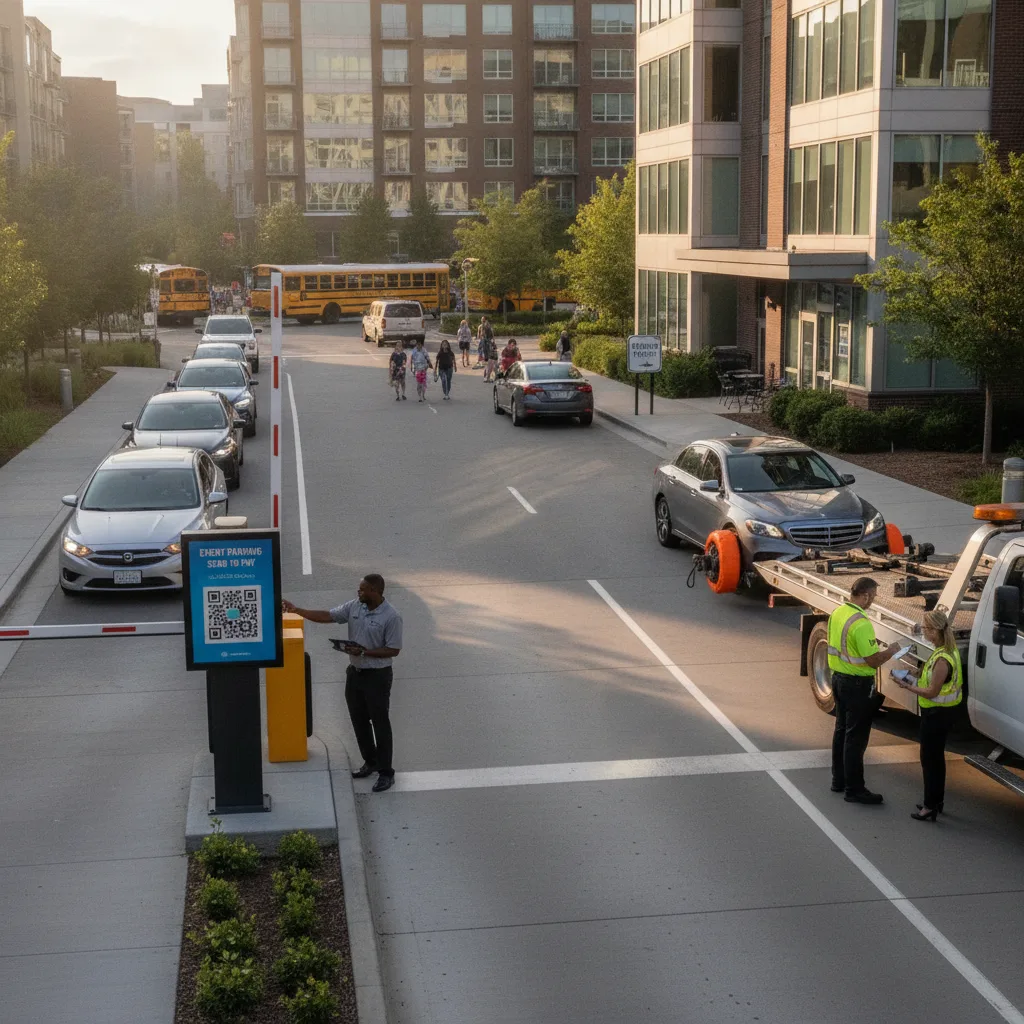
Direct answer: A mixed-use property that wants to sell prepaid event parking — for a farmers market, a holiday pop-up, an outdoor concert, or a retail promotion held on or near the property — is temporarily repurposing spaces that residents, office tenants, and retail customers already rely on every other day of the week. The hard part isn’t taking a prepayment; it’s making sure the standing tenant population isn’t the one who discovers the change by finding their usual space occupied. The system needs to treat an event window as a temporary override of the normal access rules, with a clear start and end, not a permanent new rule layered on top of the existing ones.
This guide is for mixed-use property owners and community or commercial managers coordinating occasional event parking on a property that otherwise runs standing resident, office, and retail access every day.
Event prepayment competes with standing tenant access, by definition
Unlike a dedicated event venue, a mixed-use property doesn’t have spare capacity sitting idle waiting for event demand — the spaces available for prepaid event parking are the same spaces residents park in overnight, office tenants use on weekdays, and retail customers use during business hours. Selling prepaid event parking without protecting standing access means the property is effectively overselling its own capacity for the event window, and the people who find out the hard way are the residents who can’t find their usual space when they get home.
The property needs a clear answer, before selling a single prepaid space, to which specific spaces are available for the event, during exactly which hours, and what happens to a resident or tenant whose regular space falls inside that zone during the event window. Some properties handle this by designating a specific event-only zone that’s separate from assigned tenant spaces; others rotate which section is available based on which use case has lower demand during the particular day and time of the event (a weekday daytime event can draw on evening-peak retail spaces that are empty at that hour, using the same complementary-peak logic that makes mixed-use shared parking work in the first place).
Page-specific example: Simulate a Saturday afternoon event that draws on spaces normally used by retail customers (which peak differently on weekends) rather than resident-assigned spaces. Confirm the prepayment system correctly releases those spaces back to standing retail access once the event window closes, rather than leaving them locked to the expired event session and effectively removed from the property’s regular capacity for the rest of the day.
Mixed-use event prepayment: protecting standing access during the event window
| Situation | What typically breaks | What to confirm before selling prepaid passes |
|---|---|---|
| Event zone overlaps resident spaces | A resident returns to find their assigned space sold as event parking | Event-available spaces are drawn from a designated zone that excludes assigned resident spaces |
| Event runs long | Prepaid session extends past its window into the next tenant-use period | A clear end-of-event release process, not an open-ended session |
| Event is canceled or postponed | Prepaid guests have no clear refund path and show up anyway | A defined refund and communication process tied to the specific event date |
| Multiple simultaneous events | Two event bookings unknowingly draw on the same physical spaces | A single source of truth for which spaces are already committed to which event |
Communicating the change to tenants before the event, not during it
Because the spaces being sold for an event are otherwise standing tenant capacity, residents and office or retail tenants need advance notice of exactly which zone and hours are affected — not a blanket “expect changes on event days” notice that leaves them guessing whether their specific space is involved. This is often a coordination point between whoever is selling the event parking (which might be a third-party event organizer, not property staff at all) and the property manager who actually knows the day-to-day tenant access patterns well enough to say which spaces can safely be set aside.
What belongs in a pilot
Pilot this with a single, lower-stakes event first — a smaller pop-up or market rather than the property’s highest-demand event — and track whether any standing tenant reported losing access to their regular space, whether the event zone correctly released back to normal access at the stated end time, and how a cancellation or schedule change was communicated and refunded. A workable pilot produces zero tenant access complaints and a clean release of event spaces back to standing use.
Before running larger or recurring events
- Confirm the exact zone and hours available for event parking are documented and don’t overlap assigned resident or reserved tenant spaces.
- Verify a clear refund process exists for event cancellation or postponement, and that prepaid guests are notified proactively.
- Check whether the event requires a local permit and whether that permit specifies parking or traffic requirements independently.
- If a third-party event organizer is selling the passes, confirm who owns tenant-access disputes that arise from the event.
- Retain a record of which spaces were committed to which event to prevent double-booking across simultaneous events.
Related PLACA.AI planning resources
Questions mixed-use property owners ask
How do we make sure residents don’t lose their usual spaces during an event?
Draw event-available spaces from a designated zone that excludes assigned resident spaces, and communicate the exact zone and hours to residents in advance.
What happens if the event runs longer than planned?
Build a defined release process for the end of the event window rather than an open-ended session, so spaces don’t stay locked to an expired event past its scheduled end.
Do we need new equipment to run occasional event parking?
No — this is about how existing access rules are temporarily overridden for a defined zone and window, not about adding gates or kiosks for occasional use.
Plan a limited workflow review
Bring your property’s tenant access map, a specific upcoming event’s expected timing, and any third-party event organizer agreement. PLACA.AI can help evaluate a bounded pilot without assuming standing tenant access can simply be set aside for event revenue.
Editorial refresh: September 18, 2026. Independently confirm current product capabilities, third-party features, pricing, contracts, governing requirements, and local rules before acting.
Data source: U.S. Department of Transportation