

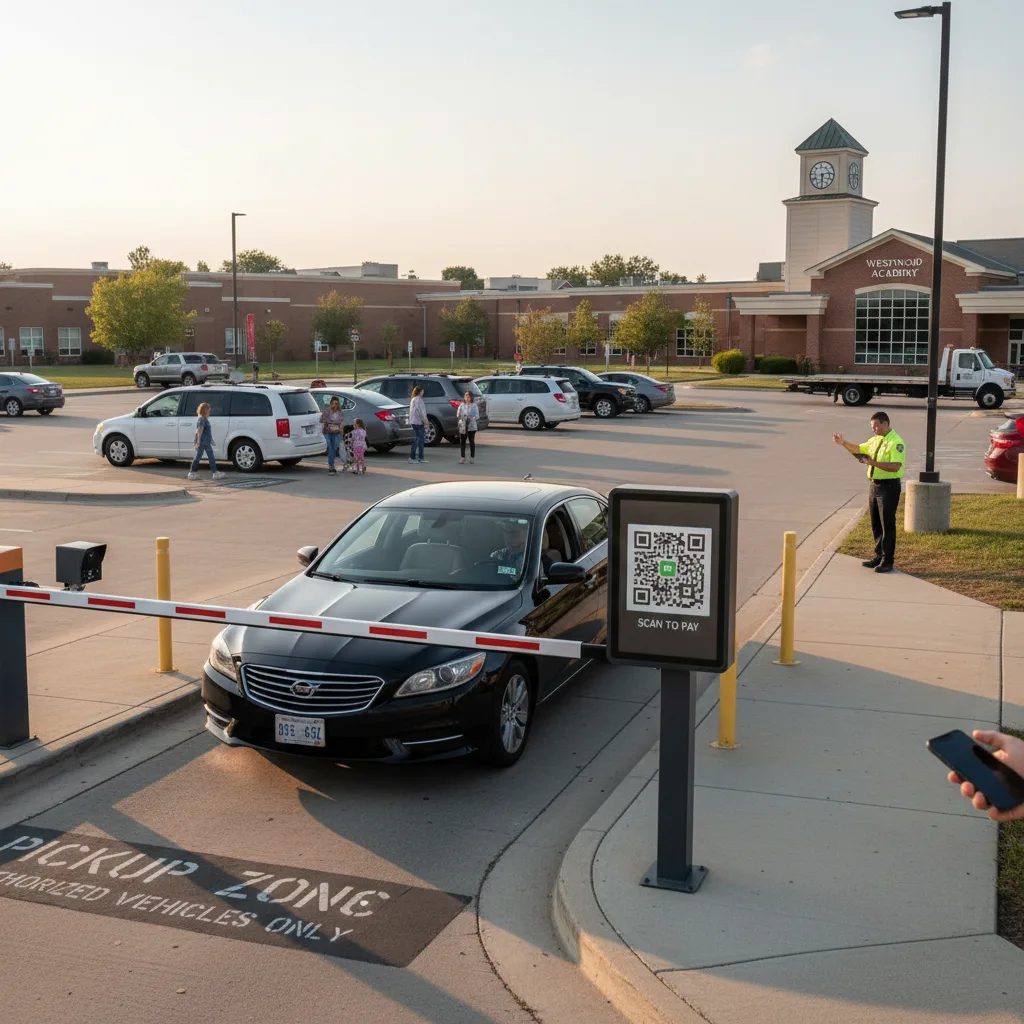
Direct answer: LPR and QR auto-pay solve two different problems, and combining them means treating them as two independent evidence sources reconciled around a plate number — not one system bolted onto the other. QR auto-pay captures a driver’s self-reported plate at the moment they choose to pay; LPR independently captures a camera read of whatever plate is actually present at the entrance, drive aisle, or space, at whatever confidence the camera achieves under current lighting and weather. The hybrid model’s value is that a driver can pay without a gate, ticket, or attendant, while LPR gives enforcement and access control a source of truth that doesn’t depend on the driver having entered anything correctly. Get the reconciliation logic right — matching, confidence thresholds, and what happens on a mismatch — and you can run a lot with no new hardware beyond cameras you may already have for security or access.
This guide is for parking operators evaluating whether to add QR-based payment on top of an existing or planned LPR deployment, without installing gates, ticket dispensers, or per-space sensors.
Two data sources, one plate number
The mistake operators make most often is assuming QR auto-pay and LPR are the same kind of data once a plate number connects them. They aren’t. A QR payment record says a driver intended to pay for a specific plate at a specific time — it’s a self-reported, high-intent, low-friction signal. An LPR read says a camera observed a specific plate at a specific location and time, with a confidence score attached — it’s an independently verified, but occasionally wrong, signal. The hybrid model works when the system treats agreement between the two as strong evidence, and disagreement as a case for a defined fallback, rather than assuming one source is always right.
Example: A driver pays via QR and enters their plate as “8CDE123” with a typo, while the LPR camera correctly reads “BCDE123” off the actual vehicle. Neither record is fraudulent — one is a data entry error. A hybrid system that treats any mismatch as unpaid will generate a false enforcement action against a driver who did pay; a system with no reconciliation logic at all will let the typo go unnoticed until a dispute arrives.
What each source proves
| Source | What it proves | What it doesn’t prove |
|---|---|---|
| QR payment record | A payment was made and a plate was entered by the driver | That the entered plate matches the vehicle actually parked |
| LPR camera read | A specific plate was physically observed at a location and time | Whether that vehicle’s driver has paid or is authorized |
| Both combined, matched | A paid session tied to a vehicle actually on site | Nothing further – this is the strong case |
| Both combined, mismatched | Something needs review: typo, stale entry, or unpaid vehicle | Which of those three it is, without a defined fallback |
Building the reconciliation logic
- Normalize before matching. Strip spaces, standardize letter/number ambiguity (O versus 0, I versus 1), and apply the same normalization to both the QR-entered plate and the LPR read before comparing them. Many false mismatches are formatting differences, not real discrepancies.
- Set a confidence floor for LPR reads. A low-confidence camera read (poor lighting, obstructed plate, unusual angle) shouldn’t trigger enforcement on its own. Route low-confidence reads to manual review instead of automated action.
- Define the near-match tolerance. A one-character difference between the QR entry and the LPR read is very likely a typo; route it to an automatic correction prompt or short review queue rather than treating it as unpaid.
- Publish the paid entitlement to enforcement in near real time. The gap between payment and entitlement visibility is where legitimate paying drivers get flagged. Measure and minimize that gap specifically.
- Give enforcement a one-step override with a reason code. When a field officer sees a mismatch, they need to record the disposition (typo corrected, unpaid confirmed, LPR misread) in the same system, not on a separate paper log.
Where hybrid deployments stall
Most hybrid rollouts that stall do so for one of three reasons: no normalization step, so trivial formatting differences generate constant false mismatches; no confidence floor, so bad camera reads trigger enforcement action against paying drivers; or no fast path from payment to entitlement, so a driver who just paid still shows as unpaid for long enough that enforcement acts on stale data. Each of these is a configuration and process decision, not a hardware limitation — which is why the model works without adding cameras, gates, or sensors beyond what most operators already run for security.
Pilot measures
- Paid sessions matched to a corresponding LPR read, by confidence tier
- Mismatches resolved as typo versus confirmed unpaid
- Time from payment completion to entitlement visible in enforcement
- Enforcement actions reversed after review, and the reason recorded
- Low-confidence LPR reads routed to manual review versus automated action
Run the pilot through at least one stretch of poor weather or low light — that’s when LPR confidence drops and the reconciliation logic gets tested for real.
Before expanding to additional lots
- Confirm the normalization and near-match rules with whoever manages enforcement, not just the payment vendor.
- Verify the confidence floor against your actual camera hardware and lighting conditions on site.
- Retain a record of every mismatch and its disposition for at least one full audit cycle.
- Confirm data handling and retention for both plate images and payment records independently with legal or compliance.
For the payment side of this join, see the mobile parking payment app guide; for the camera side, the complete guide to license plate recognition cameras covers hardware and placement, and what affects LPR accuracy explains the conditions that drive the confidence floor referenced above.
Decision questions
Do we need new cameras to run this hybrid model?
Not necessarily. Many operators already run LPR for security or gated access; the QR auto-pay layer connects to the existing camera feed rather than requiring separate hardware.
What should trigger a manual review instead of automated enforcement?
Any LPR read below your confidence floor, any near-match within your defined typo tolerance, and any mismatch where the payment timestamp is very close to the enforcement check.
How is this different from LPR-only enforcement?
LPR-only enforcement still needs a separate system to know who paid. The hybrid model joins the two so enforcement can check paid status directly against the plate it observes, without a second lookup step.
Plan a hybrid LPR and QR pilot
Bring your current camera coverage, confidence data, and payment volume. PLACA.AI’s platform is built specifically to reconcile LPR reads with QR-initiated payments in real time, and can help scope a pilot around your actual lighting and traffic conditions before a full rollout.
Editorial refresh: September 19, 2026. Independently confirm current product capabilities, third-party features, pricing, contracts, governing requirements, and local rules before acting.
Internal Resources
- How Event Valet Companies Can Move From Paper Tickets To Ticketless Valet Using Ticketless Vehicle Recognition
- Parking Payment Automation Without New Hardware: A Guide by Property Type
- How Event Lot Managers Can Simplify Guest Parking Payments Without Adding More Hardware
- How Parking Operators Can Simplify Guest Parking Payments Without Adding More Hardware
- How Private Property Towing Companies Can Verify Permits Faster With Mobile LPR Workflows
Data source: U.S. Department of Transportation