
PLACA.AI has filed a provisional patent application (35 U.S.C. § 111(b)) covering its core student dismissal technology — making it the only school pickup platform with a patent-pending, staff-controlled student release orchestration system.
At its core, the invention is: a staff-controlled student release orchestration platform in which a vehicle detection signal, QR code, manual staff entry, or parent fail-safe arrival is converted into a unified authorization request, evaluated independently against each student’s pickup rules, presented to school staff as a release card, and advanced through a controlled dismissal workflow only after authenticated staff approval.
Why This Matters for School Administrators
Most school pickup software today treats the vehicle as the subject of authorization — if the license plate matches, the child goes. PLACA.AI’s patent-pending system flips this entirely. The vehicle is an identification signal, not an authorization. The subject is always the student release decision, and that decision requires a human staff member to approve it before any child moves.
This distinction is not a feature — it is the architecture. It means that even if a vehicle’s license plate is recognized and matches a parent record, no student is staged or released without a staff member actively approving the dismissal card on their device.
What the Patent-Pending System Does
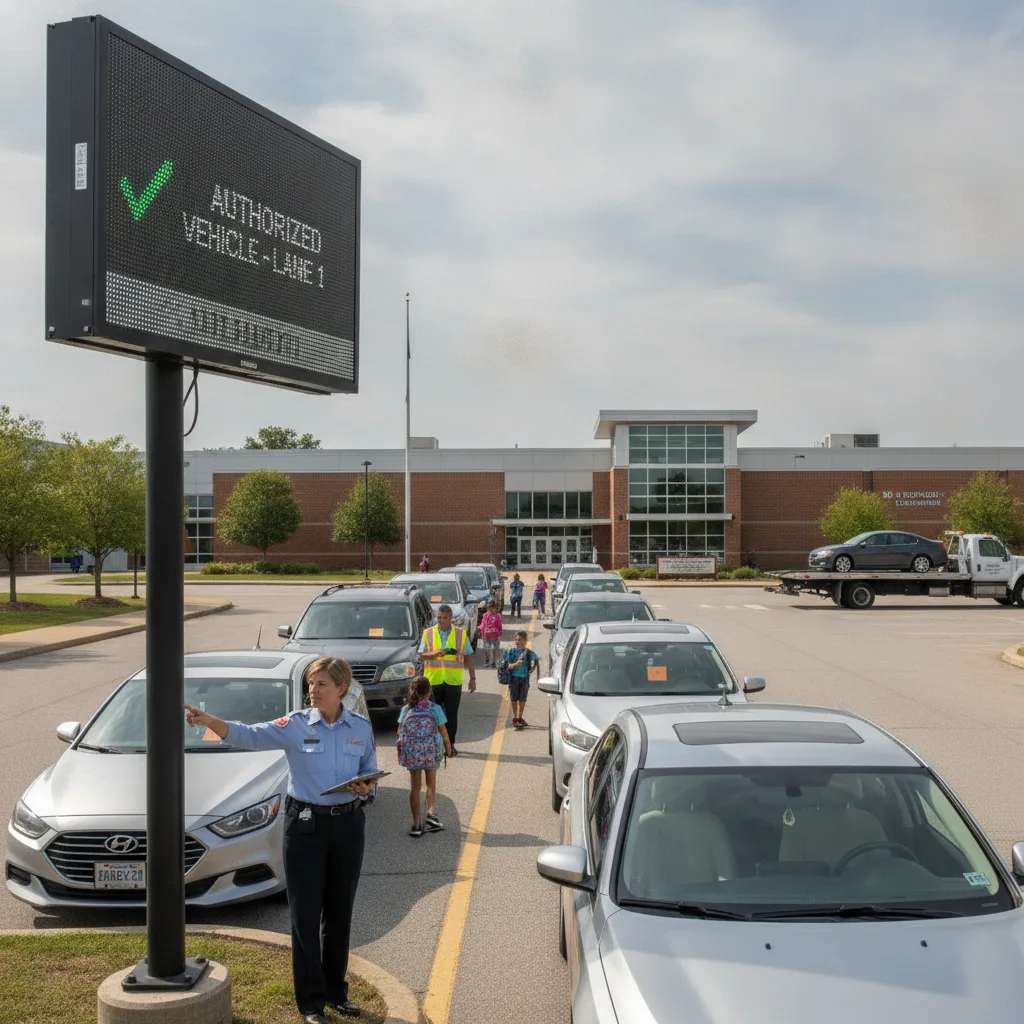
When a vehicle arrives at a school pickup lane, PLACA.AI’s system does the following in real time:
- Captures the license plate through optical recognition, QR token scan, manual staff entry, or parent geofence arrival
- Constructs a unified Authorization Request Object (ARO) that normalizes the identification regardless of how it was captured
- Evaluates the ARO independently against each student’s pickup rules — custody restrictions, authorized persons, one-time permissions, active revocations, and emergency overrides — in a defined eight-level precedence order
- Presents a staff dismissal card showing the student identity, arriving vehicle, rule evaluation result, and any active flags
- Requires an authenticated staff approval action before any student is staged or released
- Records every event — detection, evaluation, approval, staging, release, confirmation — in a tamper-evident audit log
No Student Moves Without Staff Approval
The human approval gate is the core differentiator. In PLACA.AI’s patent-pending system, the approval is not a UI confirmation — it is a cryptographically signed token containing the staff member’s identity, timestamp, student identifier, and a digital signature bound to that staff member’s active session. If a staff member does not produce this token, the student does not move. Period.
This matters for custody situations, watchlist alerts, one-time permission scenarios, and any dismissal event where a school needs to demonstrate, after the fact, that a qualified staff member made an active and deliberate decision to release a child.
Patent Pending — What It Means for Schools
The provisional patent filing establishes a priority date for the invention and puts competitors on notice that this architecture is protected intellectual property. Schools that deploy PLACA.AI today are building their dismissal operations on technology that no competitor can replicate without risk of infringement.
For district procurement teams evaluating dismissal software, patent-pending status is a meaningful signal: it reflects a depth of technical innovation that goes well beyond app-based check-in systems or simple LPR plate readers.
Ready to See It in Practice
PLACA.AI’s patent-pending student release system is deployed in schools today. If your district is evaluating dismissal technology for the upcoming school year, schedule a walkthrough of the full system and see the staff approval workflow, the dismissal card interface, and the audit log in action.
Frequently Asked Questions
What is a patent-pending student release system?
A patent-pending student release system is a school dismissal platform that has filed for patent protection with the USPTO. PLACA.AI’s system is specifically protected for its staff-controlled architecture — meaning every student release requires an authenticated staff approval action before any child moves, regardless of whether the vehicle was automatically recognized.
How does license plate recognition work for school pickup?
A camera mounted at the school entrance captures video of arriving vehicles. The system runs optical character recognition (OCR) across multiple frames per vehicle, computes a consensus plate reading with a confidence score, matches it against the school’s vehicle records, and surfaces a dismissal card to staff — all before the car reaches the carline attendant. The staff member then approves or holds the release.
Can a student be released without staff approval in PLACA.AI’s system?
No. PLACA.AI’s patent-pending human approval gate requires an authenticated staff member to take an explicit approval action before any student is staged or released. There is no automated release path — even for fully authorized vehicles with high-confidence plate reads.
What happens if the license plate camera can’t read a plate?
If the camera cannot produce a high-confidence plate read, the system routes the vehicle to manual review. A staff member can enter the plate manually, scan a QR code, or process the arrival through the parent fail-safe app. All modalities produce the same authorization workflow — no vehicle is turned away due to a camera read failure.
What does “patent pending” mean for schools choosing dismissal software?
Patent pending means the underlying technology has been filed with the USPTO and is protected from the filing date forward. For school procurement teams, it signals that the vendor has developed genuinely novel technology — not a repackaged app or a basic LPR reader — and has invested in protecting it.
Is PLACA.AI’s system compatible with existing school security cameras?
PLACA.AI’s LineCam system uses purpose-built IP cameras optimized for license plate capture at carline speeds and angles. Existing general-purpose security cameras typically do not have the frame rate, focal length, or image processing pipeline required for reliable LPR in a school pickup environment.
How long does it take to implement a school pickup LPR system?
Most PLACA.AI deployments are operational within one to two weeks of installation. The setup process includes camera mounting, network configuration, vehicle record import, staff training, and a live test session before the first production dismissal.
Data source: National Center for Education Statistics