

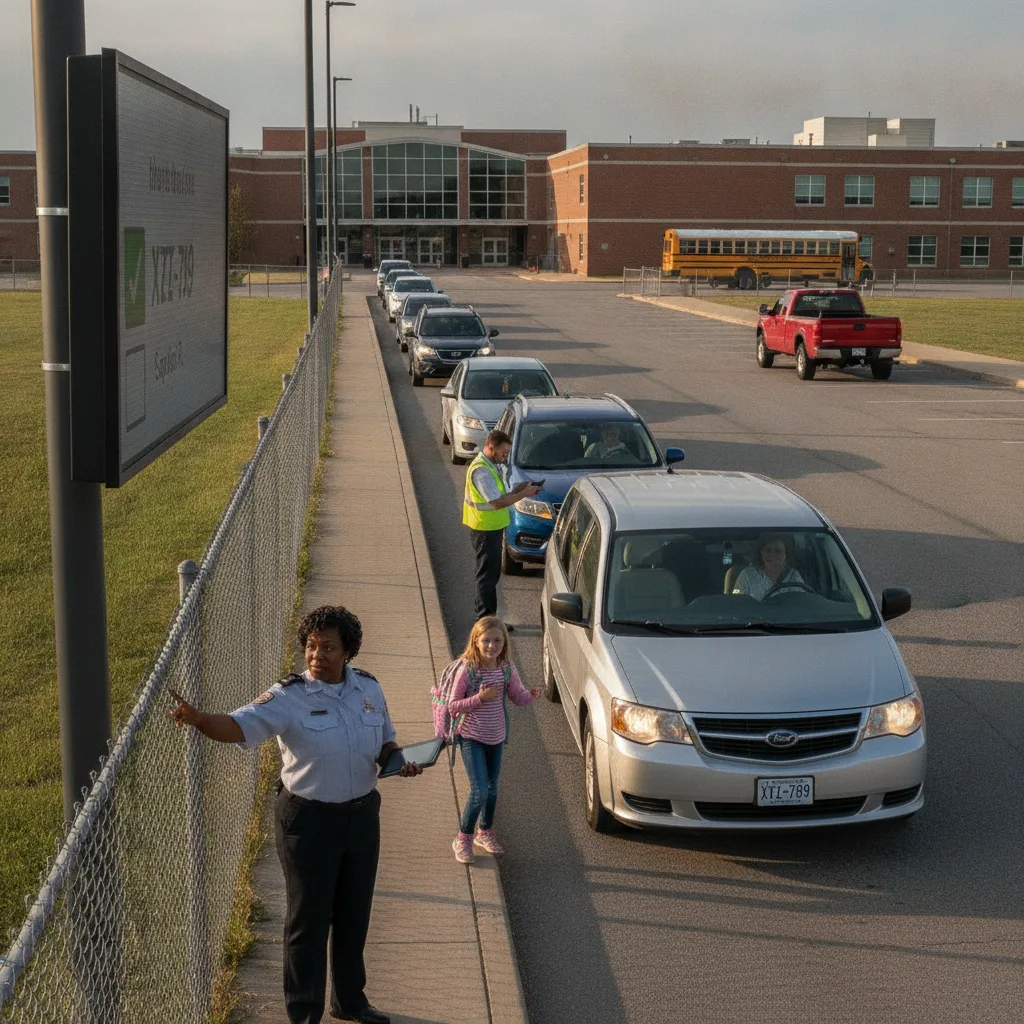
Direct answer: For transportation directors, car-tag confusion at the curb doesn’t stay contained to the parent pickup lane – it backs up into the bus loop, delays route departures, and throws off the schedule for every other campus on that bus’s run. A single stalled car-tag dispute at the front of the parent line can hold buses behind it or force a route to leave late, which cascades into every downstream stop. Fix it by giving car-pickup exceptions a resolution path that does not require stopping the physical flow of traffic – move the disputed vehicle out of the active lane while it’s resolved, rather than freezing the whole loop behind it.
This guide is for transportation directors and the dispatch, routing, and yard staff who own the interaction between bus schedules and parent pickup lanes. It focuses on the physical and scheduling consequences of car-tag confusion, not just the identity-verification question – because on a shared campus, a delay at one lane is a delay for every vehicle behind it, buses included.
A car-tag dispute is a traffic problem before it’s a paperwork problem
At most campuses, the parent pickup lane and the bus loading zone share a driveway, a gate, or at minimum a departure window. When a car at the front of the parent line can’t be resolved in a few seconds – a mismatched tag, an unlisted driver, a disputed release – every vehicle behind it stops too, including any bus staged to pull out once car traffic clears. Ten minutes lost resolving one dispute is ten minutes added to the departure time for a bus with twelve more stops on its route, each of which then runs late for its own dismissal window.
Example: A parent’s tag doesn’t match the vehicle because they picked up a rental car after an accident. Staff hold the car in place at the front of the loop to sort it out, and the bus staged behind it can’t maneuver around a stopped vehicle in a single-lane loop. The bus leaves eleven minutes late, and by the third stop on its route, families are calling the transportation office asking where the bus is – not realizing the delay started in a completely different line.
Design the lane so one dispute doesn’t stop everything
| Design choice | What it prevents | What it requires |
|---|---|---|
| Pull-aside spot for disputed vehicles | One stopped car blocking the entire loop | A physical space and a staff member to direct the pull-aside |
| Plate check before the vehicle enters the active lane | Discovering the mismatch only at the loading point | A check point ahead of where buses and cars merge |
| Separate bus and car release timing | Car-line delays directly holding bus departures | A schedule that doesn’t assume both lanes clear simultaneously |
| Dispatch visibility into car-line delays | Bus drivers and dispatch discovering the delay after the fact | A shared view of what’s holding up the loop, in real time |
Coordinate the two lanes like they’re one system, because they are
Transportation directors often inherit the bus schedule and the parent pickup process as two separate plans built by two different people at two different times, even though they share the same driveway during the same fifteen minutes. Reviewing them together – where the lanes merge, where a stopped car creates a bottleneck for a bus, and where the two schedules could be staggered instead of run simultaneously – usually finds more available minutes than trying to speed up car-tag verification alone. This connects directly to the work of separating bus and carline traffic: a car-tag dispute is far less costly once it physically cannot block a bus route. It’s also worth reviewing alongside efforts to prevent late dismissal bottlenecks more broadly, since car-tag disputes are one of several recurring causes of the same downstream delay.
A plate match resolves most disputes before they reach the loop
The fastest way to keep a car-tag dispute from ever becoming a traffic problem is to resolve it before the vehicle reaches the point where buses and cars interact. A license-plate match at the entrance, rather than at the loading curb, flags the mismatch early enough that staff can direct the vehicle to a pull-aside spot instead of letting it reach the front of an active lane and stop everything behind it. That single change – moving the check point earlier – does more for on-time bus departures than almost any adjustment to the verification process itself.
What to measure before expanding the process
- average bus departure delay attributable to car-line holdups
- disputed vehicles resolved via pull-aside versus blocking the active lane
- mismatches caught before the vehicle reaches the loading zone
- routes departing within their scheduled window
- downstream stops affected by a single upstream delay
Owner sign-off
- State the purpose and non-goals for reducing car-tag confusion’s effect on bus scheduling.
- Name who directs a disputed vehicle to a pull-aside spot and who resolves it from there.
- Test during the actual peak dismissal window with real bus and car volume, not a quiet day.
- Confirm contracts, pricing, integrations, data handling, and governing requirements independently.
- Retain a record of delay causes so recurring car-tag disputes can be distinguished from other traffic problems.
Related PLACA.AI planning resources
Decision questions
What is the first decision for reducing car-tag confusion’s effect on transportation?
Where the plate check happens relative to where buses and cars merge, and who has authority to pull a disputed vehicle aside without stopping the whole loop.
What belongs in the pilot?
A normal peak dismissal with real bus and car volume, at least one disputed vehicle handled through a pull-aside, and a measured before-and-after on bus departure times.
What blocks expansion?
No physical space for a pull-aside, no staff assigned to manage it, or a checkpoint placed too late to matter before vehicles reach the shared lane.
Plan a limited workflow review
Bring the current rule, process, exceptions, and success criteria for reducing parent car-tag confusion’s effect on your bus schedule. PLACA.AI can help evaluate a bounded pilot without assuming another campus’s layout is the right answer.
Editorial refresh: September 18, 2026. Independently confirm current product capabilities, third-party features, pricing, contracts, governing requirements, and local rules before acting.
Internal Resources
- How School Transportation Directors Can Reduce Radio Call Overload With Better Vehicle-Based Workflows
- How Front Office Staff Can Verify Grandparent Pickup Permissions With Better Vehicle-Based Workflows
- How Front Office Staff Can Shorten Pickup Line Delays With Better Vehicle-Based Workflows
- How Campus Safety Teams Can Verify Authorized Pickup Vehicles With Better Vehicle-Based Workflows
- How Elementary Schools Can Stop Unauthorized Carpool Pickups Without Slowing Down the Carline
Data source: National Center for Education Statistics