

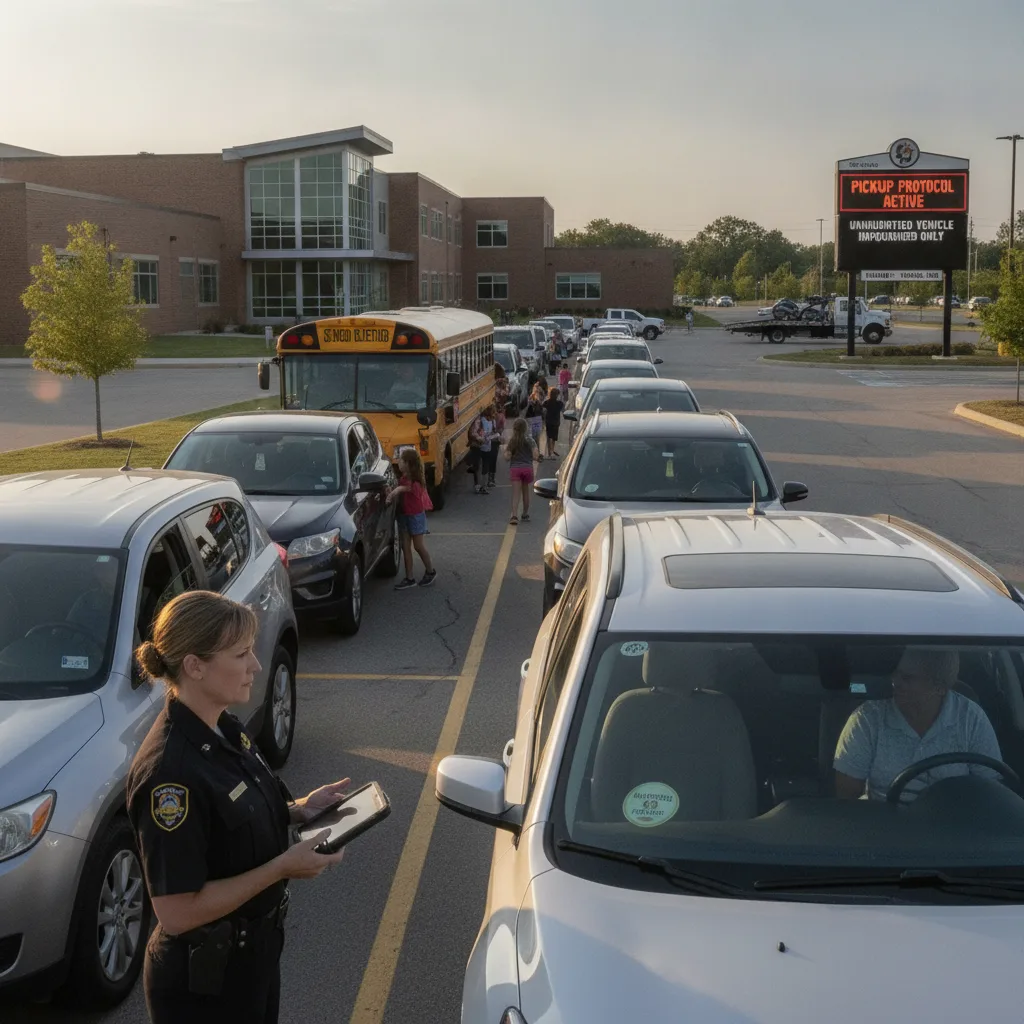
Direct answer: Verifying pickup vehicles is not a stand-alone security task for a transportation director — it’s a scheduling problem that happens to also be a safety problem. Every car-rider verification that stalls at the curb backs up behind a bus that has a route to run, a driver working toward a shift limit, and other campuses waiting on that same bus. Build the verification step so it moves at the speed of the carline, route the exceptions away from the lane instead of freezing it, and treat a same-day mode change (a normal bus rider being picked up by car today) as a routine data update, not a surprise.
Key Takeaways
- Car-rider verification and bus dispatch share the same physical space and the same clock — design them together, not separately.
- A mode change (bus to car, car to bus, walker to car) is the highest-friction case and the one that most often causes a bus to sit idle.
- Radio traffic between the curb and the bus loop should carry exceptions only, not routine confirmations.
- Measure against on-time bus departure, not just car-rider throughput — a fast carline that delays the bus schedule hasn’t actually solved the problem.
Why this sits on transportation, not just the front office
At most campuses, the front office owns the authorized-pickup list and the transportation department owns the buses, but dismissal itself doesn’t respect that org chart. Car riders, bus riders, and walkers converge on the same loop at the same few minutes, and a stalled car-rider verification doesn’t just delay one family — it holds up the bus lane behind it, which holds up a route, which arrives late at the next school on that run. Transportation directors end up owning the practical consequences of a verification process they didn’t design, which is why the process has to be built with bus dispatch in mind from the start rather than bolted on afterward. For the traffic-separation side of this problem specifically, see the front-office guide to separating bus and carline traffic.
The case that actually breaks schedules: the mode change
The routine car-rider match — plate on file, adult on file, release the student — rarely causes delay. What breaks a schedule is the student who is supposed to ride the bus today but whose parent is picking them up instead, or the reverse: a normal car rider whose ride didn’t show and who now needs to go home on a bus that has a specific number of seats and a specific route. If that change reaches the transportation side after the bus has already loaded, or reaches the front office after the car is already at the curb, someone is holding up the line while people figure out where the student is supposed to go. A workable process needs one shared, time-stamped source for mode changes that both the front office and the bus loop can see, with a hard cutoff time after which a change requires direct coordination rather than a note passed at the last second.
Verification and dispatch decision framework
| Situation | What transportation needs to know | Where it should be resolved |
|---|---|---|
| Routine car-rider match | Nothing — it shouldn’t reach transportation at all | Curb, silently |
| Same-day mode change submitted before the cutoff | Updated roster for that route or that release list | Shared system, before dismissal starts |
| Mode change discovered after the cutoff | Who is holding the student and for how long | Direct radio or phone contact, named owner on each end |
| Vehicle mismatch or unknown driver | Does this affect a bus rider’s status, or only a car rider’s | Front office, with transportation notified only if it changes a route |
Keep routine verification off the radio
Bus drivers, loop monitors, and dispatch already run a busy radio channel during dismissal — late buses, a student not at their stop, a mechanical issue, a substitute driver who doesn’t know the route. Adding routine car-rider confirmations to that channel buries the calls that actually need an immediate response. A vehicle-based workflow that quietly logs the routine matches and only surfaces a signal when something needs a human decision keeps the channel usable for what it’s actually for. If radio overload during dismissal is a recurring problem at your campuses independent of car-rider verification, the campus safety guide to reducing dismissal radio overload covers that problem directly.
Rollout sequencing for a transportation department
Start with the campus where car-rider and bus-loop conflict is worst — usually the largest elementary or K-8 campus with a shared loop — rather than the campus that’s easiest to change. Run one full dismissal cycle that includes at least one mode change submitted late, one bus running behind schedule, and one vehicle mismatch at the curb, so the process gets tested against the conditions that actually cause delay instead of just a clean afternoon. Weather is a useful stress test on its own; a rainy dismissal compresses everyone’s patience and timeline at once, which is covered in more detail in the rainy-day carline backup guide for transportation directors.
What to measure
- on-time bus departure from campuses using the shared verification workflow
- mode changes submitted before versus after the cutoff time
- average hold time for a student caught in a bus-or-car mode conflict
- radio transmissions during dismissal, before and after routine matches are removed
- routes that arrived late at a downstream campus because of a dismissal-side delay
Track on-time departure specifically — it’s the number that tells you whether the verification process is actually compatible with the transportation schedule, not just whether cars are moving through the lane quickly.
Internal Resources
Related Resources
For a deeper commercial overview, see Placa.ai’s student pickup / school dismissal solution. Transportation teams may also want to review related automation workflows and compare them with supporting use cases.
Field Questions Transportation Directors Ask
What should a transportation director confirm before rolling out vehicle-based pickup verification?
Confirm where the verification step physically sits relative to the bus loop, what the cutoff time is for a same-day mode change, who owns the shared roster between the front office and dispatch, and how a mismatch at the curb gets communicated without stopping bus loading.
How should a bus-to-car mode change be handled on a normal dismissal day?
It should be entered into a system both the front office and transportation can see, with a hard cutoff before dismissal starts. A change submitted after the cutoff needs direct contact between the two, not a note left for whoever notices it first.
Should routine car-rider matches go out over the dismissal radio channel?
No. Routine matches should be logged silently. Reserve the radio channel for exceptions — a mismatch, a late bus, a student not at the expected release point — so those calls aren’t buried under routine confirmations.
What happens if a car-rider verification stalls right as buses need to load?
The process should route that stall off to the side of the lane rather than holding the whole line, and the front office should have a way to signal transportation if the delay is going to affect a specific bus’s departure time.
Which campus should a transportation department pilot this at first?
Start at the campus where car-rider and bus-loop conflict is worst, usually a large elementary or K-8 site with a shared loop, and run a full dismissal cycle that includes a late mode change and a delayed bus before expanding.
What data does transportation actually need from the verification system?
Mainly the mode-change roster and on-time departure impact — not every car-rider match. Most routine verification events never need to reach the transportation side at all.
How does weather change the calculus?
Rain compresses everyone’s timeline at once — more cars, slower loading, shorter tempers — and is a useful stress test for whether the mode-change cutoff and exception routing actually hold up under pressure.
Who owns a disputed release that also affects a bus route?
The front office owns the authorization decision; transportation owns the routing consequence. Both need visibility into the same record so neither is guessing what the other decided.
Which metrics prove the workflow is actually working for transportation?
On-time bus departure, mode changes submitted before the cutoff, average hold time for a conflicted student, and reduced radio transmissions during dismissal are stronger evidence than carline speed alone.
When should a transportation department pump the brakes on rollout?
If mode changes are regularly arriving after the cutoff, if a mismatch at the curb is delaying bus departures, or if front office and dispatch are working from different versions of the roster.
Plan Your Transportation-Coordinated Pickup Verification Rollout
If your transportation department is evaluating vehicle-based pickup verification alongside bus dispatch, Placa.ai can help map the mode-change process and the exception path before you roll it out.
Data source: National Center for Education Statistics