

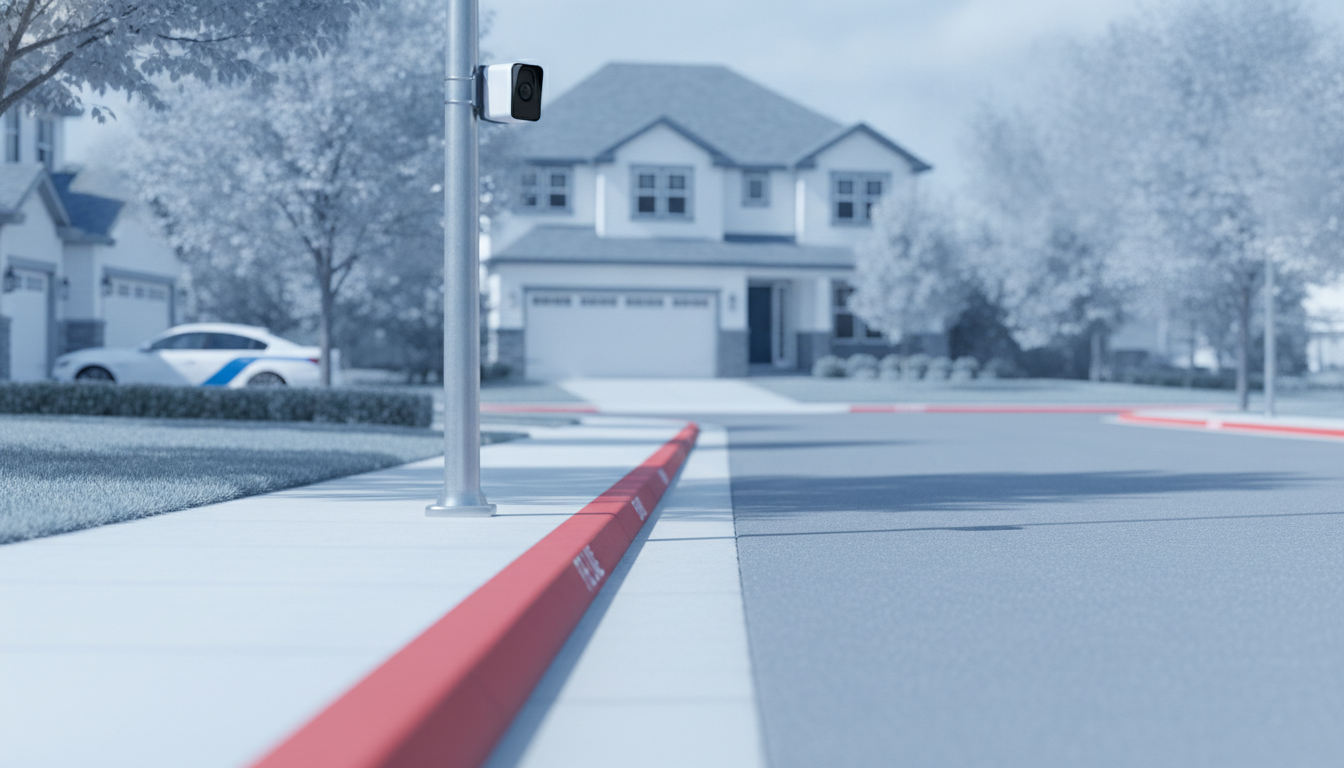
Direct answer: Texas HOAs should confirm whether a fire lane obstruction is an active hazard (call 911 or the local fire marshal) before touching the association’s own process, then document the lane marking, vehicle position, and time separately from any covenant violation, and follow the notice requirements in Texas Property Code Chapter 209 before assessing a fine or authorizing a tow.
This guide is for Texas HOA boards, community managers, and residents dealing with fire-lane complaints. Texas presents a different challenge than most states: fire code adoption and enforcement is handled locally — a fire lane in Austin, Houston, or a small exurban municipality may be marked, inspected, and enforced differently — and towing from private property is separately governed by state law with its own signage and notice rules.
Why “which fire code” is the first question in Texas
Texas does not have a single statewide fire code that every jurisdiction enforces uniformly. Most cities and many counties adopt some version of the International Fire Code, but adoption dates, amendments, and enforcement priorities vary by municipality, and unincorporated areas may have limited or no local fire marshal presence at all. That means a board managing a community that straddles city limits, or one in an unincorporated area with a volunteer fire department, needs to know who actually has jurisdiction over lane markings before treating a complaint as a fire-code violation rather than a plain parking dispute under the association’s own rules.
Texas HOAs also skew toward larger, newer subdivisions with wider streets than older Florida-style townhome sites, so fire lanes are more commonly found around clubhouses, mailbox kiosks, and amenity centers than along every residential street. That concentrates complaints in a few predictable, high-traffic locations — which is useful, because it means a board can prioritize documentation and signage review at those specific spots rather than treating the whole neighborhood as equally at risk.
Sorting the complaint before deciding how to respond
| Situation | What Texas boards need to confirm | Who acts |
|---|---|---|
| Vehicle is blocking access right now | Nothing else — call 911 or the fire marshal with jurisdiction | Emergency services, not the board or management company |
| Lane is inside city limits with clear signage | Photo of sign/curb marking, vehicle position, timestamp | Manager logs it; board applies the association rule |
| Lane is in an unincorporated area or unmarked | Which authority (county fire marshal, ESD, none) actually governs this lane | Board confirms jurisdiction before citing “fire code” as the basis |
| Repeat violation after written notice | Chapter 209 notice record, cure period, prior warnings | Board follows the association’s adopted enforcement policy |
A response sequence that holds up under Chapter 209
- Rule out an active emergency first. A currently obstructed lane during any kind of incident is a 911 call, not a board decision.
- Confirm the lane’s legal status. If the community is in an unincorporated area, check whether a county fire marshal or emergency services district has actually designated and signed that lane. If not, the association may still be able to restrict parking there under its own covenants, but it isn’t a fire-code violation, and calling it one weakens the association’s position if challenged.
- Document independently of the complaint itself. A resident’s photo is a starting point, not proof. The record needs the sign or marking, the vehicle’s plate and position, and a timestamp that doesn’t depend on the complainant’s phone metadata.
- Follow the Chapter 209 notice sequence before fining. Texas Property Code Chapter 209 (the Texas Residential Property Owners Protection Act) requires written notice and a reasonable period to cure most violations before a fine can be assessed, and gives owners a right to request a hearing. Skipping this step is the single most common reason a Texas HOA fine gets reversed on appeal.
Where board authority stops
Towing from private property in Texas is governed separately under Texas Occupations Code Chapter 2308 and related law, with specific signage, notice-to-law-enforcement, and post-tow notification requirements that apply to the towing company independently of whatever the association’s covenants say. A board that assumes “we have a no-parking sign, so towing is automatically fine” is skipping a step the towing statute doesn’t skip. For a state-by-state comparison of what HOAs can and can’t do around towing, see Can My HOA Tow My Car? Rules by State. Jurisdictional disputes, contested Chapter 209 hearings, and any case involving an accessibility accommodation should go to the association’s attorney rather than being resolved through the standard workflow.
Testing the process before it’s policy
Before adopting a formal fire-lane response policy, run it against a handful of real recent complaints, including at least one from an ambiguous jurisdiction (unincorporated area, unclear signage) and one repeat case that would actually reach the Chapter 209 notice stage. Many Texas HOAs are self-managed or use a management company that covers dozens of communities with limited on-site staff, so the practical bottleneck is usually evidence collection, not policy design — a manager covering five subdivisions can’t be parked at the clubhouse fire lane waiting for a violation. Associations solving that gap often look at enforcement approaches that don’t rely entirely on a towing company for the documentation step, pairing automated plate capture at chokepoints with the notice-and-hearing process the statute requires.
What to verify before scaling the response
- Which authority actually has jurisdiction over each fire lane in the community, especially in unincorporated areas.
- That evidence includes the marking/sign, not just the vehicle.
- That the Chapter 209 notice-and-cure sequence is documented for every fine, not only contested ones.
- That the towing vendor independently meets Texas signage and notification requirements.
- Who owns escalation when jurisdiction or evidence is unclear.
Related PLACA.AI planning resources
Implementation questions
Who enforces fire lanes in a Texas HOA outside city limits?
It depends on the county and whether an emergency services district has jurisdiction. Boards in unincorporated areas should confirm this in writing rather than assuming the same authority applies as in a nearby city.
Does Chapter 209 apply to fire-lane fines the same as other violations?
Yes — the notice-and-cure and hearing-request provisions in the Texas Residential Property Owners Protection Act apply broadly to fines assessed for deed restriction violations, including parking rules, unless a genuine emergency is involved.
What should stop a rollout before it goes association-wide?
Unclear jurisdiction over the lane, missing photo/timestamp evidence, skipped Chapter 209 notice, or a towing vendor that isn’t independently compliant with state law.
Plan a limited workflow review
Bring the current rule, process, exceptions, and success criteria for responding to fire-lane parking complaints in a Texas HOA. PLACA.AI can help evaluate a bounded pilot without assuming another property’s workflow is the right answer.
Editorial refresh: September 18, 2026. Independently confirm current product capabilities, third-party features, pricing, contracts, governing requirements, and local rules before acting.
Data source: Community Associations Institute