
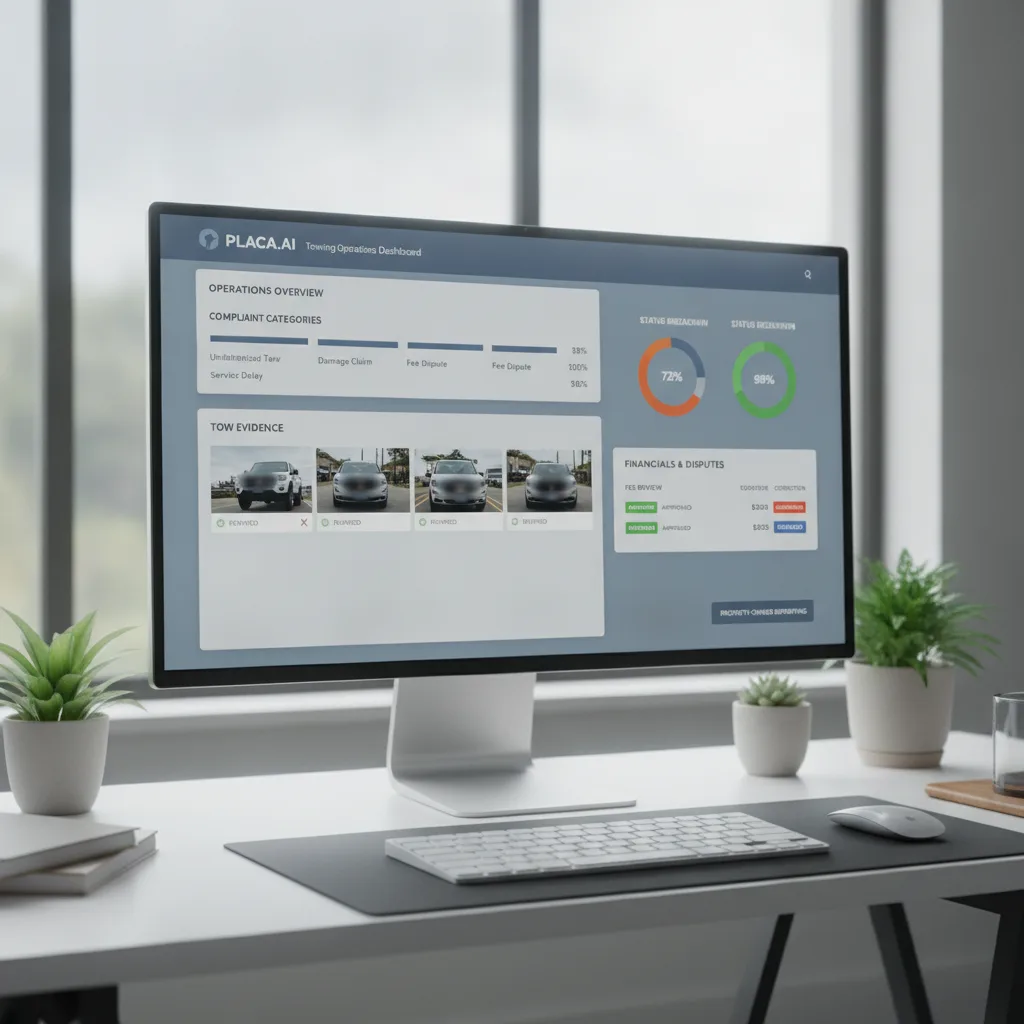
A towing complaint resolution dashboard should show more than how many people complained. For each disputed private-property tow, the operator should be able to show the allegation, source evidence, applicable rule, review outcome, remedy, and root-cause tag so property owners can see whether the tow was valid, corrected, or part of a pattern.
Key Takeaways
- Complaint volume alone is not useful unless it is tied to the tow record, evidence quality, review status, and final resolution.
- The dashboard should separate unsubstantiated complaints from substantiated errors, policy gaps, fee issues, release disputes, signage problems, damage claims, and communication failures.
- Property owners need trend data by location, rule, driver, time window, authorization path, and remedy so recurring problems can be fixed.
- Operators should avoid treating public complaints as proof of wrongdoing; the dashboard should support consistent review, not automatic reversal.
- Local law controls required records, fees, refund rights, release rules, and retention, so counsel should review the final workflow before publication or rollout.
What This Workflow Involves
This workflow starts after a tow has already happened and someone challenges it. The complaint might come from a vehicle owner, tenant, property manager, regulator, attorney, news reporter, or internal quality review. The dashboard turns that complaint into a structured case instead of leaving it as an email thread, call note, or one-off supervisor memory.
The first step is to connect the complaint to the original tow record: property, lot, rule, vehicle, timestamp, authorization source, driver, photos, LPR read, fee schedule, storage destination, release path, invoice, and prior notices. The second step is to classify the allegation. The third is to record the decision and remedy in language that a property owner can understand.
The goal is not to build a public-shaming tool or assume every complaint is valid. The goal is to make accountability measurable. If a tow was valid, the operator can show why. If a tow was wrong, the operator can correct it and show what changed.
Why This Problem Is Showing Up Now
ARLnow reported on September 16, 2026, that Arlington officials expected to publish more complaint and resolution information for towing. The report said county staff described a coming view where people could see general complaint types and resolutions, and it noted that complaints for the first seven months of 2026 had already exceeded the previous full-year total.
Arlington also maintains an official trespass towing data and complaint page, including historical complaint and tow data. That matters for private operators outside Arlington because it shows the direction of travel: towing disputes are no longer just customer-service events. They are becoming structured accountability records.
Other public sources point to the same operating pressure. The Pennsylvania Attorney General announced on September 3, 2026, allegations involving towing without proper signage or authorization, unusual payment requirements, credit-card fees, and excessive charges. Portland’s official towing complaint form asks for tow type, company, time, tow number, invoice, plate or VIN field, and complaint categories such as overcharge, signage, release refusal, missing invoice, and damage. Texas publishes towing penalty categories that include records, signage, fee schedules, tow tickets, owner notices, release/drop-charge issues, and private-property authorization problems.
The Core Operational Problem
Towing disputes become expensive when the operator cannot explain the difference between a valid complaint, an invalid complaint, and a valid tow that still revealed a weak process. A vehicle owner may say the sign was unclear. A property manager may say the tow was authorized. A driver may say the fee was correct. A regulator may ask for the ticket, license number, notice, or fee schedule. Without a dashboard, each person sees only part of the case.
That creates three risks. First, valid tows look arbitrary because the evidence is scattered. Second, invalid tows get corrected quietly but the root cause remains active. Third, property owners cannot distinguish a noisy location from a bad process. A dashboard helps separate those cases.
For towing operators, the most useful dashboard is not a marketing report. It is an operations control surface that answers: what was alleged, what did we verify, what did we decide, what did we fix, and where is it happening again?
Towing Complaint Resolution Dashboard Fields
| Dashboard field | Why it matters | Example values |
|---|---|---|
| Complaint category | Prevents every dispute from becoming a vague predatory-towing claim. | Authorization, signage, fee, release, damage, invoice, storage, notice, wrong vehicle, payment or permit mismatch. |
| Tow record link | Connects the complaint to the evidence packet instead of a separate inbox. | Property, rule, plate event, photos, authorization, driver, dispatch, invoice, storage location. |
| Evidence quality | Shows whether the case can be defended or should be corrected early. | Complete, missing sign photo, weak location photo, unclear permit status, missing authorization note. |
| Review status | Shows whether the complaint is still pending or has been decided. | New, waiting on records, supervisor review, counsel review, substantiated, not substantiated, corrected. |
| Resolution outcome | Creates a consistent answer for property owners and internal teams. | No change, refund, partial refund, fee correction, tow voided, warning to driver, property rule update, staff retraining. |
| Root-cause tag | Turns complaints into process improvement instead of anecdote. | Signage ambiguity, stale permit list, driver documentation gap, wrong fee, release communication, property authorization gap. |
| Escalation hold | Prevents collections or repeat enforcement from moving while evidence is unresolved. | Late fee paused, collections paused, property notified, license/permit review required. |
How To Classify Complaint Outcomes
A complaint can be emotionally charged and still not be substantiated. A tow can be technically allowed and still expose a weak sign, unclear payment instruction, poor photo standard, or confusing release process. The dashboard should have room for both truths.
Use at least four outcome types. Valid tow, no correction means the record supports the action and no policy gap was found. Valid tow, process improvement means the action stands but the sign, script, fee explanation, or property instruction needs cleanup. Substantiated error means the complaint was supported and the remedy should be recorded. Insufficient record means the operator cannot defend the tow to its own standard even if the rule may have been violated.
That last category is uncomfortable, but useful. It prevents thin evidence from being mislabeled as either a valid tow or a proven mistake. It also gives managers a practical target: improve documentation before the next tow from that location.
What Property Owners Should See
Property owners do not need every private detail from every complaint. They do need enough information to know whether enforcement is protecting the site or creating avoidable friction. A monthly owner view can show total tows, complaints, substantiated complaints, top complaint categories, average resolution time, refunds or voids, repeat locations, and corrective actions.
For apartment, retail, hospital, campus, and mixed-use properties, the most useful view is usually by location and rule. If most complaints come from one loading zone, one visitor lot, one after-hours rule, or one unclear sign, the owner can fix the operating condition instead of debating each complaint from scratch.
Keep the owner report privacy-aware. Do not expose unnecessary personal data, full plate lists, payment identifiers, or unrelated driver history. Show the operational pattern and the correction.
Where LPR Fits
LPR evidence can strengthen the dashboard when it is tied to context. A plate read, timestamp, and image can help prove presence, timing, repeat events, and permit status. But LPR should not be treated as the whole complaint record. The dashboard also needs the posted rule, property authorization, fee schedule, release path, invoice, review notes, and final outcome.
For teams using parking enforcement software for towing companies, the dashboard should connect patrol evidence to complaint status without forcing staff to rebuild the case manually. It should also connect to the private-property tow documentation workflow so pre-tow records and post-tow complaints are not managed in separate worlds.
Risks And Limits
Towing rules vary by state, city, property type, contract, and tow category. A dashboard should not make legal conclusions automatically. It should organize the record so the right person can make the decision. Counsel should review category names, retention rules, fee language, refund workflows, release policies, and any public-facing report.
Do not over-collect information during complaint intake. The complaint record usually needs the tow number, invoice, property, date/time, vehicle identifier, contact path, allegation, and supporting documents. It usually does not need unrelated financial records, personal travel details, or information about other vehicles.
Also avoid weaponizing complaint counts. A high complaint count at one property may reflect high tow volume, unclear signs, unusually strict rules, better awareness of complaint channels, or a real operational problem. The dashboard should normalize by tow count and resolution type before anyone draws conclusions.
Implementation Plan
Start with the last 30 to 90 days of complaints. Map each one to its tow record, allegation category, evidence quality, decision, remedy, and root-cause tag. Then review the top three locations by substantiated complaint rate, not just complaint volume.
Next, define hold rules. If a complaint includes credible evidence of wrong vehicle, wrong property, missing authorization, unclear sign, fee error, release refusal, or payment/permit mismatch, pause escalation until a supervisor reviews the case. A hold is not an admission; it is a control that keeps a questionable file from becoming a larger problem.
Finally, share the owner-facing version with property clients. Keep it short: number of tows, number of complaints, substantiated count, average resolution time, common root causes, and what changed. That is the difference between accountability and a folder full of complaints no one studies.
Frequently Asked Questions
Should every towing complaint be treated as valid?
No. A complaint is an intake signal. The dashboard should verify the tow record, evidence, rule, fee, release path, and local requirements before assigning an outcome.
What is the minimum data for a complaint dashboard?
At minimum, track the tow record, complaint category, evidence quality, reviewer, decision, remedy, root-cause tag, resolution date, and whether any escalation was paused.
How is this different from pre-tow documentation?
Pre-tow documentation asks whether the operator had enough evidence to tow. A complaint dashboard asks what happened after someone challenged the tow and whether the issue was valid, corrected, or recurring.
Should property owners see individual complaint details?
They should see enough detail to manage the property and vendor relationship, but unnecessary personal information should be removed. Most owner reports can focus on categories, outcomes, remedies, and repeated locations.
Can LPR evidence decide the complaint by itself?
No. LPR can show vehicle presence, timing, and plate history, but the complaint may turn on authorization, signage, fees, release rules, permit data, invoice records, or local law.
What should trigger a refund or correction?
The trigger should be defined by policy and local law. Common triggers include unsupported authorization, wrong vehicle, missing required notice, fee error, unclear sign record, release-rule violation, or a company decision to resolve an insufficient record.
Next Step
Export the last 25 disputed tows and tag each one by allegation, evidence quality, resolution, remedy, and root cause. If your team cannot produce that view in one sitting, build the dashboard before the next property-owner review.