

school parking lot safety risks
The incident rarely comes without warning. In hindsight, the conditions were almost always visible: a blind corner nobody had assessed, a pedestrian crossing that relied on drivers noticing it, a pickup flow that depended on everyone behaving perfectly at once. Parking lot safety failures aren’t random – they’re predictable, preventable, and when they occur without documented controls, legally costly.
Risk 1: Blind Spots at Entry and Exit Points
Parking lot accidents disproportionately occur at transitions – entrances, exits, and lane intersections – where driver visibility is limited and vehicle paths converge unpredictably. In school zones, cars arriving and departing simultaneously at a single entry point while pedestrians cross is a geometry of collision risk. Controlled flow manages this: one direction at a time, guided by a system that knows who is coming and when.
Risk 2: Pedestrian/Vehicle Path Conflicts
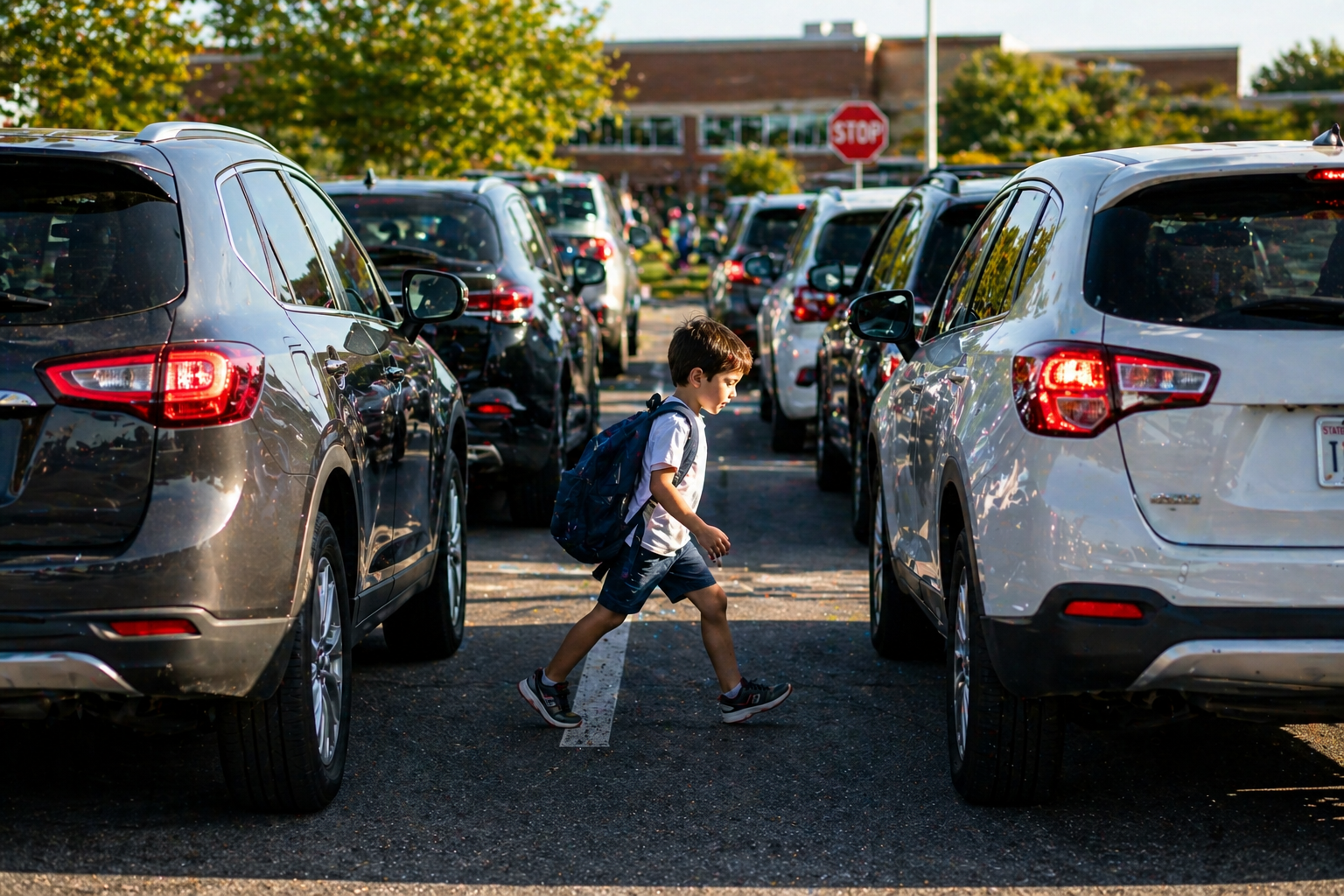
Most parking lot pedestrian injuries happen not in marked crossings, but between them – where children walk between parked cars to reach a pickup point. A 2021 NHTSA report found approximately 50% of vehicle-pedestrian incidents involving children occur in non-roadway environments including parking lots and school zones. These are predictable outcomes of uncontrolled mixed-use zones.
Risk 3: Congestion-Induced Blind Acceleration
When drivers have waited in a slow-moving line for 15 minutes, they accelerate more aggressively when space opens. The stress of waiting creates urgency, and urgency overrides caution – meaning a gap in traffic can trigger sudden forward motion from multiple vehicles converging on the same space. Structured queuing eliminates this by removing the underlying stressor.
Risk 4: Unauthorized Vehicle Access
In many school pickup zones, any vehicle can enter. There is no verification that the driver is an authorized guardian. Student release is based on verbal identification or a name card – both trivially easy to bypass. LPR-based systems match incoming vehicles against authorized guardian databases in real time, triggering an alert before an unauthorized vehicle reaches the pickup point.
Risk 5: Staff Attention Saturation
During peak pickup, staff manage communication, identification, release coordination, traffic direction, and parent questions simultaneously. No human can maintain high-quality safety vigilance while managing six parallel tasks. Automated systems take coordination and identification off staff plates, freeing attention for genuine safety monitoring.
Risk 6: No Incident Documentation
When a near-miss occurs in an unmanaged zone, there is often no record – no camera timestamp, no vehicle identification, no sequence reconstruction. This creates legal exposure and eliminates the data needed to prevent recurrence. PLACA.AI’s LPR system creates an automatic, timestamped log of every vehicle entry, position, and student release. If something happens, there is a documented record.
The Question Worth Asking Before the Incident
The standard administrative question is: “Has anything happened?” The better question is: “What are the conditions under which something will happen?”
Blind corners. Unverified vehicle access. Congestion-triggered aggression. Attention-saturated staff. These conditions exist in most unstructured school pickup operations today. The liability question isn’t whether your current system is fine – it’s whether it is documented and controlled to the standard that would hold up after an incident.
Learn how PLACA.AI controls and documents school zone safety
Related Reading: Why School Pickup Lines Are Chaotic | Why Parking Is Broken | How Schools Can Fix Pickup Traffic
Talk to PLACA.AI
Need help choosing the right LPR workflow?
Send your property, parking, or access-control question through the PLACA.AI contact form. Dr. Suhayb and the team can help map the right camera, software, and enforcement setup.
Open contact formRelated Resources
Data reference: National Center for Education Statistics