

best school pickup systems
The school pickup system market has grown significantly in the past three years. Administrators now have options beyond clipboards and name cards – but not all systems are equal. Here’s a comparison across what school decision-makers care about most: safety, staff burden, parent friction, and total cost.
How to Evaluate a School Pickup System (The Right Criteria)
- What does a parent have to do differently every day? More friction = lower compliance = broken system.
- How many staff does it require during peak pickup? Systems needing 3 people aren’t reducing burden.
- What happens when a regular staff member is absent? Resilience to personnel variation matters.
- What is the safety documentation output? Can you reconstruct who released which student to which vehicle at what time?
- What is the total cost including labor? A “free” system with heavy staff requirements is not free.
Category 1: Paper / Manual Systems
Parent action: Display name card at pickup, every day. Staff required: 3-5. Safety documentation: Paper log only. Pickup speed: 45-65 min for 200 students. True cost: $10,000-$15,000/year in staff labor. Verdict: Still used because inertia is powerful. No longer defensible from a safety or efficiency standpoint in 2026.
Category 2: QR Code / App-Based Systems
Parent action: App download, daily app activation, phone in hand at pickup. Staff required: 2-3. Safety documentation: Digital log via app. Pickup speed: 25-35 min for 200 students. True cost: $3,000-$8,000/year software plus partial staff time. Note: App adoption is rarely 100%. Parents without smartphones or with dead batteries create manual exceptions. Verdict: Significant improvement over manual; app adoption friction is the primary limitation.
Category 3: LPR-Based Automated Systems
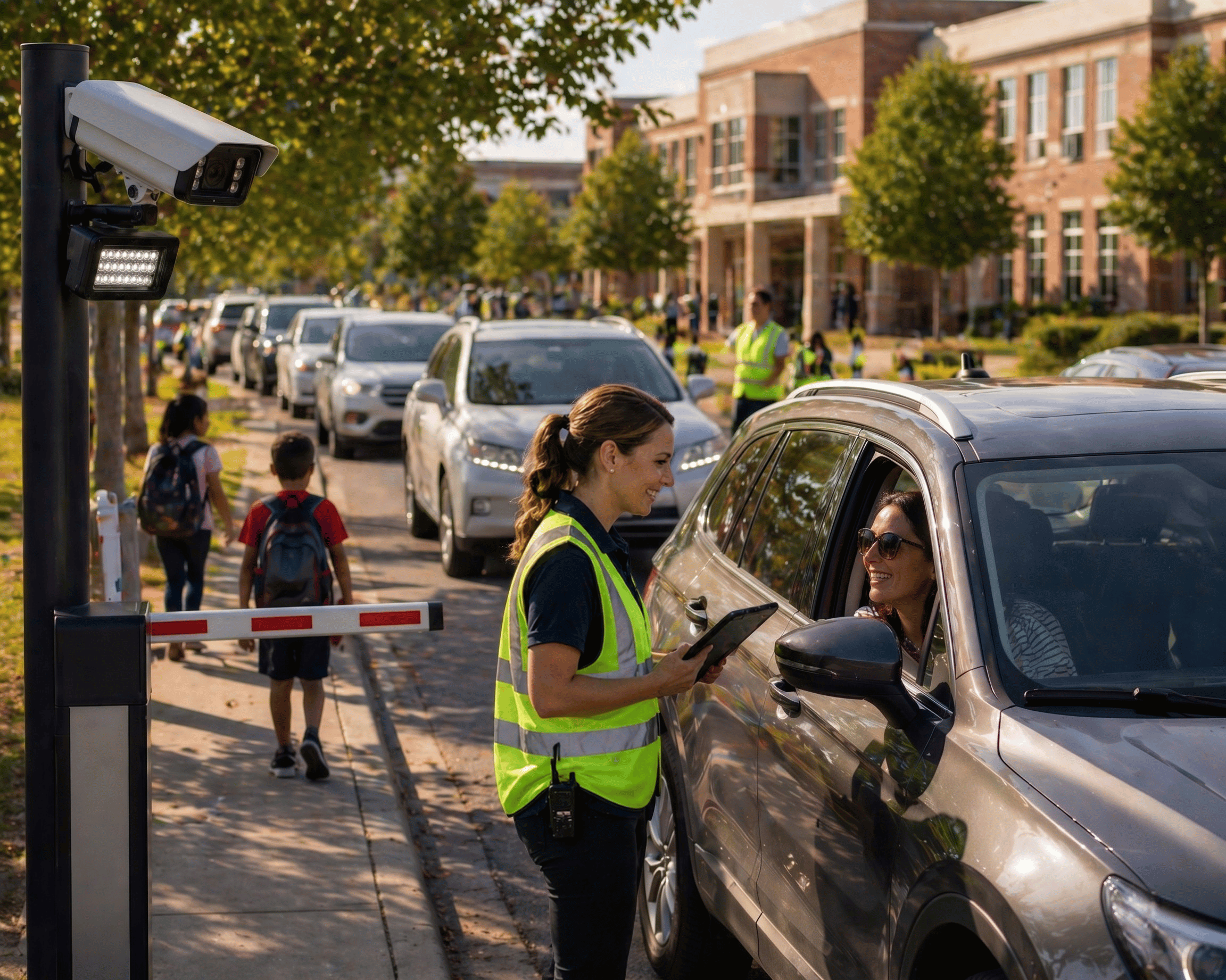
Parent action: One-time vehicle registration. Nothing else, ever. Staff required: 1-2, focused on staging and safety – not identification. Safety documentation: Automatic, timestamped, per-event log for every student released. Pickup speed: 12-20 min for 200 students. Verdict: Current best-in-class for schools prioritizing safety, staff efficiency, and parent experience.
Where PLACA.AI Sits in This Landscape
PLACA.AI is built specifically for schools – not adapted from commercial or law enforcement LPR applications. School-specific design means it handles:
- Custody restrictions and guardian authorization levels
- Multi-student family pickups – one vehicle, multiple students, coordinated staging
- Emergency lockdown integration – system-level alerts for unauthorized vehicles
- SIS data sync – enrollment and guardian changes reflected automatically
PLACA.AI is not the right fit for every school. It requires camera hardware installation and higher upfront investment than app-based alternatives. For schools under 100 students with minimal safety concerns, simpler systems may suffice. For schools with 200+ students, safety documentation requirements, or significant staff burden, the ROI case is strong.
What to Request from Any Vendor
- Accuracy rate in outdoor conditions, varying light, and partial plate obstruction?
- Staff training requirement and ongoing admin burden?
- Dismissal audit report from an existing school customer?
- What happens to our data if we leave the platform?
- SIS integration list and how data is synced?
See how PLACA.AI answers each – with a live walkthrough.
Book a demo
Related Reading: What Is LPR for Schools? | Manual vs Automated Systems | School Pickup System Cost Guide
Talk to PLACA.AI
Need help choosing the right LPR workflow?
Send your property, parking, or access-control question through the PLACA.AI contact form. Dr. Suhayb and the team can help map the right camera, software, and enforcement setup.
Open contact formRelated Resources
Data reference: National Center for Education Statistics
Additional Considerations
Evaluating parking solutions requires careful assessment of pricing models, feature sets, and integration capabilities. The best parking platforms provide transparent pricing, reliable uptime, and dedicated customer support. Consider whether the solution integrates with your existing payment systems, access control hardware, or enforcement workflows before making a commitment.
Implementation Tips
Start with a pilot program at one location to validate performance before full deployment. Track key metrics including transaction volume, support ticket frequency, and user satisfaction scores. A well-implemented parking solution should reduce administrative overhead while improving compliance and revenue collection.
Before Comparing Pickup Systems
A system comparison is most useful after you know the operational problem. Use 10 signs your school pickup line needs a better system to identify the gaps first.
Before Choosing a Pickup System
Before comparing software, review the best practices for elementary school pickup lines your process should support.