

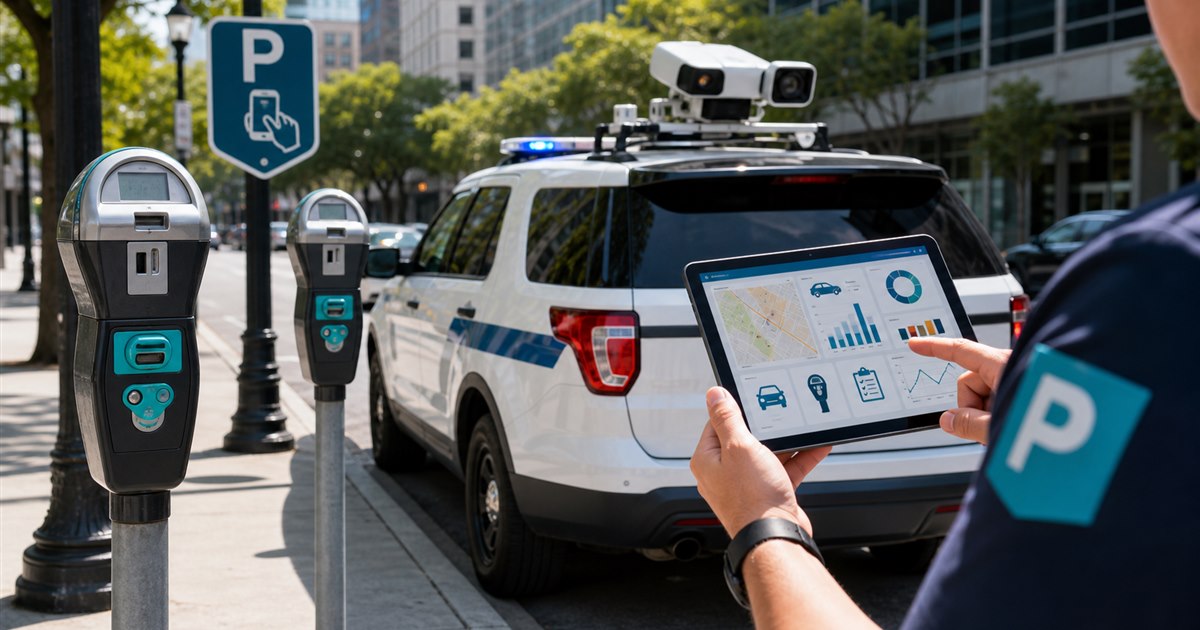
Direct answer: Treat meters, digital permits, mobile payments, and enforcement as one municipal operating chain. The payment channel should produce a location-and-plate entitlement that enforcement can verify, finance can reconcile, and residents can correct when a mistake occurs.
This guide is for municipal parking directors, finance teams, enforcement leaders, procurement staff, and residents and addresses choosing municipal parking payment workflows for meters, permits, and enforcement. The boundary matters because adjacent use cases may require different evidence and authority.
What must work
Cities often procure the payment interface separately from signage, permit rules, enforcement refresh timing, reconciliation, and support.
Example: A driver pays by zone while an enforcement officer checks by plate. If the zone map, plate entry, payment timestamp, and enforcement feed do not agree, a valid payer can still receive a citation.
Municipal channel-integration matrix
| Decision point | Evidence or control | Required response |
|---|---|---|
| Meter payment | space or plate, rate, receipt | publish enforcement evidence |
| Mobile session | zone, plate, time, extensions | synchronize entitlement promptly |
| Digital permit | eligibility, vehicle list, effective dates | define activation and expiry |
| Citation review | payment and permit evidence | offer a documented correction path |
Assign each handoff
- Step 1. Review meter payment: space or plate, rate, receipt; then publish enforcement evidence.
- Step 2. Review mobile session: zone, plate, time, extensions; then synchronize entitlement promptly.
- Step 3. Review digital permit: eligibility, vehicle list, effective dates; then define activation and expiry.
- Step 4. Review citation review: payment and permit evidence; then offer a documented correction path.
Record the source, timestamp, correction, and approval behind the result.
Escalation boundary
When a system or communications link is unavailable, the city needs a time-bounded fallback for drivers and enforcement rather than silently treating missing data as nonpayment.
Correct the record, approve a bounded exception, deny under the documented rule, or escalate to the named authority; do not leave the case open-ended.
Measure the live process
Do not average away a serious failure mode.
- paid sessions visible to enforcement
- plate or zone corrections
- valid-payment citations
- reconciliation exceptions
- support cases by payment channel
Define who counts each measure, the observation period, and the result that prevents expansion.
Approval evidence
- State the purpose and non-goals for choosing municipal parking payment workflows for meters, permits, and enforcement.
- Assign owners for the normal path, correction, exception, and final approval.
- Test live conditions with the people who administer and experience the workflow.
- Confirm contracts, pricing, integrations, support, data handling, and governing requirements independently.
- Retain the evidence needed to reproduce an approval, denial, correction, or escalation.
Related PLACA.AI planning resources
Frequently asked questions
What should be approved first for choosing municipal parking payment workflows for meters, permits, and enforcement?
Approve the purpose, responsible owner, decision rule, required evidence, and exception path before selecting a broad rollout.
What should the pilot prove?
The pilot should reproduce the normal path and the exception described above, while collecting paid sessions visible to enforcement and the other named measures.
When should implementation stop?
Stop when the required evidence is unavailable, ownership is unclear, a serious exception has no safe route, or the actual result conflicts with the approved rule.
Plan a limited workflow review
Bring the current rule, process, exceptions, and success criteria for choosing municipal parking payment workflows for meters, permits, and enforcement. PLACA.AI can help evaluate a bounded pilot without assuming another property’s workflow is the right answer.
Editorial refresh: July 22, 2026. Independently confirm current product capabilities, third-party features, pricing, contracts, governing requirements, and local rules before acting.
Data source: U.S. Department of Transportation