

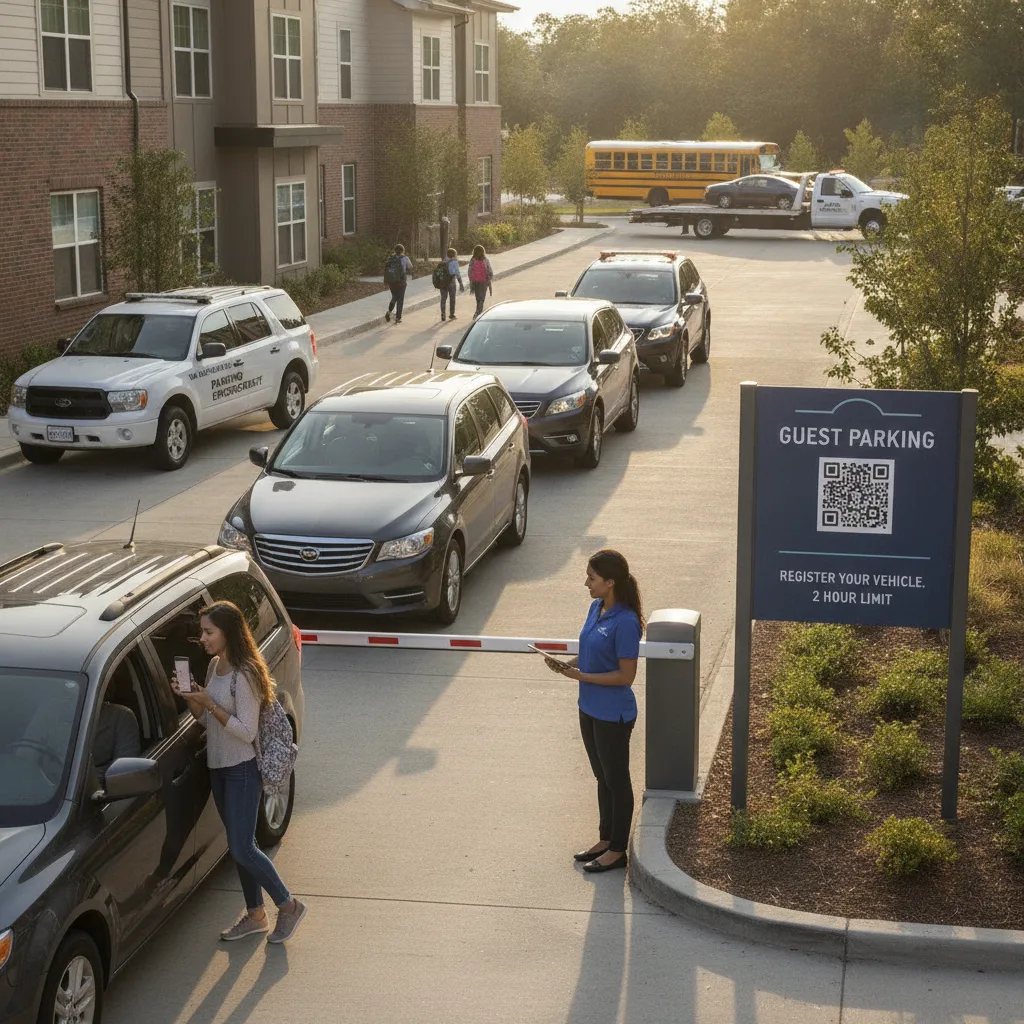
Direct answer: Self-parking compliance in guest parking depends on being able to answer one question fast: which resident is this guest visiting? A scan-and-pay session that doesn’t capture a resident link is compliant on paper but useless when a vehicle overstays, blocks a spot, or gets disputed — because there’s no one to call. Improve compliance by requiring a resident match at checkout, giving leasing staff a fast lookup tool, and treating repeat noncompliant guests as a pattern tied to the sponsoring unit, not just a plate.
When an apartment guest doesn’t comply — doesn’t scan, doesn’t pay, overstays a visit window — the property’s real problem isn’t just an unpaid space. It’s that nobody on staff can say who invited that vehicle. Leasing offices end up guessing, checking sign-in sheets that may not exist, or towing a vehicle that turns out to belong to a resident’s visiting parent. For apartment guest parking managers, the fix that matters most isn’t more enforcement — it’s a faster, more reliable way to trace a plate back to a unit.
Why plate-only compliance falls short for guest parking
A resident parking program can enforce against a static roster: plate, unit, done. Guest parking can’t, because the vehicle usually isn’t in any system until the moment it arrives. A compliance program built only around “did this plate pay” misses the actual accountability question a property needs answered: which lease is this guest attached to, and who should hear about it if something goes wrong?
That distinction matters most at the moment of a dispute. If a guest’s car is blocking a fire lane or has overstayed a three-day visit window, staff need to reach the resident quickly — not search a spreadsheet or ask around the leasing office. A checkout flow that captures the resident’s unit or name at the time of payment turns that lookup from a 20-minute scramble into a search.
Resident-to-guest tracing checklist
| Situation | What staff need | Where it should come from |
|---|---|---|
| Guest vehicle overstays visit window | Sponsoring resident’s contact info | Captured at QR checkout, not looked up after the fact |
| Guest doesn’t scan at all | A way to identify the visit even without a payment record | Callbox or intercom logs cross-referenced with the visitor list |
| Repeat noncompliant guests from one unit | A pattern tied to the resident, not just recurring plates | Guest violations grouped by sponsoring unit over time |
| Resident disputes a guest’s tow | Proof the guest either was or wasn’t sponsored at time of parking | Timestamped sponsorship record from checkout |
Building the resident link into the workflow
- Require a unit number or resident name field at QR checkout before payment completes, and validate it against the current resident roster in real time.
- Give leasing staff a live search by plate, unit, or resident name so a dispute or overstay can be resolved without a phone tree.
- When a guest can’t be matched to a resident, flag the session as unsponsored rather than blocking or silently allowing it, and route it to a staff member with a same-day deadline.
- Track violations by sponsoring unit, not only by plate, so a pattern of repeat noncompliant guests from one apartment is visible before it becomes a lease issue.
- Give residents a way to see and manage their own guest sessions, which reduces the number of “who is this car” calls staff have to field.
A scenario worth testing directly: a guest’s visit runs past the approved window because the resident forgot to extend it, and by the time enforcement notices, the resident is unreachable. If the system can show that the vehicle was originally sponsored and simply overstayed — rather than treating it as an unknown, unauthorized vehicle from the start — staff can apply a grace period and a resident notice instead of an immediate tow. That distinction only exists if the sponsorship link was captured up front.
What to measure
- Share of guest sessions with a valid resident match at checkout
- Average time for staff to identify the sponsoring resident during a dispute
- Repeat noncompliant guests traced back to the same unit within a 90-day window
- Unsponsored sessions resolved same day versus left open
- Resident complaints about incorrect towing or enforcement of a guest they did sponsor
Review these weekly for the first month of any policy change, since guest patterns shift with move-in cycles, holidays, and seasonal visits. A property with a lot of short-term subleases or student housing turnover will need tighter resident-matching checks than a stable long-term community.
Where LPR adds a second layer
Pairing the QR sponsorship record with license plate recognition gives staff a second way to confirm a vehicle actually arrived and how long it stayed, even if the initial sponsorship data was incomplete. The guide to combining LPR with QR auto-pay for apartment guest parking covers how that pairing works in practice, and the resident parking report workflow is a useful reference for routing a guest violation back to the correct lease file without treating every visitor mix-up as a formal complaint.
Internal Resources
- commercial pillar
- technical authority
- related resource
- contact form
- Bike Bus Dismissal Workflow for School Pickup Lines
- How Apartment Guest Parking Managers Can Handle Unpaid Parking Sessions Without Adding More Hardware
- Patrol Software vs. Mobile LPR: A Practical Comparison for HOA Patrol Operators
- How Hotel Parking Teams Can Manage Monthly Permit Upgrades Without Adding More Hardware
- How Restaurant Valet Operators Can Improve SMS Valet Communication Using Ticketless Vehicle Recognition
Related Resources
For a deeper commercial overview, see Placa.ai’s qr self parking solution. Technical teams may also want to review related automation workflows and compare them with supporting use cases.
Field Questions Operators Ask
How do we identify which resident a non-compliant guest belongs to?
Capture the resident’s unit number or name at QR checkout before payment completes, and validate it in real time against the current resident roster. That link is what lets staff search by plate, unit, or resident name later instead of relying on memory or a sign-in sheet.
What happens when a guest doesn’t scan and there’s no payment record at all?
Cross-reference callbox or intercom access logs with the visitor list, since a guest who was buzzed in usually left some record even without completing a parking payment. If neither exists, treat the vehicle as unsponsored and route it to staff for a same-day check before any enforcement action.
How should repeat guest violations from the same apartment be handled?
Track violations by sponsoring unit, not just by plate. A resident whose guests repeatedly overstay or fail to comply is a pattern the leasing office should see and address directly with that resident, separate from one-off visitor mistakes.
What should staff do when a resident disputes a guest’s tow?
Pull the timestamped sponsorship record from checkout. If the guest was sponsored and simply overstayed, that’s a different situation than an unsponsored vehicle, and it usually calls for a grace period and a resident notice rather than treating the tow as automatically justified.
How much data should the property actually collect on guests?
Collect only what the workflow needs: plate, arrival time, visit window, and the sponsoring resident’s unit. Avoid collecting or retaining guest details beyond what’s needed to resolve a dispute or overstay.
Plan Your QR Self Parking Rollout
If your team is working through how to trace guest vehicles back to the right resident, Placa.ai can help map the checkout fields, lookup tools, and escalation path before you roll it out property-wide.
Data source: U.S. Department of Transportation