

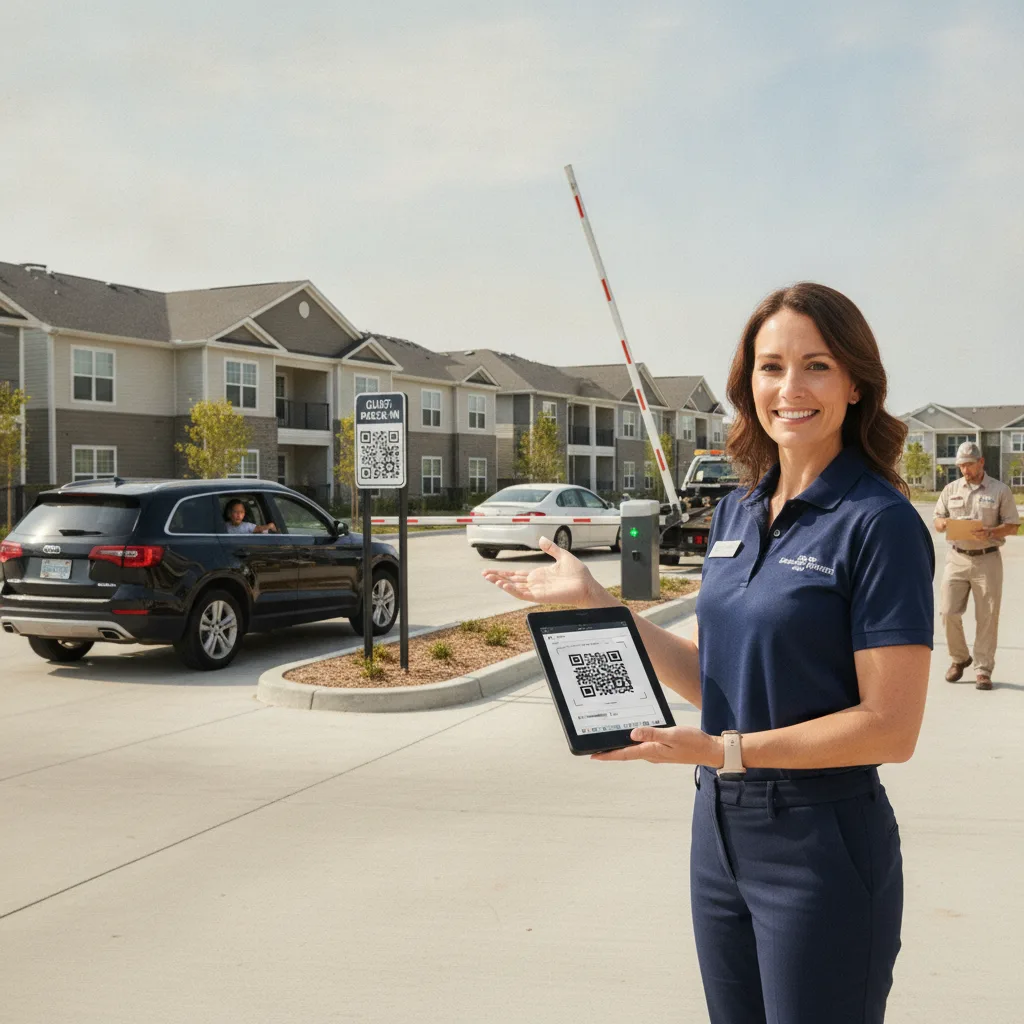
How Apartment Guest Parking Managers Can Connect QR Sessions To License Plates Without Adding More Hardware
Direct answer: The reliable way to connect a guest’s QR parking session to their license plate at an apartment community is to anchor the record to the resident who invited them, not to a generic “authorized vehicle” list. When a resident issues a guest pass through the resident portal, that pass should carry the unit number, the guest’s plate, and a start and end time. The existing scan-and-pay QR flow at the guest lot, paired with a single plate camera at the drive lane, is usually enough to match arrivals against that resident-issued list — no gate arms or per-space kiosks required.
This guide is for apartment guest parking managers, leasing staff, on-site community managers, and the enforcement or patrol vendors who work guest and visitor lots.
Why a plate-only allowlist breaks for guests
Resident parking is comparatively easy to automate: the leasing office knows which units have which permitted plates, and that list changes slowly. Guest parking is the opposite. Guests change by the day, sometimes by the hour, and the leasing office is closed for most of the hours guests actually arrive. A plate list built the way resident permits are built — one flat table of “authorized” plates — cannot capture who invited a given guest, which is exactly the fact a manager needs when a guest overstays, a dispute happens, or a tow decision gets challenged.
Example: A resident in Building C invites a guest for a weekend visit and texts them a QR link. The guest arrives Friday night in a car the resident didn’t mention — a rental, because their own car was in the shop. If the system only checks “is this plate on a list,” the guest is unauthorized and gets flagged. If the system checks “does an active guest pass from Building C match this arrival window,” the resident’s actual intent is what gets verified, not a plate they never entered.
Make the resident-to-guest link the actual record
| Decision point | What gets checked | Result |
|---|---|---|
| Resident issues a guest pass | Unit number, guest plate (if known), valid arrival window | Creates a guest record tied to that unit, not a standalone plate entry |
| Guest scans the QR code and pays or checks in | Plate capture at the drive lane, matched against active guest records for that property | Session is linked to the sponsoring resident automatically |
| Guest plate doesn’t match the record the resident entered | Arrival time falls inside the resident’s approved window | Session still links on time-and-unit match; flagged for a quick resident confirmation, not an automatic violation |
| Guest overstays the approved window | No active sponsor record covering the current time | Routed to patrol review with a grace period, not straight to towing |
How the workflow runs day to day
- The resident creates the pass before the guest arrives. A simple mobile form — unit, guest name, expected plate if known, and a time window — is enough. Residents shouldn’t need to know their guest’s plate in advance; the system should let them confirm it at arrival if it wasn’t entered.
- The guest scans and the plate gets captured automatically. The QR session and the plate read happen in the same moment at the drive lane, so staff never have to manually type a plate into a spreadsheet.
- Matching runs against sponsor records, not a blanket list. The system looks for an active, unexpired guest pass tied to a unit whose timing fits the arrival, rather than asking only “is this plate on file anywhere.”
- Mismatches get a short, defined grace step. A guest whose plate doesn’t match what the resident typed, or who arrives slightly outside the window, should trigger a text to the resident or a patrol check — not an immediate citation.
Where apartment guest lots actually break
The failure cases that matter here are specific to multifamily property, not generic parking. A resident forgets to log a guest and calls the after-hours line at 11 p.m. A guest shares their QR link with a second car that arrives separately — the same kind of code-sharing that shows up in QR payment fraud patterns at private lots generally. Temporary tags or dealer plates on a new or rental vehicle don’t match what a resident entered by memory. Two buildings on the same street have visitor lots close enough that guests park in the wrong one. Overflow during a resident’s birthday party or holiday visit fills the guest lot before the assigned spaces for other guests. Each of these needs a resolution path that a leasing associate can act on without a manager present, and each should be logged with the same structure a resident parking report would use, so a repeat pattern shows up in the record instead of disappearing into individual memory.
What to measure before expanding site-wide
- Guest plates that arrive with no matching resident record
- Disputes that get reversed once a resident confirms a guest after the fact
- Overstays resolved by a resident extension versus overstays that go to enforcement
- Average time between guest arrival and a confirmed match
- After-hours leasing calls tied to guest parking confusion
Run this at one building or one guest lot for two to four weeks before extending it property-wide. A community with several buildings sharing one visitor lot should pilot there first, since that is where mismatched plates and overflow are most common.
Rollout checklist
- Confirm how residents will issue guest passes today — portal, app, or text to leasing — and don’t force a channel change on day one.
- Set a real grace window for plate mismatches and overstays before any tow or citation trigger fires — communities that skip this step end up relitigating the same disputes that a clear rule-change-before-towing process is meant to prevent.
- Give leasing staff a single screen that shows the guest record next to the plate scan, not a raw camera feed they have to interpret.
- Decide, in writing, who can override a lapsed guest pass when a resident insists the visit was legitimate.
- Pilot in the lot with the most current complaints, then expand once mismatches and after-hours calls drop.
Internal Resources
Related Resources
For a deeper commercial overview, see Placa.ai’s qr self parking solution. Technical teams may also want to review related automation workflows and compare them with supporting use cases.
Field Questions Operators Ask
What should parking operators, property managers, hospitality teams, and lot owners running self-service parking confirm before evaluating connect QR sessions to license plates QR self parking?
They should confirm the exact rule they want to enforce, the vehicle data needed to support that rule, who reviews exceptions, and what outcome will prove the workflow is better than the current manual process.
What is the most useful first use case for qr self parking?
A practical first use case is when a parking operator starts by connecting each scan-and-pay session to a plate record so staff can review unpaid or overstayed sessions without adding kiosks. That keeps the pilot narrow enough to train staff, check data quality, and measure whether the process actually improves.
Which questions would an operator usually ask about connect QR sessions to license plates QR self parking?
Operators usually ask what happens when a plate is misread, how temporary vehicles are handled, whether staff can review the evidence, how long records are kept, and how the workflow prevents unfair enforcement.
What data should the team collect, and what should it avoid collecting?
Collect only the operational data needed for the workflow: plate, time, location, permit or account match, event history, and reviewer notes. Avoid collecting unrelated personal details or keeping records longer than the policy requires.
What does Placa.ai usually recommend as the safest rollout path?
Placa.ai’s opinion is that teams should start with a written policy, a limited pilot, a warning or education period, and a clear human review step before enforcement decisions become routine.
How can a team make the article’s advice unique to its own operation?
Add the real failure points staff see every week, the current workaround, one example dispute or bottleneck, the policy language used today, and the metric leadership already cares about.
What is a useful field example for this topic?
A useful example is a team comparing manual notes against plate-based event history for the same workflow. If the plate record reduces lookup time, missing evidence, or repeated manual checks, the workflow has a stronger business case.
How should exceptions be handled?
Exceptions should be documented in the same system as normal events. Temporary permits, rental cars, caregivers, vendors, emergency situations, and data entry corrections all need a review path that staff can explain later.
Which metrics prove the workflow is helping?
The best metrics are operational: fewer disputes, faster review time, fewer unauthorized vehicles, shorter queues, more complete evidence, fewer manual lookups, and fewer staff hours spent reconciling spreadsheets or paper notes.
When should a team avoid automating this workflow?
A team should wait if the policy is unclear, the vehicle data is outdated, staff do not know who owns exceptions, or leadership cannot define what success should look like after the pilot.
Plan Your QR Self Parking Rollout
If your team is evaluating connect QR sessions to license plates QR self parking, Placa.ai can help map the policy, vehicle data, and operating workflow before you roll it out.
Data source: U.S. Department of Transportation