

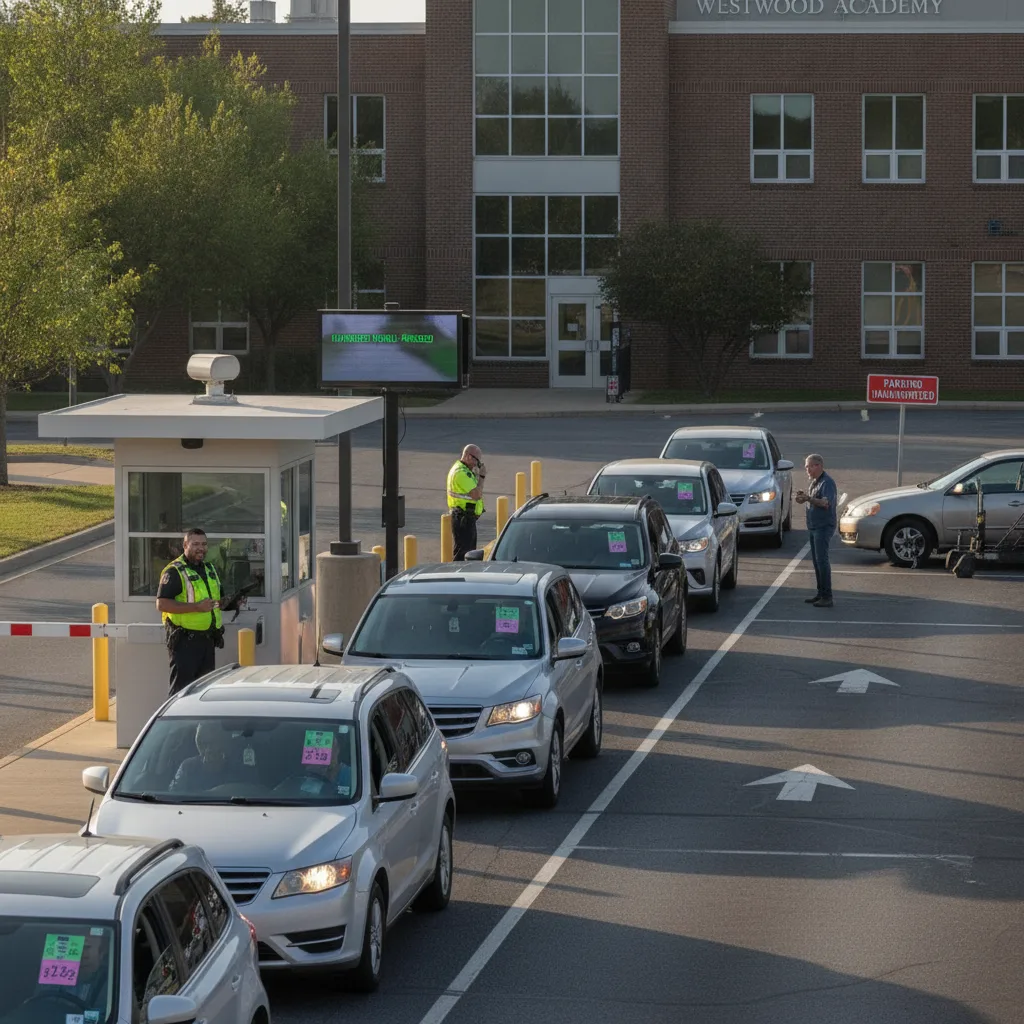
Direct answer: For campus safety teams, car-tag confusion is not primarily a traffic annoyance – it is noise that buries the one vehicle you actually need to notice. If every mismatched or missing tag gets the same radio call as a genuinely unrecognized vehicle circling the lot, staff stop treating any alert as urgent, and that habituation is exactly what lets a real unauthorized vehicle slip through unchallenged. Cut the noise by resolving routine tag mismatches (a lost tag, an unlisted grandparent, a same-day driver) through the front office before they reach the safety team, and reserve staff attention for vehicles that do not match any authorized record at all.
This guide is for campus safety officers, school resource officers, and the security and monitoring staff who watch the pickup lot alongside dismissal duties. It addresses the specific failure mode safety teams run into: a system that treats routine paperwork problems and genuine security concerns as the same category of alert.
Alert fatigue is a security problem, not just an efficiency problem
A pickup lane generates dozens of small mismatches every afternoon – a tag left at home, a name spelled differently on two forms, a grandparent who was never added to the list. If campus safety is looped into every one of those as a “stop and verify,” the team spends its attention on paperwork instead of on the smaller number of vehicles that genuinely do not belong: a car with no record at all, a vehicle that has circled the lot multiple times without approaching the loading zone, or a plate that matches a district-wide restricted list. The job of a well-designed workflow is to route the first category to the front office quietly and put only the second category in front of a safety officer.
Example: A vehicle with no matching record circles the visitor lot twice during dismissal, never joining the pickup line. In a system where every tag mismatch also triggers a radio call, this vehicle is one alert among a dozen routine ones and easy to miss. In a system that filters out routine mismatches, it is the only alert campus safety sees – which is the point.
Separating routine noise from a genuine security signal
| Situation | Who should handle it | Why |
|---|---|---|
| Tag missing, adult is on the authorized list | Front office | Identity is already established – this is a paperwork gap |
| New driver, not yet on the list | Front office, same-day approval | Resolved by a phone call to the parent, not a curb confrontation |
| Vehicle has no record at all, in the loading line | Campus safety | No identity has been established – requires a direct check |
| Vehicle circling without approaching pickup | Campus safety | Behavior pattern outside the normal dismissal flow |
Keep the pickup channel separate from the lockdown channel
Dismissal-time monitoring and emergency response share a location but should not share a communication channel. A safety team that spends the last twenty minutes of the school day fielding routine tag questions has that much less bandwidth if a genuine incident starts at the exact same time – and dismissal is a statistically common window for exactly that kind of incident. Keeping routine car-tag resolution on a front-office channel, with campus safety looped in only for the unresolved or genuinely unmatched cases, means the safety radio stays clear for what it is actually for. Teams building out a broader reunification or emergency posture should review the Standard Reunification Method alongside this – a quiet, low-noise dismissal channel is also what makes an emergency escalation to full reunification procedures recognizable as a real escalation rather than one more radio call.
Build the record you’d want after an incident
If an unauthorized vehicle does get flagged, the value of the stop depends on what got recorded: plate, time, description of the interaction, and disposition. A license-plate match at the gate gives campus safety a timestamped record automatically, rather than relying on an officer’s handwritten notes reconstructed after the fact. That record matters twice – once in the moment, to confirm the vehicle genuinely does not match any authorized entry, and again afterward, if the incident needs to be reviewed by administration or shared with law enforcement. Review how this connects to verifying authorized pickup vehicles campus-wide, since the two controls reinforce each other – one keeps routine traffic moving, the other flags what doesn’t belong.
What to measure before expanding the process
- routine mismatches resolved by the front office without a safety-team alert
- genuinely unmatched vehicles flagged to campus safety
- time from an unmatched vehicle’s arrival to a staff check
- false positives escalated to safety that turned out to be routine
- radio channel volume during the dismissal window
Owner sign-off
- State the purpose and non-goals for reducing car-tag confusion through campus safety.
- Name what gets routed to the front office versus what reaches the safety team directly.
- Test with the actual dismissal-time staffing, not a fully staffed drill scenario.
- Confirm contracts, pricing, integrations, data handling, and governing requirements independently.
- Retain a timestamped record for every vehicle that was flagged and how it was resolved.
Related PLACA.AI planning resources
Decision questions
What should be settled before this goes live for campus safety?
What counts as a routine mismatch versus a genuine unauthorized-vehicle alert, and who has final say when the two are hard to tell apart in the moment.
What belongs in the pilot?
A normal dismissal, at least one routine tag mismatch resolved by the front office, and one vehicle with no matching record, tested with the actual safety staffing on duty.
When should rollout pause?
If routine mismatches are still reaching the safety channel, if a genuinely unmatched vehicle was missed among routine noise, or if the record from a flagged stop is not complete enough to support a later review.
Plan a limited workflow review
Bring the current rule, process, exceptions, and success criteria for reducing parent car-tag confusion through campus safety. PLACA.AI can help evaluate a bounded pilot without assuming another campus’s workflow is the right answer.
Editorial refresh: September 18, 2026. Independently confirm current product capabilities, third-party features, pricing, contracts, governing requirements, and local rules before acting.
Internal Resources
- How School Transportation Directors Can Manage Rainy Day Carline Backups With Better Vehicle-Based Workflows
- How Front Office Staff Can Reduce Radio Call Overload With Better Vehicle-Based Workflows
- How Campus Safety Teams Can Verify Grandparent Pickup Permissions With Better Vehicle-Based Workflows
- How District Operations Teams Can Standardize Dismissal Across Campuses With Better Vehicle-Based Workflows
- How District Safety Teams Can Prove Every Student Release Was Staff-Approved Using a Tamper-Evident Audit Log
Data source: National Center for Education Statistics