

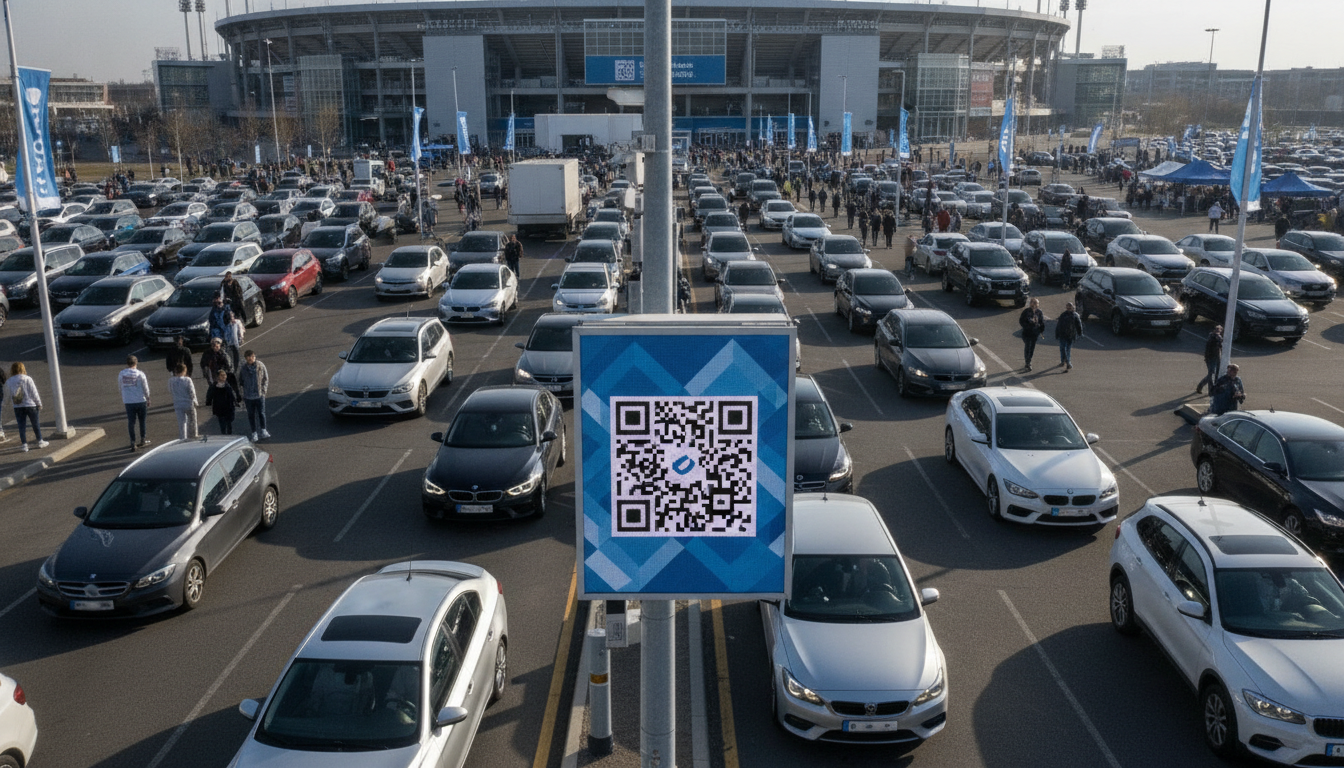
Direct answer: A single event lot doesn’t have all day to sort out a payment mismatch — it has the 60 to 90 minutes before gates open, when most of a night’s cars arrive at once. Prepayment has to survive that window: a plate that was purchased weeks ago has to be recognized in under a second per vehicle at the gate, a last-minute vehicle swap has to be correctable from a phone in the driveway on the way over, and one jammed lane can’t be allowed to back traffic onto the access road. Design for the arrival surge first; everything else about the booking flow is secondary to whether it holds up in that window.
This is written for lot managers running prepaid parking for a single high-volume event — a concert, a game, a festival — where thousands of cars need to clear the gate in a tight arrival window, not a portfolio of facilities running prepayment across different contract types.
The arrival window is the whole problem
Selling the prepaid pass is the easy part. The hard part happens 45 minutes before the show, when several lanes of cars are all trying to enter at once and every vehicle needs its plate checked against a purchase record in the time it takes to roll past the gate. A booking flow that works perfectly for the person who bought a pass in April falls apart if it can’t resolve a plate fast enough to keep four lanes moving during the surge.
Example: A driver bought a parking pass under their old car’s plate, then sold that car and drove a rental to the event. If the only way to update the plate is a support ticket that takes a day to process, that driver arrives at the gate with a valid pass that doesn’t match the vehicle in front of the reader, staff have to pull them aside to sort it out, and the lane behind them backs up for every car that follows.
What the high-volume window actually requires
| Moment | Failure mode under volume | What holds up |
|---|---|---|
| Weeks before the event | Duplicate purchases from repeated attempts on a slow checkout | Instant confirmation so buyers aren’t tempted to retry |
| Day of, before leaving home | Vehicle swap can’t be updated in time | Self-service plate change up to arrival, no support ticket needed |
| At the gate, peak surge | Plate lookup too slow, lane backs up | Sub-second match against the prepaid list, multiple lanes reading independently |
| Mismatch at the gate | Staff pull every uncertain case out of line | A staffed overflow lane specifically for exceptions, separate from the fast lanes |
Building for the surge, not the average
- Let buyers fix their own plate. Up until a defined cutoff — an hour before gates, typically — a buyer should be able to update the plate on their own pass without contacting anyone. This alone eliminates most of the gate-side mismatches.
- Separate the fast lane from the exception lane. Vehicles that match cleanly should never share a lane with vehicles that need a manual check. One or two staffed exception lanes keep the clean matches moving at full speed.
- Test the lookup at real volume, not a demo. A plate-matching system that works fine for ten test cars can behave differently at 300 cars an hour per lane. Load-test against the actual expected arrival curve, not a steady trickle.
- Reconcile after the gates close, not during. Refunds, no-shows, and duplicate purchases get resolved after the surge, once the priority — keeping vehicles moving — is no longer competing for staff attention.
What breaks the plan on event day
Connectivity is the usual failure point at a high-volume lot — a stadium concourse or a rural festival field can both have dead zones that a downtown garage never sees. Gate staff need an offline fallback: a downloaded or cached list of valid plates that still works if the live connection drops during the surge, with reconciliation catching up once connectivity returns. Duplicate purchases from a slow or confusing checkout page are the second common failure — if a buyer isn’t sure their payment went through, they’ll try again, and now there are two charges to untangle after the fact instead of one clean record.
What to measure after the event
Debrief every high-volume event while the details are fresh — lane-by-lane throughput, not just a single end-of-night total.
- Average time per vehicle at each lane during peak arrival, not just average for the whole night
- Plate changes completed before arrival versus mismatches caught at the gate
- Duplicate purchases identified and how they were resolved
- Vehicles routed to the exception lane, and what each one actually needed
If one lane consistently runs slower than the others at peak, check whether it’s a hardware or connectivity difference before assuming it’s a staffing problem — a lane with a weaker signal will bottleneck no matter how many staff are on it.
For keeping the lot moving when the payment system itself has a connectivity problem during the surge, see the parking system outage workflow. General compliance considerations for a self-parking event lot are in improving self-parking compliance for event lot managers, and the underlying scan-and-pay setup is covered in launching scan-and-pay parking for event lots. Buyers comparing how to book ahead can reference the mobile parking app guide.
Questions event lot managers ask before a big night
How late can a buyer change their plate?
Set a clear cutoff — commonly an hour before gates — and communicate it in the confirmation email so buyers know the window instead of discovering it’s closed when they try.
How many exception lanes do we need?
Enough that a mismatch doesn’t stall a fast lane behind it — for most single-event lots, one dedicated exception lane per three or four fast lanes is a reasonable starting ratio to test and adjust.
What if connectivity drops during the surge?
Gate staff need a cached list that works offline. Reconcile against the live system once connectivity returns rather than stopping vehicle flow to wait for it.
Plan a limited workflow review
Bring your expected arrival curve, lane count, and last event’s gate-time data. PLACA.AI can help stress-test the plan against your actual surge, not an average night.
Editorial refresh: September 19, 2026. Independently confirm current product capabilities, third-party features, pricing, contracts, governing requirements, and local rules before acting.
Data source: U.S. Department of Transportation