

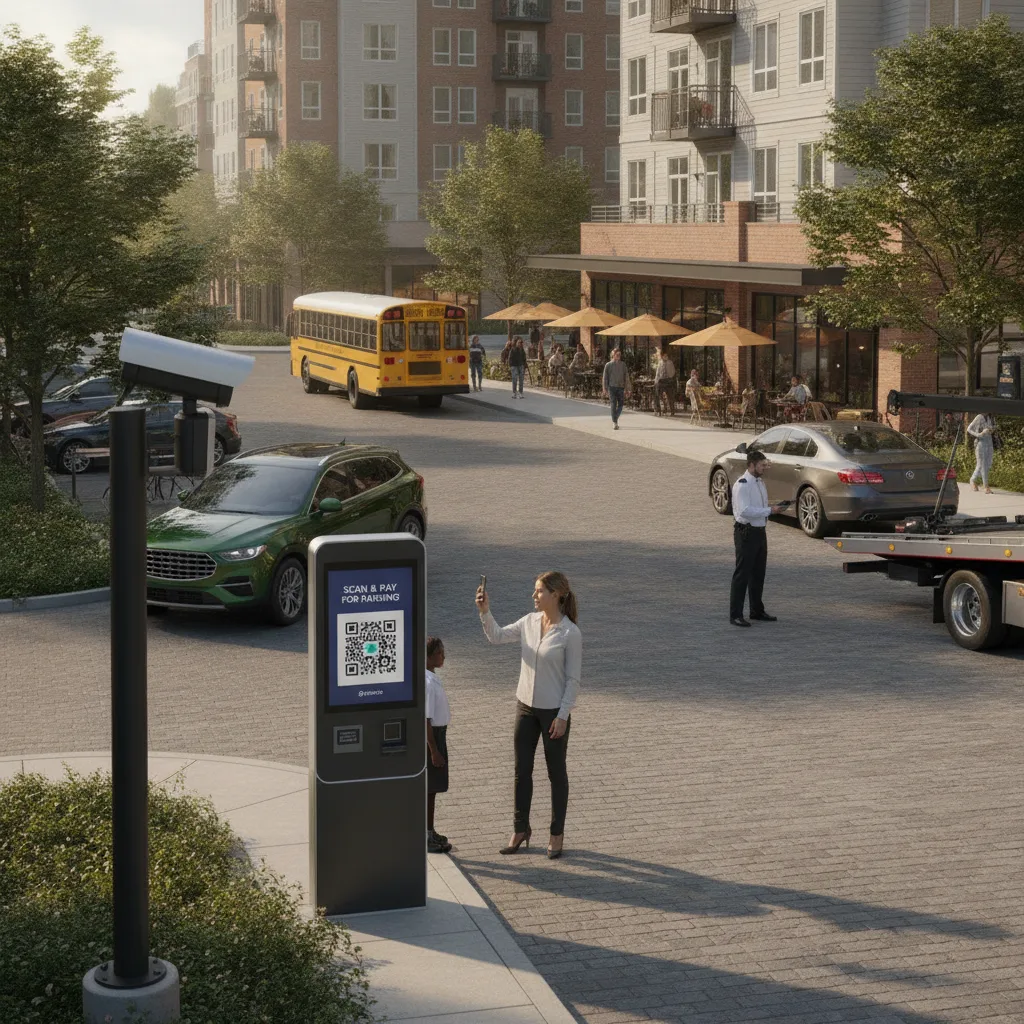
Direct answer: A mixed-use property isn’t one parking population, it’s three or four sharing the same physical spaces on different schedules: residents who need access around the clock, office tenants whose demand peaks on weekday mornings and empties out by evening, retail and restaurant customers whose demand peaks evenings and weekends, and visitors who don’t fit any of the standing categories. Combining LPR with QR auto-pay only works at a mixed-use property if the rate and access rules follow the time and the tenant type, not just the plate — the same space that’s reserved resident parking at 9 p.m. may need to be open retail-validated parking at 1 p.m., and a single flat rule for the whole facility will either overcharge residents or leave retail spaces sitting empty during a lunch rush.
This guide is for mixed-use property owners and the on-site teams — often a community manager for the residential portion and a separate commercial property manager for retail and office — who share one parking facility across tenant types with different needs.
Why shared parking in mixed-use works — and where the rules break
The underlying reason mixed-use properties can share fewer spaces than the sum of what each use would need standalone is that peak demand doesn’t happen at the same time for every tenant type. Office parking peaks on weekday mornings and clears out by early evening. Residential parking is fairly constant with an overnight peak. Retail and restaurant parking peaks evenings and weekends. This complementary-peak pattern is well established in mixed-use planning and is the entire justification for shared parking ratios that are lower than what each use would require on its own. But that same complementary pattern is exactly what breaks a flat, single-rule LPR and payment setup: a system that treats every plate the same, all day, either has to allocate spaces as if every tenant type peaked simultaneously (wasting capacity) or picks one tenant type’s needs to prioritize and shortchanges the others.
The plates a mixed-use LPR system needs to recognize fall into distinct categories that behave differently: resident plates that should have standing, no-friction access without a QR step every time; office tenant plates that should have business-hours access tied to their employer’s lease terms; retail and restaurant customer plates that need short-duration validated or paid parking, often with a merchant-issued discount or comp; and visitor plates with no standing record that need a straightforward pay-by-QR path. A workflow built only around “resident vs. everyone else” (the common apartment-property default) misses the retail validation case and the office business-hours case entirely.
Page-specific example: Simulate a retail customer’s plate entering the garage at 1 p.m. on a Saturday, when a portion of the facility is designated resident-priority overnight but open to the public during the day. Confirm the QR auto-pay rate applied matches the daytime public rate, not a resident-only rule or a flat rate that doesn’t reflect the time-based zone switch. Then simulate an office tenant’s plate arriving on a Sunday, outside their lease’s business-hours access window, and confirm the system correctly denies or charges guest rate rather than silently granting free access based on a stale weekday-only rule.
Mixed-use parking: matching the rule to the tenant type and the clock
| Tenant type | Typical access pattern | What the LPR + QR rule needs to check |
|---|---|---|
| Resident | 24/7, often assigned or reserved spaces | Standing plate record, no repeated payment step |
| Office tenant | Weekday business hours, tied to employer lease | Time-of-day and day-of-week rule, linked to employer’s active lease |
| Retail or restaurant customer | Short-duration, evenings and weekends peak | Merchant validation or time-limited public rate |
| Visitor with no standing record | One-off, unpredictable timing | QR pay-on-entry path that doesn’t require prior registration |
Who actually owns a rule change
Mixed-use properties often split management across a residential association or community manager and a separate commercial property manager handling retail and office leasing, sometimes under a reciprocal easement or shared-facility agreement that predates the current management teams. Before changing how LPR and QR auto-pay handle any tenant category, confirm who has authority to change that category’s rule — a rate or access change for the retail validation program usually isn’t the residential community manager’s call to make alone, and vice versa for resident-reserved spaces.
What belongs in a pilot
Run the pilot across a full week that includes both a weekday business-hours period and a weekend retail peak, since the failure modes for each tenant type only show up under their own peak conditions. Track whether resident access stayed frictionless, whether office access correctly followed business-hours rules on both weekdays and weekends, whether retail validation applied the right rate at the right time, and how many visitor plates completed payment without a standing record. A workable pilot shows each tenant type getting the access pattern appropriate to it, not one uniform rule applied everywhere.
Before expanding property-wide
- Confirm which manager or association owns rule changes for each tenant category before altering shared-facility rules.
- Verify retail and restaurant validation agreements are reflected in the rate rules, not maintained as a separate manual process.
- Check that office tenant access rules reference active lease status, so a vacated suite doesn’t retain standing access.
- Review any reciprocal easement or shared-facility agreement independently for parking allocation requirements.
- Retain a record of rule changes by tenant category so residential and commercial management aren’t overwriting each other’s settings.
Related PLACA.AI planning resources
Questions mixed-use property owners ask
Can one LPR and QR auto-pay system really handle four different tenant types?
Yes, as long as the rate and access rules are built around time-of-day and tenant category rather than a single flat rule for the whole facility.
Who decides the rate for shared spaces used by both residents and retail customers?
That should be settled explicitly between the residential and commercial management teams before go-live — it’s a common source of disputes when it’s assumed rather than agreed.
Do we need new cameras or gates to separate these tenant types?
No — this is a configuration question about how existing plate reads are matched against time-based rules and lease or validation records, not new hardware.
Plan a limited workflow review
Bring your current shared-parking ratios, any reciprocal easement or facility-sharing agreement, and each tenant type’s access hours. PLACA.AI can help evaluate a bounded pilot without assuming a single-use property’s rules apply to a mixed-use site.
Editorial refresh: September 18, 2026. Independently confirm current product capabilities, third-party features, pricing, contracts, governing requirements, and local rules before acting.
Internal Resources
- How Private Lot Owners Can Track Parking Receipts For Business Users Without Adding More Hardware
- How Private Lot Owners Can Manage Monthly Permit Upgrades Without Adding More Hardware
- How Apartment Enforcement Teams Can Prioritize High-Risk Lots With Mobile LPR Workflows
- How Hotel Parking Teams Can Improve Self-Parking Compliance Without Adding More Hardware
- How Hotel Valet Teams Can Track Repeat VIP Vehicles Using Ticketless Vehicle Recognition
Data source: U.S. Department of Transportation