

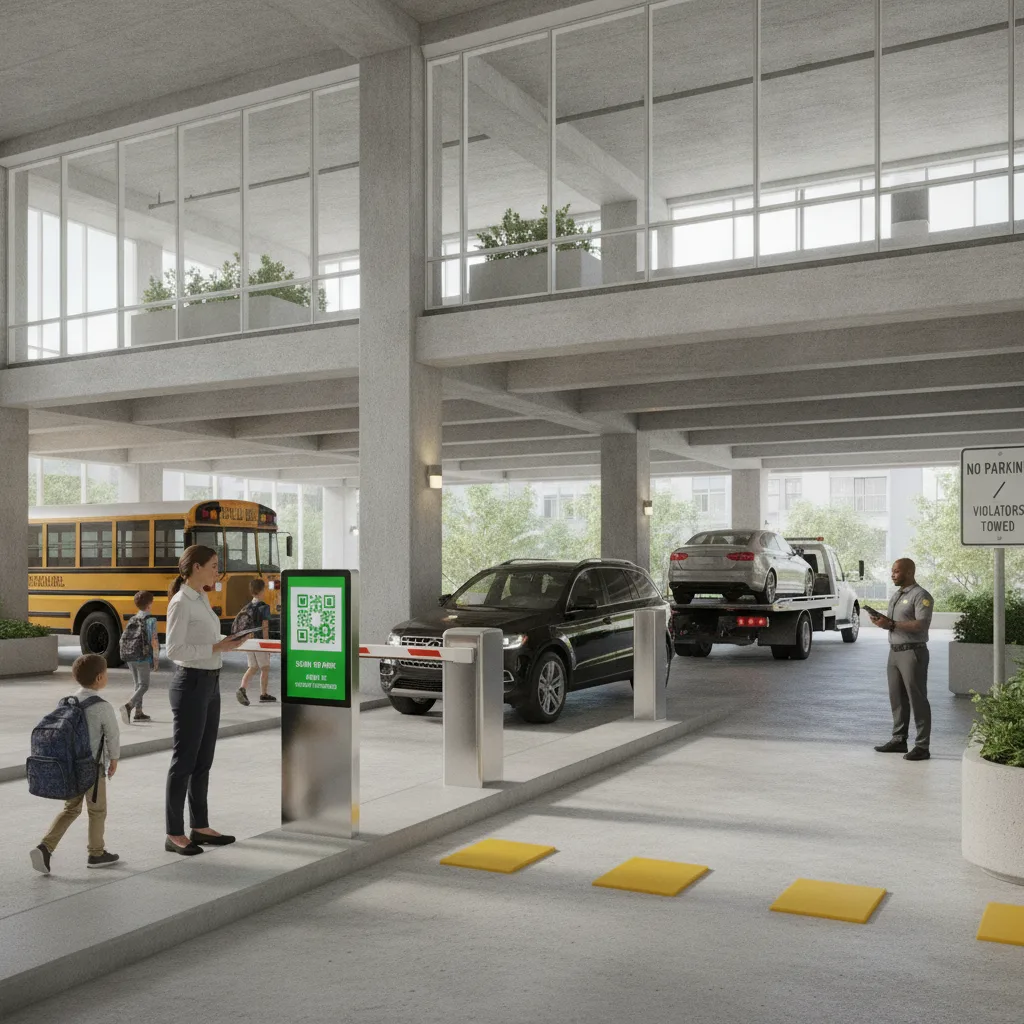
Direct answer: Improve compliance by separating resident, employee, customer, delivery, event, and visitor parking into understandable zones and time rules. Connect payment or validation evidence to enforcement and publish a correction path.
This guide is for mixed-use property owners, parking managers, tenants, residents, retailers, and enforcement teams and addresses improving self-parking compliance at a mixed-use property. Separate what the system detects from what an authorized person may decide.
Set a narrow outcome
Mixed-use garages create disputes when the same space changes purpose by floor, hour, tenant, or event and the driver cannot see which entitlement applies.
Example: A restaurant customer may receive evening validation in a zone used by office employees during the day. Signage, checkout, and enforcement must use the same schedule.
Mixed-use entitlement matrix
| Decision point | Evidence or control | Required response |
|---|---|---|
| Resident | vehicle and lease eligibility | assign stable access rule |
| Employee | tenant, shift, location, expiry | separate from customer inventory |
| Customer or visitor | validation, payment, duration | show usable zone and time |
| Delivery or event | temporary operating window | issue bounded exception |
Turn the rule into action
- Step 1. Review resident: vehicle and lease eligibility; then assign stable access rule.
- Step 2. Review employee: tenant, shift, location, expiry; then separate from customer inventory.
- Step 3. Review customer or visitor: validation, payment, duration; then show usable zone and time.
- Step 4. Review delivery or event: temporary operating window; then issue bounded exception.
Test the least convenient scenario, not only the happy path.
Stop conditions
When signage, validation, payment, access, or enforcement feeds disagree, suspend escalation for the affected case and correct the controlling rule.
Correct the record, approve a bounded exception, deny under the documented rule, or escalate to the named authority; do not leave the case open-ended.
Baseline and pilot
A rollout should stop when required evidence is missing.
- sessions matched to the correct user class
- validation and zone errors
- paid or authorized cases flagged
- space availability by user group
- corrections completed before penalty
Define who counts each measure, the observation period, and the result that prevents expansion.
Proof before rollout
- State the purpose and non-goals for improving self-parking compliance at a mixed-use property.
- Assign owners for the normal path, correction, exception, and final approval.
- Test live conditions with the people who administer and experience the workflow.
- Confirm contracts, pricing, integrations, support, data handling, and governing requirements independently.
- Retain the evidence needed to reproduce an approval, denial, correction, or escalation.
Related PLACA.AI planning resources
Operational FAQs
What should be approved first for improving self-parking compliance at a mixed-use property?
Approve the purpose, responsible owner, decision rule, required evidence, and exception path before selecting a broad rollout.
What should the pilot prove?
The pilot should reproduce the normal path and the exception described above, while collecting sessions matched to the correct user class and the other named measures.
When should implementation stop?
Stop when the required evidence is unavailable, ownership is unclear, a serious exception has no safe route, or the actual result conflicts with the approved rule.
Plan a limited workflow review
Bring the current rule, process, exceptions, and success criteria for improving self-parking compliance at a mixed-use property. PLACA.AI can help evaluate a bounded pilot without assuming another property’s workflow is the right answer.
Editorial refresh: July 22, 2026. Independently confirm current product capabilities, third-party features, pricing, contracts, governing requirements, and local rules before acting.
Data source: U.S. Department of Transportation