

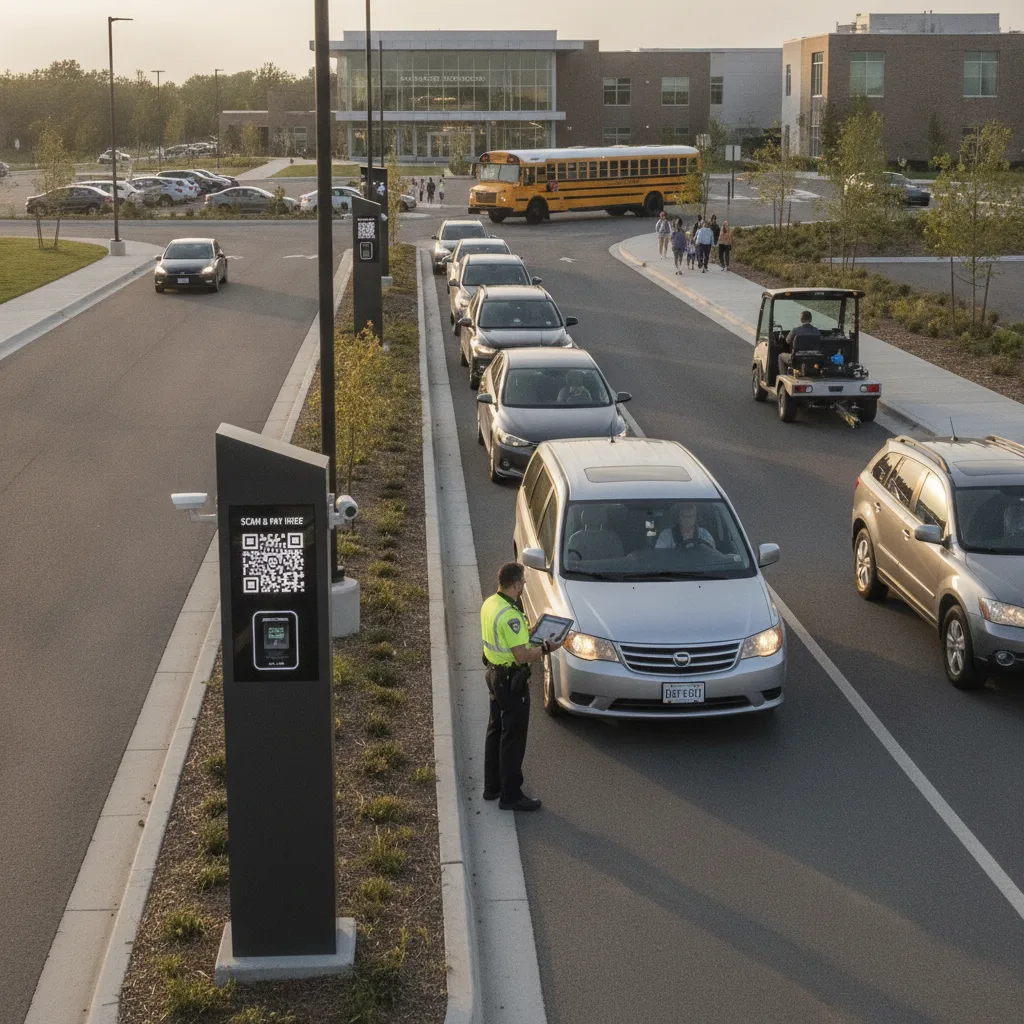
Direct answer: A private lot owner usually doesn’t have a gatehouse attendant, a front desk, or a booking system that already knows who’s supposed to be there — the plate read at entry often is the entire record. That changes what “improving compliance” means. A hotel or event venue is reconciling a plate against an existing reservation; an independent surface lot is often starting from nothing but the plate itself, a posted rate, and whatever payment method the driver chooses at a sign or a QR code. The fix that doesn’t require new hardware is making that single record — plate, timestamp, and payment status — do all the work a bigger property would split across a PMS, a gate system, and a staffed booth, since a small operator usually can’t afford to run three systems that don’t talk to each other.
This guide is for private lot owners and the small operations teams — often just the owner and one or two part-time staff — running unattended or lightly-attended surface lots, typically without a dedicated IT department or a parking management contractor handling day-to-day decisions.
Why the small-operator version of this problem looks different
A private lot’s economics are tighter than a hotel garage or a stadium lot subsidized by ticket revenue. Every unpaid space is a larger percentage hit to a smaller total, and every dollar spent on new equipment has to be justified against a lot that might only clear a modest daily margin. That’s the practical reason “without adding more hardware” matters more here than almost anywhere else in parking: a private lot owner is often already running one camera and one software subscription, and the question isn’t whether to add a second system — it’s whether the one system they have can be configured to close the gaps it currently misses, like grace-period abuse, expired day-passes that were never flagged, and vehicles that park across two rate periods without a second payment.
Unlike a hotel or venue, a private lot rarely has an existing customer record to check a plate against. There’s no reservation, no room folio, no season pass database in most cases — just the lot’s own posted rate and whatever the driver pays at entry or via a QR sign. That means the compliance question is almost always “does this plate have a valid, current payment record,” not “does this plate match something we already know about the driver.”
Page-specific example: Simulate a vehicle that pays for a two-hour block through the lot’s QR or kiosk payment, then stays four hours. Confirm whether the system flags the overstay automatically or whether it silently treats the original payment as covering the full visit — a common gap in lots where the payment step and the compliance check were set up separately and never actually reconciled against each other.
Private lot compliance: where the record actually breaks
| Situation | What typically breaks | What to confirm before relying on it |
|---|---|---|
| Overstay past a paid block | Original payment is treated as covering the whole visit | System checks elapsed time against paid duration, not just presence of any payment |
| Monthly or permit parker | Permit list is a separate spreadsheet nobody updates | Permit status lives in the same record the plate read checks against |
| Disputed charge | Owner has no timestamped record to point to when a driver disputes a charge | Every entry and payment event is retained with a timestamp the owner can pull up |
| Competing free curb parking nearby | Drivers park briefly, leave before payment posts, then return | Short-duration re-entries within the same day are handled by a clear, posted rule |
Running compliance without a back office
Most private lot owners are also the person who fields the phone call when a driver disputes a charge, and often the person deciding whether to call a towing company. That means the compliance workflow needs to produce something an owner can actually act on alone: a short list of genuine non-payments (not overstays or in-progress payments), with enough of a timestamped record to defend a charge if it’s disputed, and a clear line between “this vehicle simply never paid” and “this vehicle’s payment hasn’t synced yet.” Owners without a back-office team can’t afford to chase every ambiguous case — the list needs to be short and confident, not exhaustive.
What belongs in a pilot
Run it over a normal week that includes at least one weekend, since private lots near retail, restaurants, or event-adjacent areas often see very different patterns on weekends. Track how many flagged non-payments turn out to be payment-sync delays rather than genuine violations, how many overstays past a paid block get caught, and how long it takes the owner to resolve a disputed charge using the system’s record instead of memory. A workable pilot means the owner spends less time per week resolving disputes, not more.
Before relying on it day to day
- Confirm the rate rules (grace period, overstay threshold, permit exceptions) are entered correctly and match what’s posted on-site signage.
- Keep a simple, current record of permit or monthly parkers in the same place the plate check runs against — not a separate spreadsheet.
- Verify how disputed charges are resolved and what record the owner can pull up when a driver calls.
- Check local towing and enforcement rules independently before acting on a non-payment flag.
- Review the past month’s flagged cases periodically to catch a recurring false-positive pattern before it costs goodwill with repeat customers.
Related PLACA.AI planning resources
Questions private lot owners ask
Do I need a gate arm or attendant to fix this?
No — most of this is about reconciling the payment record against elapsed time and permit status, not about adding staffed control points.
How do I handle a driver who disputes a charge?
Pull the timestamped entry and payment record for that plate before the call, so the conversation is about a specific record instead of a memory of what usually happens.
What if my lot doesn’t have consistent internet or connectivity?
Confirm how the system behaves offline — whether it queues reads for later sync or simply misses them — before treating any gap in coverage as a compliance failure.
Plan a limited workflow review
Bring a week of your actual entry and payment records, your current rate rules, and a few recent disputed charges. PLACA.AI can help evaluate a bounded pilot sized for a single-operator lot, without assuming a larger property’s staffing or budget.
Editorial refresh: September 18, 2026. Independently confirm current product capabilities, third-party features, pricing, contracts, governing requirements, and local rules before acting.
Internal Resources
- How Apartment Guest Parking Managers Can Reduce Payment Kiosk Dependence Without Adding More Hardware
- How Luxury Residential Valet Teams Can Coordinate Valet Staffing On Busy Nights Using Ticketless Vehicle Recognition
- How Apartment Enforcement Teams Can Compare Patrol Software Workflows With Mobile LPR Workflows
- How Hotel Parking Teams Can Support Event Parking Prepayment Without Adding More Hardware
- How Private Property Towing Companies Can Capture Better Evidence Before A Tow With Mobile LPR Workflows
Data source: U.S. Department of Transportation