

Last reviewed: August 8, 2026
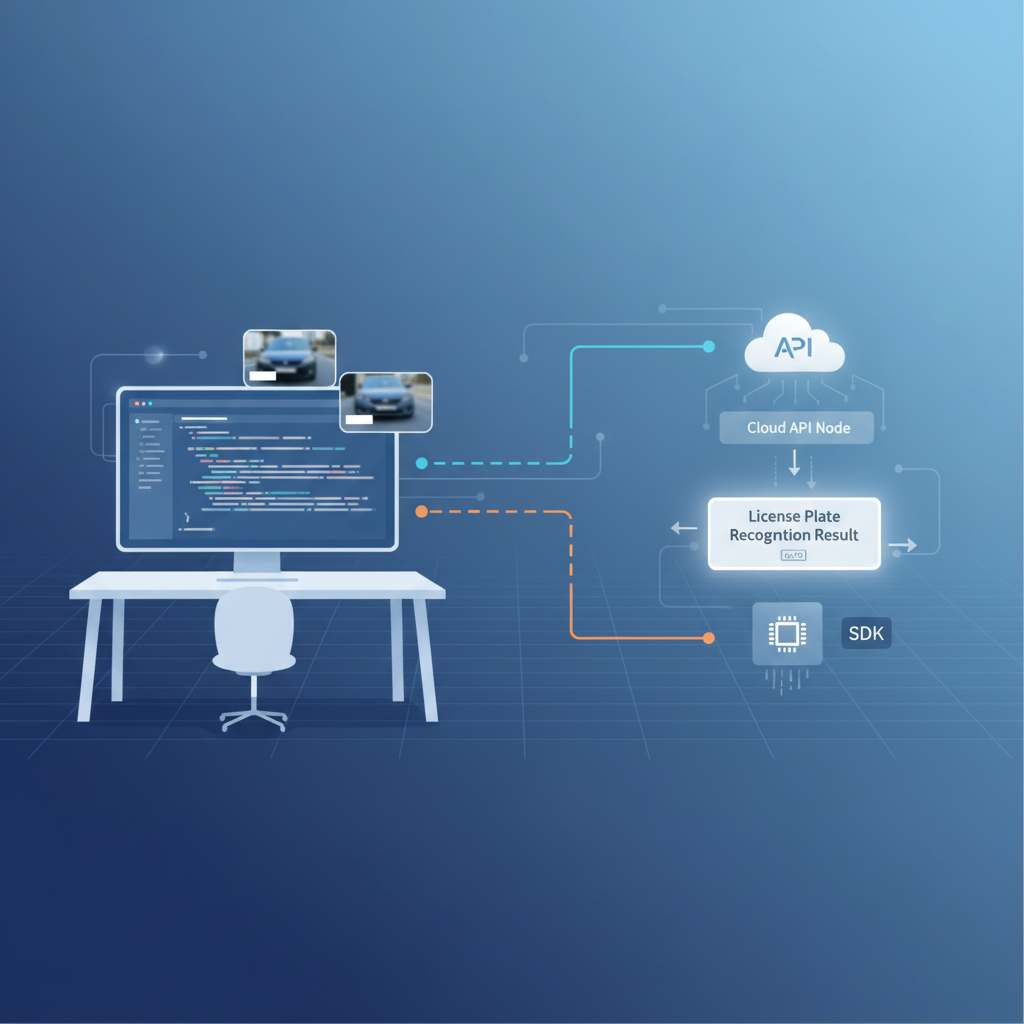
For most enterprise projects, a license plate recognition API vs SDK decision comes down to control, deployment location, latency, privacy, and maintenance. Choose an API when you want a faster connection to a managed recognition service. Choose an SDK when recognition must run inside your application or on hardware you control. Use a hybrid architecture when local recognition and centralized workflow automation are both important.
The best option is not the one with the longest feature list. It is the one that can turn a camera event into a reliable business action—such as opening a gate, matching a parking session, alerting staff, validating a pickup, or creating a review task—under your actual operating conditions.
Key takeaways
- An API is an interface that lets one system request or receive recognition results. An SDK is a broader development package that may include libraries, tools, documentation, samples, and one or more APIs.
- A cloud LPR API usually reduces deployment and model-maintenance work, while an on-premise LPR SDK generally provides more control over processing, hardware, and data location.
- API and SDK are not mutually exclusive. An enterprise system can recognize plates locally and use APIs or webhooks to send normalized events to cloud workflows.
- Recognition accuracy alone is not enough. Evaluate capture quality, end-to-end latency, event delivery, error handling, security, auditability, retention, and manual review.
- Test shortlisted options with representative cameras, plates, lighting, speeds, angles, and failure scenarios before committing to a production architecture.
License plate recognition API vs SDK: what is the difference?
A license plate recognition API defines how software sends an image, video frame, or event to a recognition service and receives a structured result. Depending on the product, the interface may be cloud-hosted, available on a local server, or exposed directly by an intelligent camera.
A license plate recognition SDK is a development kit used to build recognition into another product. It may contain compiled libraries, language bindings, sample applications, documentation, testing tools, and deployment components. The SDK itself can expose functions through an API, which is why the terms are related but not interchangeable. Adaptive Recognition provides a useful technical explanation of the relationship between ANPR APIs and SDKs.
The practical question is therefore not simply “API or SDK?” It is:
Where should recognition run, who should maintain it, what data can leave the site, and what must happen after a plate is read?
API vs SDK comparison
The license plate recognition API vs SDK comparison below maps the usual tradeoffs, but the final architecture should be verified against the provider’s actual hosting, licensing, and support model.
| Decision factor | LPR API | LPR SDK | Hybrid architecture |
|---|---|---|---|
| Typical processing location | Vendor cloud, private cloud, local server, or camera | Customer-controlled server, edge device, mobile device, or embedded system | Recognition at the edge with centralized APIs and workflow services |
| Initial integration | Usually faster when documentation and sample requests are complete | Usually requires more engineering and environment setup | Moderate; requires both edge and service integration |
| Control over recognition runtime | Limited to exposed settings and endpoints | Greater control over runtime, hardware, and application behavior | Local runtime control with centralized business rules |
| Offline operation | Depends on whether a local or on-premise API is available | Often better suited to disconnected operation | Can continue essential local functions during connectivity loss |
| Maintenance | Provider may manage model and service updates | Customer usually owns packaging, compatibility testing, and upgrades | Responsibility is divided between local and cloud components |
| Platform constraints | Often language-neutral over HTTPS | May be limited to supported operating systems, processors, or languages | Depends on the edge component and central API |
| Data boundary | Images or events may cross a network boundary | Processing can remain on controlled infrastructure | Raw data can remain local while selected events are transmitted |
| Scaling model | Service quotas, rate limits, bandwidth, and usage pricing | Hardware capacity, licenses, deployment automation, and support | Edge capacity plus central event-processing capacity |
| Best fit | Fast integrations, centralized applications, and variable volume | Embedded, offline, hardware-specific, or tightly controlled deployments | Multi-site enterprise workflows needing local resilience and central oversight |
This table describes common deployment patterns, not guarantees. Some vendors provide both cloud and on-premise APIs, while some SDKs package a local REST service instead of a library linked directly into an application. Verify the actual product architecture before comparing proposals.
When should you choose an LPR API?
Choose an LPR API when your primary goal is to add plate recognition to an existing application without operating the recognition engine yourself. This is often the most practical starting point for web platforms, pilot programs, business workflow integrations, and teams with limited computer-vision infrastructure.
An API is a strong candidate when:
- your application already exchanges data through HTTPS or event services;
- centralized updates are more valuable than control over the recognition runtime;
- the workflow can tolerate the expected network and service latency;
- image transfer is permitted by your privacy and security requirements;
- volume is variable and usage-based capacity is acceptable;
- your developers need language-neutral integration; or
- you want to validate the workflow before investing in edge infrastructure.
Do not choose an API only because the first request succeeds. Enterprise evaluation should include authentication, authorization, rate limits, timeouts, retry rules, versioning, regional availability, data retention, deletion, audit logs, support response, and behavior when the service returns no plate or a low-confidence result.
What should a license plate recognition API return?
At minimum, the response or event should make the recognition result traceable and usable. Required fields vary, but enterprise teams commonly evaluate:
| Field | Why it matters |
|---|---|
| Event ID | Supports deduplication, tracing, and audit history |
| Camera and site ID | Identifies where the event occurred |
| Capture timestamp | Establishes sequence and workflow timing |
| Plate text | Provides the recognition candidate |
| Jurisdiction or region | Helps distinguish similar plate formats |
| Confidence score | Supports automation and manual-review thresholds |
| Alternative candidates | Helps resolve ambiguous characters when available |
| Image reference | Preserves review evidence according to policy |
| Lane, direction, or zone | Connects the event to the correct physical workflow |
| Processing time and version | Helps diagnose latency and recognition changes |
| Match outcome | Distinguishes allowed, denied, unmatched, expired, or review states |
Webhooks can move results from a recognition service into another system without repeated polling. For example, Plate Recognizer documents data-only and image-bearing webhook formats and makes webhook delivery available for both its cloud service and on-premise SDK. This illustrates why event delivery should be evaluated separately from where recognition runs. See the vendor’s webhook and result documentation.
When should you choose an LPR SDK?
Choose an LPR SDK when recognition must run inside a controlled environment or needs deeper access to local hardware and application behavior. This can be important for offline gates, embedded camera systems, mobile enforcement, private networks, high-volume local processing, or products that need tightly integrated recognition features.
An SDK is a strong candidate when:
- a critical workflow must continue without internet access;
- raw images cannot leave the controlled environment;
- local processing is needed to reduce network dependency;
- the application must use specific CPUs, GPUs, accelerators, cameras, or mobile devices;
- developers need control over frame selection, regions of interest, processing cadence, or runtime settings;
- usage-based cloud calls would not fit the expected workload; or
- the recognition experience must be embedded deeply into an existing product.
The additional control creates additional responsibility. Confirm supported operating systems and processor architectures, library dependencies, model size, hardware acceleration, thread safety, upgrade procedures, backward compatibility, license activation, offline licensing, container support, and support for development, testing, and production environments.
An SDK pilot should also test resource consumption. Measure CPU or GPU load, memory, temperature on edge devices, frames processed per second, queue growth, restart behavior, and the effect of other applications running on the same hardware.
When is a hybrid LPR architecture better?
A hybrid model is often the strongest option when a site needs local speed or resilience but the organization also needs centralized policies, dashboards, integrations, and audit records.
A typical hybrid workflow looks like this:
- A camera or edge service captures a vehicle event.
- Local software detects and recognizes the plate.
- A normalization service converts the result into a consistent enterprise event.
- The site applies any safety-critical or offline rule that must happen immediately.
- An API or webhook sends the permitted fields to a central platform.
- Central business rules match the event to a permit, tenant, order, visitor, pickup, payment, or enforcement record.
- The workflow records the decision, exception, user action, and retention class.
Industry interfaces can reduce—but do not eliminate—integration work. ONVIF Profile M defines interfaces for analytics metadata and events, including vehicle and license-plate metadata, recognition events, and optional MQTT communication. Teams should still verify the exact features supported by each conformant device and client. Review the official ONVIF Profile M overview.
Enterprise LPR integration architecture
Whether the project uses an API, SDK, or both, separate recognition from business decisions. A plate-reading component should produce evidence and confidence data. A workflow layer should decide what that evidence means in the current site, account, time window, and policy context.
The architecture normally contains six layers:
1. Capture layer
Document the camera source, resolution, frame rate, shutter behavior, lighting, infrared illumination, lane geometry, vehicle speed, plate distance, and expected obstruction. Poor capture cannot be repaired reliably by changing the integration method.
2. Recognition layer
Define where detection and OCR run, which regions and plate types are supported, what confidence information is returned, and how unreadable or multiple-plate images are handled.
3. Event and normalization layer
Convert product-specific output into a stable enterprise schema. Add event IDs, timestamps, site context, and version information. Validate payloads and prevent duplicate delivery from producing duplicate business actions.
4. Business-rules layer
Match the event to an authorized list, permit, payment, order, tenant, pickup record, or review queue. Do not treat a plate string as sufficient proof for every decision. Use confidence thresholds, context, permissions, and human review according to the consequence of an error.
5. Destination systems
Send approved actions to the systems that staff already use: gate controllers, parking platforms, property-management systems, school dismissal tools, order-management systems, security dashboards, alerts, or case queues.
6. Operations and governance
Monitor latency, failures, duplicates, manual-review volume, camera health, model or version changes, access history, and retention. Assign an owner for both technical incidents and disputed business decisions.
Security and privacy requirements
Plate events can become sensitive operational records when connected to locations, accounts, access permissions, payments, or case histories. Security requirements should apply to the complete event path, not just the recognition endpoint.
The integration review should cover:
- service and device authentication;
- least-privilege authorization by role, site, tenant, and function;
- encryption in transit and at rest;
- secret and certificate rotation;
- signed or otherwise authenticated webhooks;
- input validation and file-size limits;
- rate limiting and resource controls;
- audit logs for searches, exports, changes, and decisions;
- separate development, testing, and production credentials;
- retention, deletion, legal hold, and backup behavior; and
- incident response when a device, token, integration, or downstream service is compromised.
NIST’s current guidelines for API protection in cloud-native systems recommend assessing API risks and applying controls across development and runtime stages. The architecture should also avoid granting trust solely because a device or service sits on an internal network; NIST SP 800-207 frames authentication and authorization around protected resources rather than network location alone.
Privacy and retention requirements vary by location and use case. Before launch, document the business purpose, fields collected, image handling, permitted users, third-party transfers, retention periods, deletion process, notice or consent requirements, and process for responding to access or correction requests. Obtain appropriate legal review for the deployment jurisdiction.
How to evaluate an LPR API or SDK
Use the same test plan for every shortlisted solution. This makes vendor results comparable and prevents a polished demonstration from substituting for evidence from the intended site.
Technical evaluation checklist
- Supported inputs: Confirm images, video files, RTSP streams, camera events, mobile capture, or batch processing as required.
- Deployment options: Document cloud region, private cloud, on-premise server, container, edge device, mobile, and offline support.
- Result schema: Confirm confidence, candidates, region, timestamps, camera identifiers, vehicle attributes, and version fields.
- Site performance: Test representative plates, angles, speeds, weather, glare, darkness, temporary plates, obstructions, and multi-vehicle frames.
- Latency: Measure capture-to-result and capture-to-business-action latency at median and high-percentile conditions.
- Event reliability: Test timeouts, retries, duplicate events, out-of-order delivery, failed webhooks, and recovery after an outage.
- Security: Review credentials, permissions, encryption, webhook verification, audit logs, vulnerability handling, and data isolation.
- Data governance: Verify image storage, retention controls, deletion, backups, exports, subprocessors, and regional data handling.
- Observability: Require health checks, logs, metrics, usage reporting, version visibility, and actionable error messages.
- Change management: Review API versioning, SDK release cadence, deprecation notice, rollback, and backward compatibility.
- Commercial model: Compare call volume, camera or core licenses, development licenses, support, hardware, bandwidth, storage, and upgrade costs.
- Supportability: Confirm documentation, sample applications, test credentials, sandbox behavior, service-level commitments, and escalation routes.
A practical decision scorecard
| Requirement | Likely starting point |
|---|---|
| Fast pilot in an existing web application | Cloud or managed LPR API |
| Recognition must continue without internet | On-premise SDK, local API, or hybrid |
| Raw images must remain at the site | SDK, local API, or edge-first hybrid |
| Deep integration with mobile or embedded hardware | SDK |
| Centralized rules across many locations | API or hybrid |
| Hardware-specific optimization | SDK |
| Small team that does not want to maintain recognition models | Managed API |
| Local action plus enterprise-wide reporting | Hybrid |
| Uncertain workflow and limited initial volume | API pilot, followed by architecture review |
Use this scorecard as a starting hypothesis, not the final decision. Licensing, camera conditions, data policy, availability targets, and existing infrastructure can change the answer.
Seven-step enterprise implementation plan
1. Define the business action
Write one sentence describing what should happen after a valid plate event. Identify the users, systems, decision owner, maximum acceptable delay, and consequence of a wrong decision.
2. Establish a baseline
Measure the current manual process: volume, processing time, error types, staffing, disputed events, and exception rates. The pilot needs a baseline to prove improvement.
3. Validate capture conditions
Test the intended cameras and lanes before building a large integration. Separate capture failures from recognition failures so the team knows what to fix.
4. Define the event contract
Agree on required fields, confidence thresholds, event IDs, retry rules, image references, retention class, and version behavior. Document how the receiving system handles missing and unexpected fields.
5. Build the exception path
Plan for unreadable plates, low confidence, duplicate events, no match, multiple matches, temporary plates, borrowed vehicles, lost connectivity, unavailable destination systems, and manual overrides.
6. Run a limited pilot
Start with one site, lane, workflow, or customer group. Compare the API, SDK, or hybrid result against a verified sample and monitor the full business action, not only OCR output.
7. Scale with operating controls
Create repeatable camera, deployment, credential, monitoring, retention, training, rollback, and support procedures before adding sites or higher-consequence automation.
Metrics that matter after launch
| Metric | What it reveals |
|---|---|
| Capture availability | Whether usable vehicle evidence is reaching recognition |
| Readable-plate rate | How often the system produces an actionable candidate |
| Verified match rate | How often the selected result agrees with reviewed ground truth |
| End-to-end latency | How long the complete business action takes, not only OCR |
| Automatic-action rate | How much volume can proceed without review under policy |
| Manual-review rate | Staff workload created by uncertainty and exceptions |
| False acceptance rate | Risk of acting on the wrong vehicle or record |
| False rejection rate | Friction caused by rejecting a valid vehicle or record |
| Duplicate-event rate | Reliability of event identity and delivery controls |
| Integration availability | Whether dependent systems can complete the workflow |
| Dispute or correction rate | Operational quality visible to customers and staff |
Define each metric before the pilot. “Accuracy” can refer to detection, character recognition, complete-plate matching, regional classification, or successful business decisions; those are not the same measurement.
Common mistakes to avoid
- Choosing the engine before defining the workflow. Start with the decision and evidence required after the read.
- Relying on a single accuracy percentage. Test against representative site conditions and report the denominator, thresholds, and failure types.
- Ignoring idempotency. Retries and duplicated events must not open a gate, create a charge, or send an alert twice.
- Automating every result. Route low-confidence and high-consequence cases to review.
- Forgetting camera and network dependencies. Recognition software cannot compensate for every capture or connectivity problem.
- Underestimating SDK ownership. Budget for hardware qualification, packaging, upgrades, security patches, monitoring, and support.
- Leaving retention undefined. Decide what is stored, why, for how long, and who can retrieve or export it.
- Skipping rollback. Version changes in an API, SDK, model, schema, or business rule need a tested recovery path.
How PLACA.AI approaches custom LPR integration
PLACA.AI designs custom license plate recognition workflows around cameras, databases, permissions, alerts, audit requirements, and business rules. The appropriate architecture may use APIs, SDK-style components, edge processing, centralized workflow services, or a combination based on the deployment requirements.
If you are evaluating a custom project, continue with the custom license plate recognition software guide. It covers the broader build, buy, white-label, and customization decision. For camera planning, review IP cameras that work with LPR software and the RTSP and IP camera setup guide.
Frequently asked questions
Is an LPR API the same as an LPR SDK?
No. An API specifies how software components communicate. An SDK is a development package that may include libraries, documentation, samples, tools, and APIs. Some LPR products expose a cloud REST API, while others provide an SDK that runs locally and may expose its own API.
Which is faster: a license plate recognition API or SDK?
Neither is automatically faster. A local SDK can avoid internet transit, but performance still depends on the camera, hardware, workload, model, queue, and application. A managed API may scale efficiently but adds network and service time. Compare end-to-end latency under representative load.
Can a license plate recognition API run on-premise?
Yes, if the provider offers a local service, container, server, or camera API. “API” describes the interface, not necessarily the hosting location. Confirm whether processing, images, logs, license checks, and support diagnostics remain on-premise or communicate with external services.
Do real-time gate systems always require an SDK?
No. A local camera API, on-premise recognition service, or hybrid system may meet the timing and resilience requirements. The design should define maximum response time, behavior during connectivity loss, safe fallback, and whether the gate controller can make a local decision.
Can an enterprise use both an LPR API and SDK?
Yes. A common design runs recognition locally through an SDK and sends normalized plate events through an API or webhook to centralized workflows. This can combine local resilience with enterprise-wide rules, integrations, monitoring, and reporting.
What is the first question to ask an LPR vendor?
Ask the vendor to map one representative camera event through recognition, result delivery, business matching, exception handling, storage, deletion, and audit history. This exposes how the product behaves as part of a workflow instead of evaluating OCR in isolation.
How should we choose between edge and cloud LPR?
Compare data-boundary requirements, offline operation, latency, bandwidth, camera count, hardware capacity, update ownership, multi-site management, and total operating cost. If local action and centralized oversight are both mandatory, test a hybrid architecture.
Next step
Before selecting an LPR API or SDK, document one workflow, one camera environment, one event schema, one exception process, and measurable pilot success criteria. This prevents a technology purchase from moving ahead without a deployable operating model.
Internal Resources
- How Casino Parking Teams Can Coordinate Valet Staffing On Busy Nights Using Ticketless Vehicle Recognition
- How HOA Patrol Operators Can Manage Overnight Patrol Routes With Mobile LPR Workflows
- How Hotel Parking Teams Can Improve Self-Parking Compliance Without Adding More Hardware
- Why Cloud LPR Is the Future of Parking Enforcement