

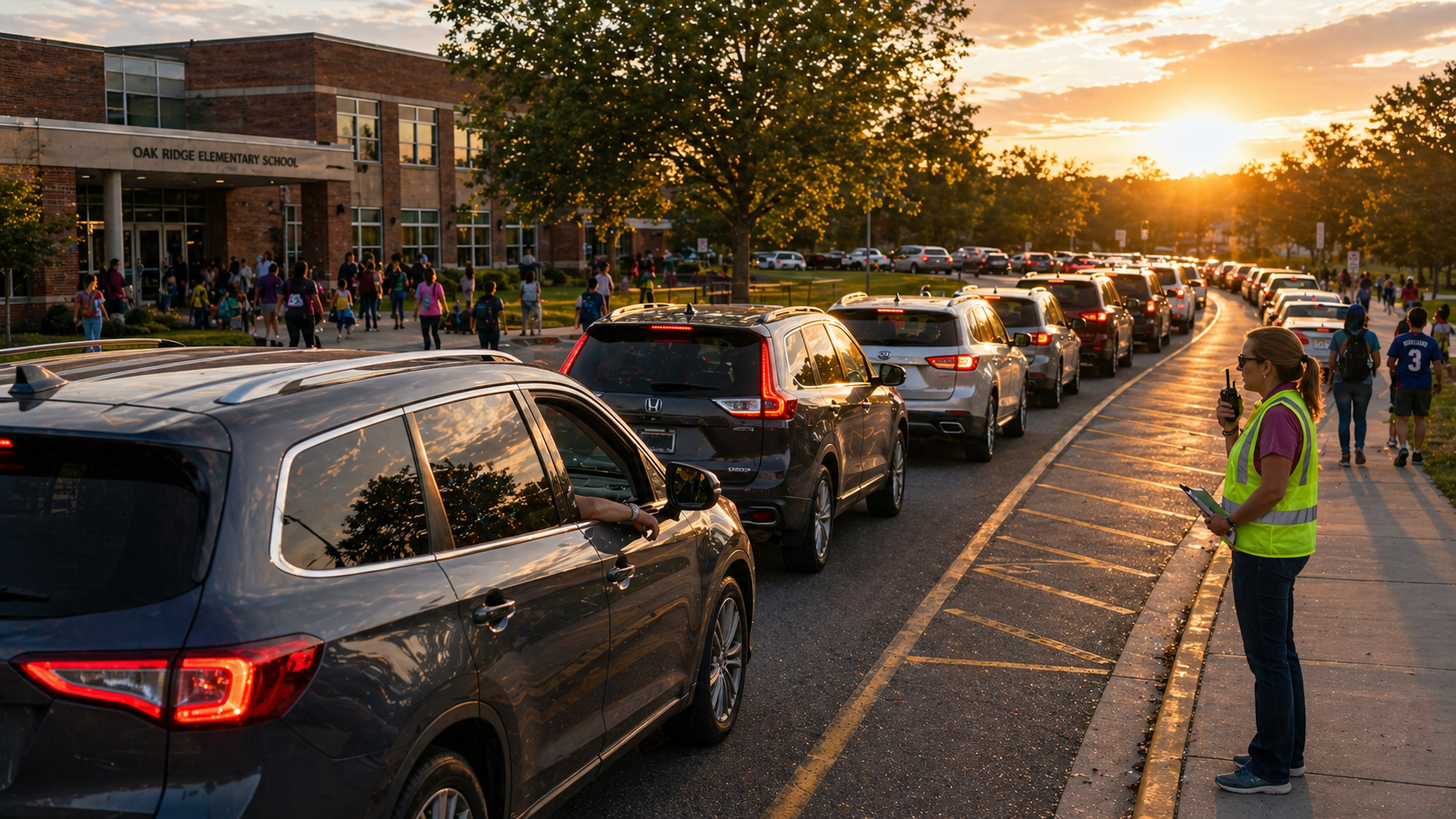
why school pickup lines are chaotic
You didn’t do anything wrong. You left work on time. You drove carefully. And you still sat in that line for 27 minutes.
The problem wasn’t the car in front of you, the slow staff member, or the kid who forgot their backpack. The problem was that nobody in that system knew you were coming until you were already there. That’s the root of school pickup chaos – and it’s entirely fixable.
The Anatomy of a Broken Pickup Line
1. Zero Arrival Visibility
Staff have no idea how many cars are coming or when. Every vehicle arrival is a surprise. Preparation is impossible when you can’t see five minutes ahead.
2. Manual Communication
A staff member walks to a car window. Reads a name card. Radios the name. Finds the student. Walks them out. Repeat – for 200+ students in 20 minutes. At 45 seconds per handoff, that’s 26 students per 20 minutes. The queue is structural, not accidental.
3. Peak-Time Convergence
Everyone is released at the same time, to the same exit, through the same bottleneck. No staggering, no sequencing, no intelligent routing. A funnel with too much input and too little output.
4. The Parent Anxiety Loop
Parents burned before arrive early – creating a queue before dismissal begins, blocking traffic, frustrating later arrivals, making everyone arrive even earlier next time. A self-reinforcing feedback loop that gets worse each semester.
What the Chaos Actually Costs
- Safety: Congested, unstructured pickup zones are among the highest-risk environments for child pedestrian injuries.
- Staff time: 2-4 staff x 45 min/day x 180 days = 135-270 staff-hours/year on a task technology can handle automatically.
- Parent trust: Pickup chaos is a top complaint in school satisfaction surveys and a leading impression for new families.
- Liability: A single documented incident in an unstructured zone exposes districts to claims a structured system would have prevented.
The Fix Isn’t More Staff. It’s Better Information.
The constraint isn’t human effort – it’s information latency. If staff knew 3 minutes before a car arrived exactly which student to stage and in what order the next 10 vehicles would arrive, the operation would run completely differently. That’s a data problem – and data problems have technology solutions.
How Automation Fixes It
| The Failure | The Fix |
|---|---|
| No arrival visibility | LPR cameras detect vehicles as they enter the zone |
| Manual handoff | Staff receive instant digital notification: student name, car location |
| Peak-time congestion | Queue sequencing stages students before cars arrive |
| Parent anxiety loop | Parents receive confirmation when their child is ready for release |
What Schools Using PLACA.AI Experience
- Pickup time reduced by 40-60%
- Staff reassigned from traffic duty to instructional support
- Zero manual check-in – no apps for parents, no cards to forget
- Full dismissal audit log for every student, every day
The system works with the vehicles already in your parent database. No new hardware for families. No behavior change from parents. The school changes its process – everyone benefits automatically.
See what structured pickup looks like.
Book a PLACA.AI demo
Related Reading: Why Parking Is Broken | How Schools Can Fix Pickup Traffic | Manual vs Automated Pickup Systems
Talk to PLACA.AI
Need help choosing the right LPR workflow?
Send your property, parking, or access-control question through the PLACA.AI contact form. Dr. Suhayb and the team can help map the right camera, software, and enforcement setup.
Open contact formRelated Resources
Data reference: National Center for Education Statistics