

lpr for schools
LPR gets talked about as a technology. Schools think about it as a problem-solver. The distinction matters – because the reason to adopt LPR isn’t because it’s impressive technology. It’s because it eliminates the specific friction points that make school pickup slow, unsafe, and staff-heavy. This guide explains what LPR is, how it works in a school context, and what to look for when evaluating systems. No technical background required.
What Is License Plate Recognition?
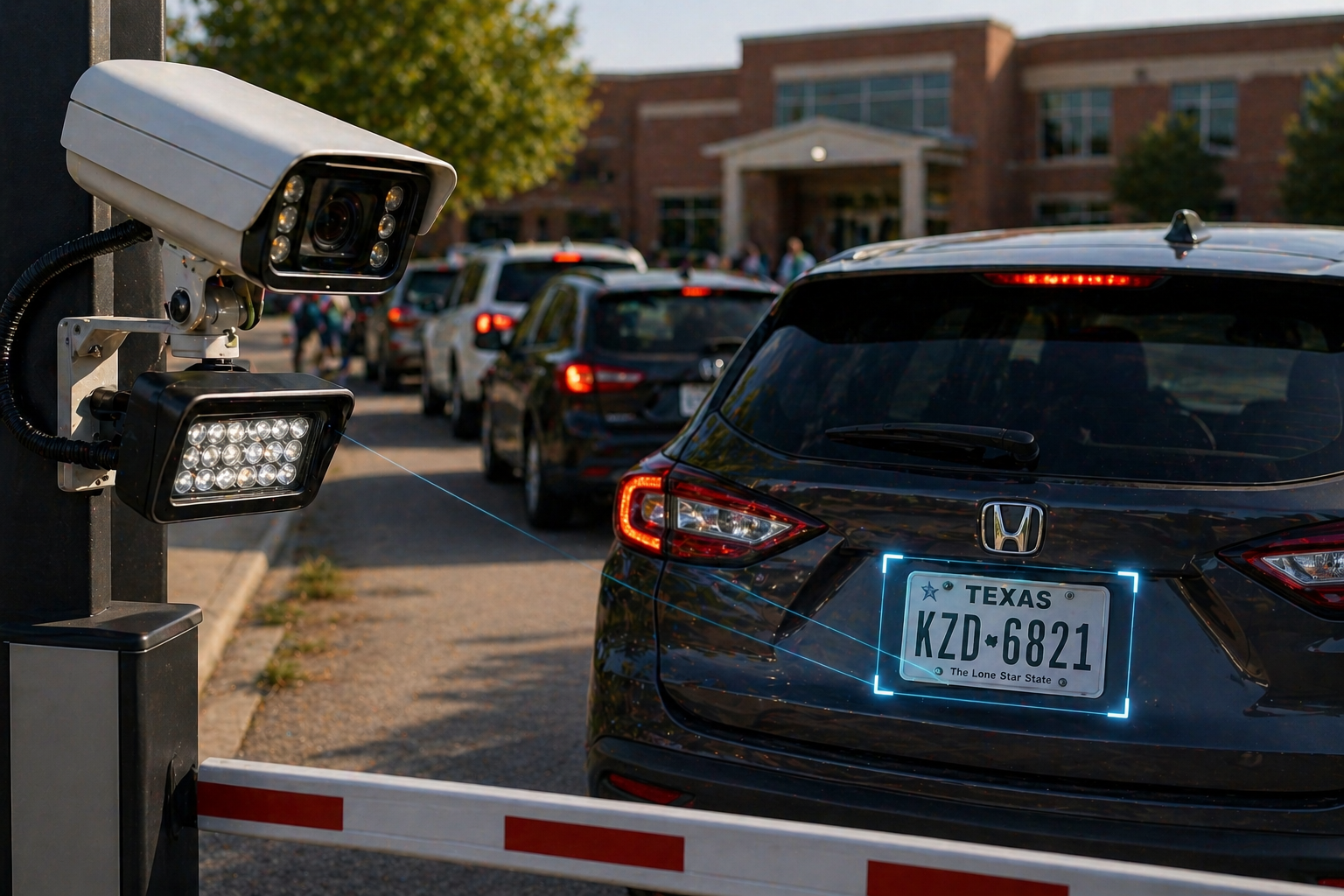
License Plate Recognition (LPR) uses cameras and software to automatically read and interpret vehicle license plates in real time. The camera captures an image of a passing or stationary vehicle. Software analyzes the image, isolates the plate, reads the alphanumeric characters, and converts them to text – in under a second.
That text is matched against a database: in a school context, the database of parent/guardian vehicles registered to each student. When a match is found, the system knows which vehicle belongs to which guardian, which student they’re picking up, and what the authorization level is. All before the car reaches the pickup point.
How It Works During School Pickup
- Vehicle enters detection zone: LPR camera at the lot entrance captures the plate as the vehicle enters.
- Plate is read and matched: System cross-references against the registered guardian database in real time. Under one second.
- Staff are notified: Dashboard shows: “Marcus Chen – Parent vehicle detected, ETA 90 seconds.” Staff begin preparing Marcus.
- Student is staged: Marcus is brought to the pickup point before his parent’s car arrives. The car pulls up to a waiting student.
- Release is confirmed and logged: Staff confirm release on the dashboard. Event is timestamped: vehicle ID, time, student, confirming staff. Car departs.
The entire event takes 15-25 seconds of active time, versus 60-90 seconds for a manual handoff.
What LPR Does Not Require
- No parent app
- No QR codes
- No name cards
- No check-in calls
- No extra hardware for families
The only action required from parents: register your vehicle’s plate number once when setting up their school account. After that, the system recognizes them automatically every day. This zero-friction design is why LPR adoption rates dramatically outpace app-based alternatives – there’s nothing to adopt.
What Makes an LPR System Good for Schools?
- Accuracy in variable conditions: Readable in rain, direct sunlight, partial obstruction, and real parking lot approach angles.
- Speed at scale: 400 students needs concurrent arrival processing without queuing delays.
- Custody and access controls: Handle authorized guardian lists, custody restrictions, and unauthorized vehicle alerts.
- SIS integration: Connect to existing student information system to automatically sync enrollment and guardian data.
- Dismissal audit trail: Every release generates an automatic, timestamped record – your documentation layer.
How PLACA.AI Handles Each of These
PLACA.AI was designed specifically for school vehicle management – not adapted from commercial or law enforcement LPR applications. The platform delivers:
- High-accuracy cameras calibrated for outdoor school environments
- Real-time processing of concurrent vehicle arrivals
- Full custody restriction and guardian authorization management
- Direct integration capability with major SIS platforms
- Automatic dismissal log generation for every event
Want to see LPR in action at a school like yours?
Request a PLACA.AI demo
Related Reading: Manual vs Automated Pickup Systems | Best School Pickup Systems in 2026 | How to Fix Pickup Traffic
Talk to PLACA.AI
Need help choosing the right LPR workflow?
Send your property, parking, or access-control question through the PLACA.AI contact form. Dr. Suhayb and the team can help map the right camera, software, and enforcement setup.
Open contact formRelated Resources
Data reference: National Center for Education Statistics
Related LPR School Pickup Resources
Learn how LPR fits into school pickup line software, carline workflows, and staff-approved dismissal.
- School Pickup Line Software
- School Car Line Software for Elementary and Middle School Dismissal
- Parent Pickup App for Schools vs Vehicle Recognition
- Carline Automation Software
- School Dismissal Management System
- School Car Rider Dismissal Software for Safer Afternoon Pickup
- QR code school pickup system for privacy-conscious families
- authorized student pickup software concepts