
HOA License Plate Cameras: What Board Members Should Know Before Installing LPR
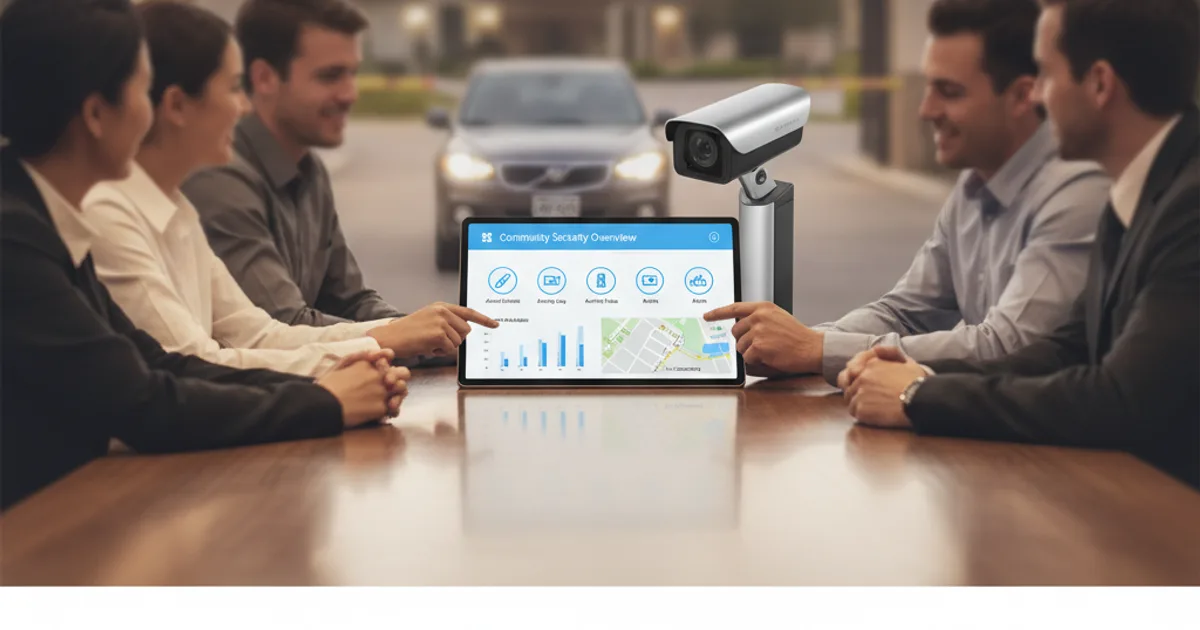
HOA license plate cameras can make resident access and visitor review easier, but the board decision should start with policy instead of hardware. A thoughtful deployment explains what the cameras do, what they do not do, who can use the data, and how residents can ask questions.
Short answer: HOA license plate cameras are cameras configured to capture vehicle plates at community entrances, private roads, gates, or parking areas. Before installing them, board members should define the use case, confirm legal and governing-document authority, choose retention settings, set administrator roles, plan visitor access, and require an accuracy review process.
Key Takeaways
- HOA LPR should be designed around private-property workflows, not fear-based surveillance.
- Accuracy, privacy, retention, and audit logs should be board-level requirements.
- Resident and visitor workflows work best when vehicle records, confidence scoring, and human review are connected.
- Placa.ai is positioned as a practical, privacy-conscious cloud AI LPR platform for HOAs and other private-property operators.
Start With the Problem, Not the Camera
Direct answer: A board should first decide what community problem LPR is supposed to solve.
Common HOA use cases
Some communities need better gate access records. Others want to reduce unauthorized vehicles, verify overnight visitor parking, support private-road incident review, or replace manual resident vehicle spreadsheets. These are different workflows. A camera that works for a slow single-lane gate may not be enough for a wide entrance, a shared visitor lane, or a parking area with odd angles.
For a deeper product overview, see Placa.ai’s HOA license plate recognition camera page.
Are HOA License Plate Cameras Legal?
Direct answer: The answer depends on location, governing documents, camera placement, notice, data use, and legal advice.
Boards should document authority
An HOA should not rely on a vendor blog as legal advice. Before installation, the board should review state law, community covenants, privacy expectations, signage requirements, and any rules about access control or parking enforcement. Many communities use cameras on private property for legitimate operational purposes, but the board still needs a written policy that explains use, access, retention, sharing, and resident questions.
The practical standard is simple: if the board cannot explain why data is collected and how it is controlled, the policy is not ready.
Privacy Questions to Answer Before Installation
Direct answer: Resident trust depends on clear answers before the cameras go live.
Make the data path visible
Residents will ask whether the system tracks them, who can search plate records, how long data is stored, whether data is shared outside the association, and how mistakes are corrected. A privacy-conscious LPR policy should answer those questions in plain language. It should also distinguish routine gate access from incident review, visitor management, and enforcement-related workflows.
Boards comparing systems should read the cluster article on Flock Safety alternatives for HOAs and Placa.ai’s audit log guidance.
Camera Placement and Accuracy
Direct answer: LPR accuracy is strongly affected by camera placement and operating conditions.
Plan for the actual entrance
Camera position, lane width, vehicle speed, lighting, plate angle, and gate timing all affect capture quality. The board should ask for a camera plan that matches the entrance, not a generic device recommendation. It should also ask how the platform handles low-confidence reads, character ambiguity, and manual review.
For a focused explanation, see why HOA license plate recognition needs accuracy checks.
Board Questions Before Buying
Direct answer: A good buying process should cover governance, operations, and technical fit.
Ask questions that vendors can answer plainly
The board should ask who owns the vehicle records, who can search events, whether searches are audited, how retention is configured, how visitor passes work, how resident vehicle registration is maintained, how gate integration is handled, and how exports are controlled. If the answers are vague, the community may be buying confusion instead of a practical system.
The best HOA LPR camera project feels boring in the right way: a clear use case, a clear policy, a clear administrator list, and a clear review workflow.
Board Governance and Resident Communication
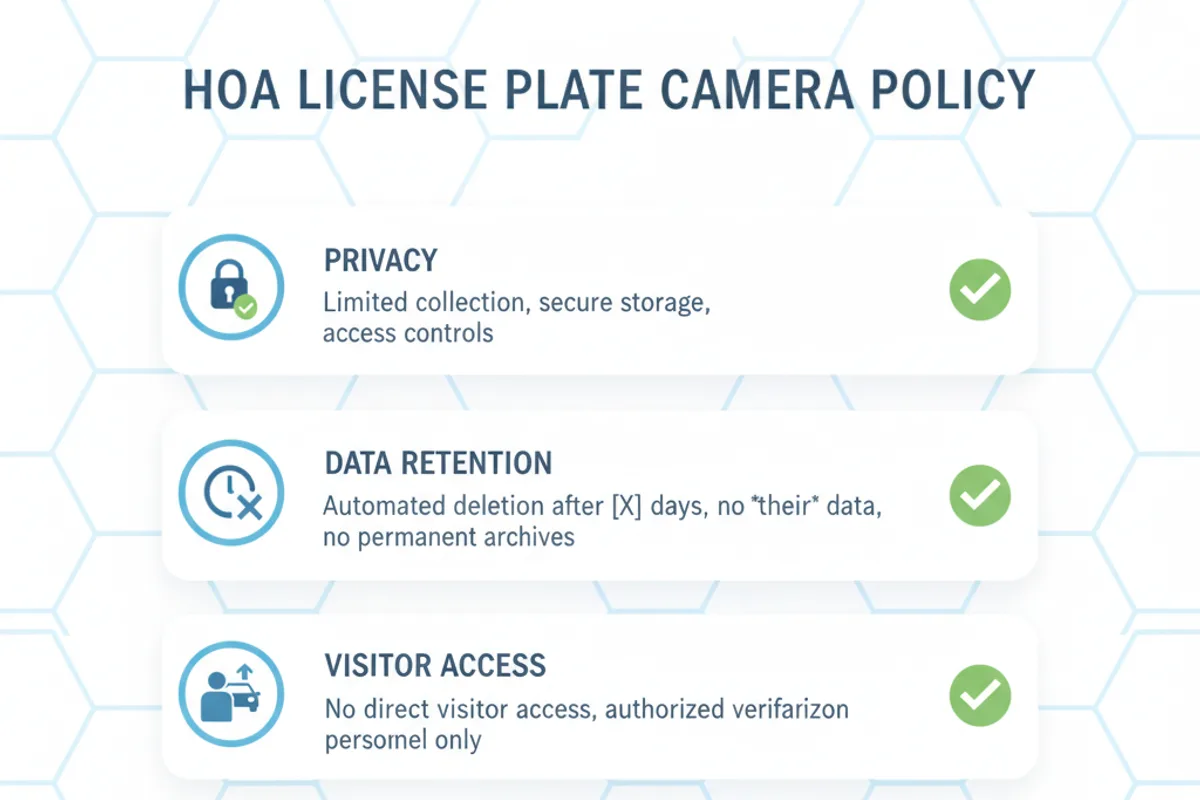
Direct answer: HOA boards should treat LPR as a governed operating system, not just a camera purchase. The board should document the approved purpose, who can administer records, when manual review is required, how long data is retained, and how residents can update vehicle information or ask questions.
Make the policy easy to explain
A clear resident notice should say where cameras are used, what vehicle data is collected, why the association collects it, who can access it, and what safeguards are in place. It should also explain that LPR supports community access and operational review, not unlimited monitoring. This kind of plain-language communication helps property managers answer questions consistently and gives residents a practical path for correcting plate records, adding temporary vehicles, or understanding visitor access rules.
Boards should also review the workflow after launch. Early reviews can reveal camera placement issues, registration gaps, confusing visitor rules, or staff training needs. A short monthly review of low-confidence reads, manual overrides, resident support requests, and administrator searches can improve the system without changing the community’s broader structure or archive behavior.
Questions Every HOA Should Ask
- What specific use case are we solving first?
- Do our governing documents and local legal review support this use?
- Who can search or export plate records?
- How long are vehicle events retained?
- How are visitor vehicles and temporary vehicles handled?
- What happens when the system returns a low-confidence read?
- How are residents notified and how can they correct vehicle data?
Suggested Internal Resources
- HOA license plate recognition camera – Placa.ai’s main HOA LPR resource.
- Access control – broader vehicle and gate access automation guidance.
- Cloud access audit logs – why administrator accountability matters.
- Contact Placa.ai – talk through your community entrance, gate, or vehicle access workflow.
Related HOA LPR Cluster Articles
- HOA license plate recognition accuracy checks – how confidence scoring and review workflows reduce risk
- Flock Safety alternatives for HOAs – how to compare private community LPR systems
- HOA gate access with license plate recognition – how residents, visitors, and contractors can be managed at the entrance
FAQ
What should an HOA ask before buying LPR cameras?
The HOA should ask about purpose, placement, accuracy review, retention, audit logs, administrator roles, visitor workflows, data exports, and legal review.
Are HOA license plate cameras legal?
They may be legal in many private-property contexts, but legality depends on local law, governing documents, placement, notice, and data use. Boards should consult counsel before deployment.
Can HOA license plate cameras be privacy-conscious?
Yes. A privacy-conscious deployment limits use to defined community purposes, controls administrator access, logs searches, configures retention, and communicates with residents.
Do HOAs need resident vehicle registration data?
Most HOA LPR workflows depend on accurate resident vehicle registration so the system can distinguish known residents, visitors, vendors, and unknown vehicles.
Should an HOA install cameras before writing policy?
No. The policy should come first because it defines purpose, access, retention, sharing, review, and resident communication.
Can Placa.ai support gated communities?
Yes. Placa.ai supports private-property LPR workflows for gated communities, resident vehicle records, visitor access, audit logs, and gate access use cases.
Conclusion: Build a System the Board Can Explain
HOA license plate recognition works best when the board can explain the purpose, the data controls, the accuracy review process, and the resident support path. Placa.ai helps communities think through LPR as an operating workflow: vehicles, visitors, access decisions, review, retention, and auditability. If your community is evaluating HOA LPR cameras, gate access, or a private community LPR system, start with the policy and workflow before buying hardware.
Request a Placa.ai HOA LPR consultation to review your entrance layout, resident vehicle process, visitor access needs, and privacy requirements.
Internal Resources
Data source: Community Associations Institute