

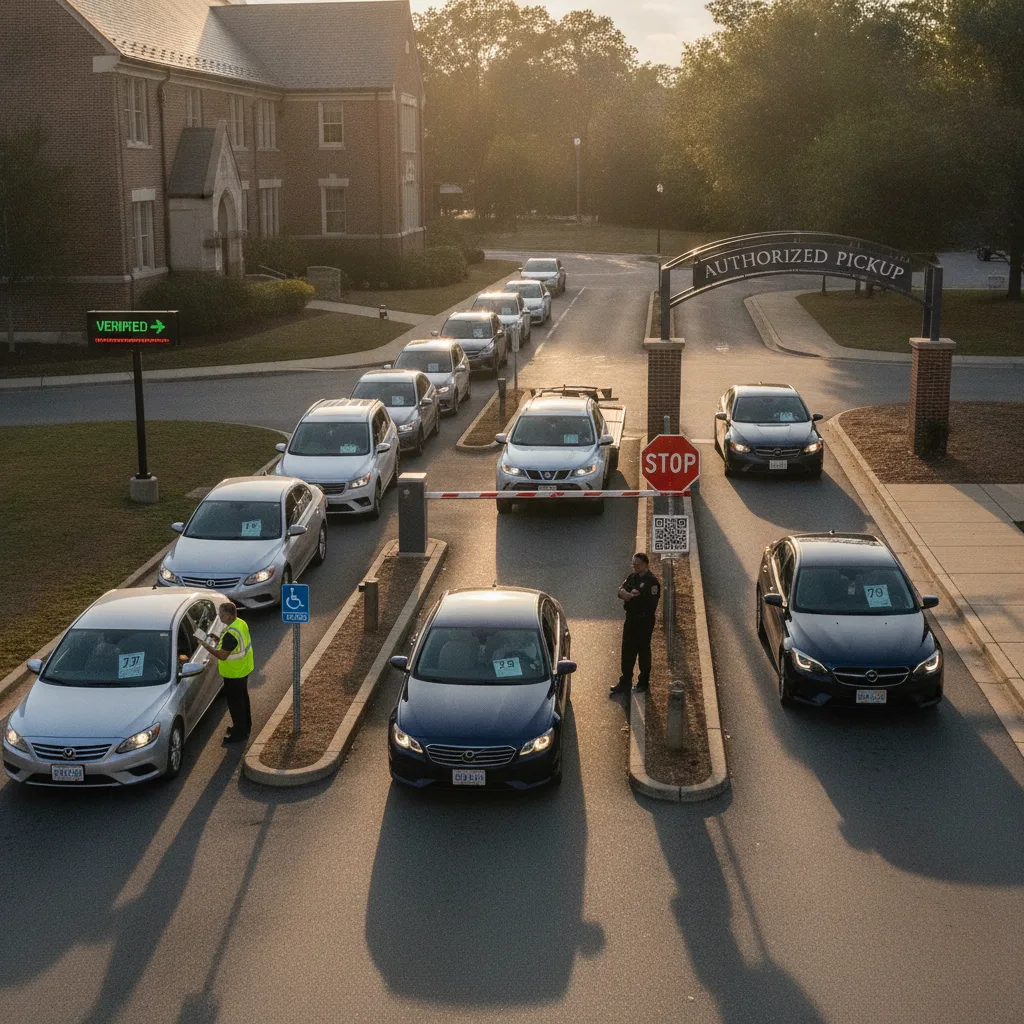
Direct answer: At a private school, a mishandled car tag is not just a traffic problem – it is a visible service failure in front of the tuition-paying families whose re-enrollment decisions you are trying to earn every spring. Fix it by tying every tag to one current record of student, authorized adult, and vehicle, giving front desk or admissions staff (not just the curb team) a fast way to add a same-day driver, and training every adult on the curb – including seasonal or event staff – to treat an unfamiliar or missing tag as a two-minute office confirmation, not a public holdup. The families judging your dismissal line are often the same families deciding whether to renew.
This guide is for private school heads, directors of admissions and advancement, business office staff, and the carpool and security personnel who run afternoon dismissal. It is written around the specific pressure private schools carry: families who pay directly for the experience notice friction that a public school family might shrug off, and a chaotic pickup line shows up in parent surveys, re-enrollment conversations, and word-of-mouth referrals.
Why car-tag confusion costs more at a private school
Public district schools absorb pickup friction as a known cost of scale. Private schools cannot, because the parent relationship is transactional in a way that public enrollment is not – families are choosing, every year, whether the experience justifies the invoice. A lost tag, a driver who has to explain themselves through a rolled-down window while cars stack up behind them, or a sibling released to the wrong building reads as a lapse in the “we have this handled” promise the school is selling alongside academics.
Example: A family with three children across the lower and middle school buildings sends the children’s new nanny for the first time. She has no tag, does not know which building loads first, and the family did not think to call ahead because the old system used one laminated tag for all three kids. Staff either wave her through on a guess – a real risk – or stop her cold in front of a line of other parents, which reads as an accusation to a family that pays a premium for a personal relationship with the school. Neither outcome is acceptable, and neither is rare: private schools with blended families, employer-provided drivers, or multiple children across buildings hit this scenario constantly.
The private-school pickup roster is more complex than one tag per family
| Common private-school scenario | What breaks with a single laminated tag | What a current vehicle record fixes |
|---|---|---|
| Multiple siblings, multiple buildings | One tag can’t signal three different release points and times | Each child’s release ties to the same vehicle without a second tag |
| Nanny, driver, or employer car service | Staff have no way to confirm the driver is currently authorized | Admissions or front desk adds the driver same-day, tied to the family record |
| Divorced or blended families, alternating custody | A visible custody dispute plays out publicly at the curb | Custody rules live in the record, checked quietly before release |
| Prospective or visiting families | No system distinguishes a toured family from an enrolled one | Visitor and enrolled records stay clearly separate |
Give someone other than the curb the authority to fix it
Most car-tag confusion at private schools does not need to be solved at the car window – it needs to be solved before the car ever reaches the window. That means front desk or admissions staff, who already field the calls and emails about schedule changes, need the same real-time authority to add or adjust a driver that a curb monitor has to check one. Routing every exception through the person actually holding up traffic guarantees a public delay; routing it through whoever answered the 1:45 p.m. phone call from the family does not. Schools that still lean on laminated car tags run into this limit constantly – see why paper car tags fall short for modern dismissal for the specific failure points that show up first at higher-touch campuses. A license-plate match at the gate lets the front office resolve most of these changes before the car is anywhere near the line, and pairs naturally with the kind of dismissal system built for private-school expectations rather than a district-scale tool retrofitted downward.
Protect the parent experience, not just the schedule
Private-school dismissal is also a daily brand touchpoint – it is frequently the only in-person interaction a family has with staff that day. A verification step that looks like a checkpoint search erodes the relationship the school spent an admissions cycle building. The fix is the same discretion a good maître d’ uses: check quietly, resolve mismatches out of earshot of other families, and reserve any visible stop for a genuine unresolved case. Pair that with a documented same-day change process so families never feel penalized for sending someone new, and the curb becomes a place that reinforces the premium experience instead of undercutting it. Schools already working on the broader pickup experience should also review how shortening pickup line delays compounds with tag accuracy – a fast line with the wrong driver waved through is not actually a win.
What to measure before expanding the process
- same-day driver changes cleared before the car reached the curb
- tag mismatches resolved without a visible public stop
- sibling releases matched correctly across buildings
- custody-restricted releases handled without a public confrontation
- family complaints about the pickup experience, month over month
Owner sign-off
- State the purpose and non-goals for reducing car-tag confusion at this campus.
- Name who can approve a same-day driver – front desk, admissions, or both – and who has final say on a disputed release.
- Test with the actual curb staff, including seasonal or event-day coverage, not only full-time administrators.
- Confirm contracts, pricing, integrations, data handling, and custody-related legal requirements independently.
- Retain enough of a record to reconstruct any approval, denial, or correction if a family raises it later.
Related PLACA.AI planning resources
Decision questions
What should be settled before this goes live at a private campus?
Who besides curb staff can approve a same-day driver, how a mismatch gets resolved discreetly, and who owns the final call on a disputed or custody-restricted release.
What belongs in the pilot?
A normal afternoon, one same-day nanny or driver substitution, one multi-sibling multi-building release, and one custody-sensitive case, tested with real curb and front-desk staff.
When should rollout pause?
If front desk cannot clear a same-day change before the car reaches the curb, if a mismatch cannot be resolved without a visible public stop, or if the family-facing record is out of date at pickup time.
Plan a limited workflow review
Bring the current rule, process, exceptions, and success criteria for reducing parent car-tag confusion at this private school. PLACA.AI can help evaluate a bounded pilot without assuming another campus’s workflow is the right answer.
Editorial refresh: September 18, 2026. Independently confirm current product capabilities, third-party features, pricing, contracts, governing requirements, and local rules before acting.
Internal Resources
- How School Transportation Directors Can Verify Authorized Pickup Vehicles With Better Vehicle-Based Workflows
- How Front Office Staff Can Separate Bus And Carline Traffic With Better Vehicle-Based Workflows
- How Campus Safety Teams Can Reduce Radio Call Overload With Better Vehicle-Based Workflows
- How District Operations Teams Can Avoid Substitute Teacher Dismissal Gaps With Better Vehicle-Based Workflows
- How School Administrators Can Enforce Custody Restrictions During Carline Using an Eight-Level Authorization System
Data source: National Center for Education Statistics