

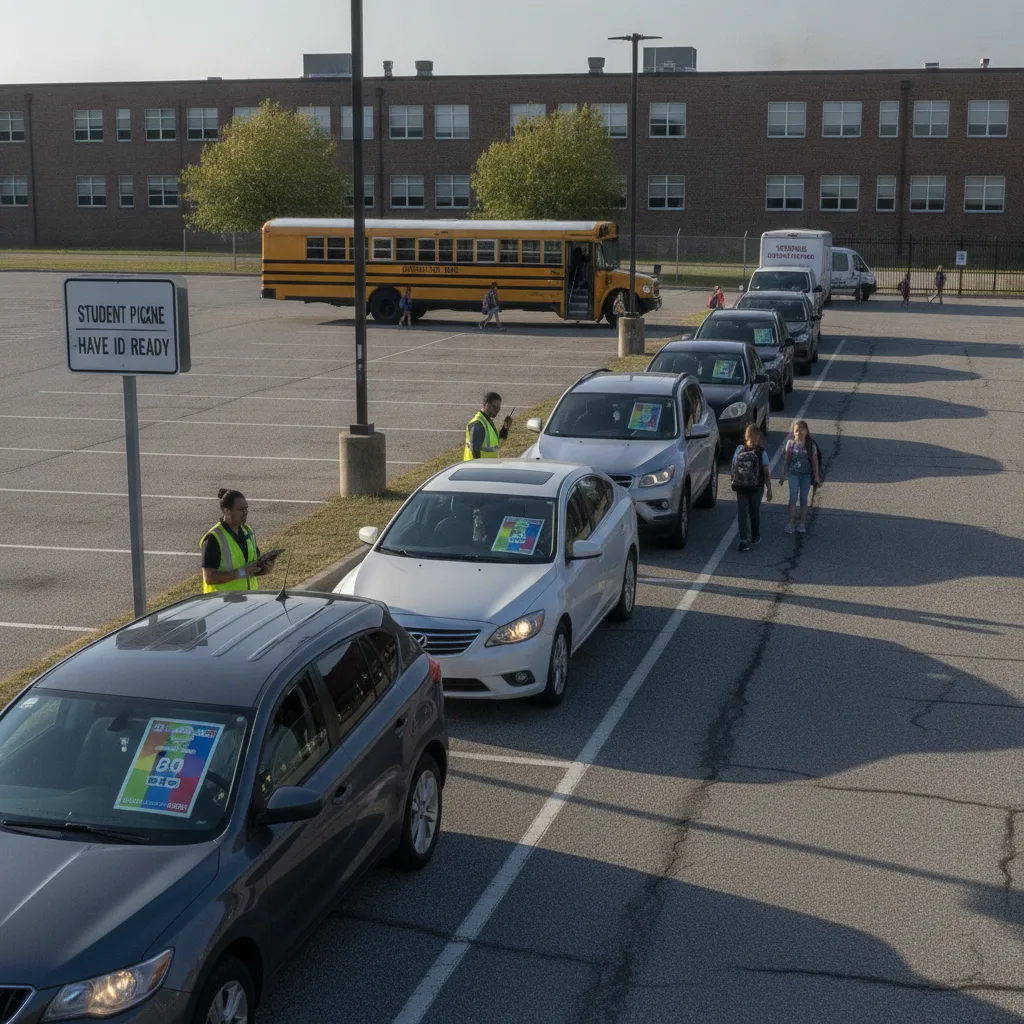
Confusion at student pickup usually isn’t a technology problem – it’s a records problem. When the authorized-adult list, the vehicle tag, and the carline release step live in different places – a spreadsheet in the front office, a laminated card in the parent’s glovebox, a verbal understanding among curb staff – small mismatches turn into long dismissal lines and, occasionally, real safety gaps. PLACA.AI’s vehicle-based workflows tie those pieces together so release decisions are made against one current record instead of a stack of paper tags that can be lost, copied, or left in yesterday’s car.
The underlying record is the same at every campus: which student, which authorized adults, which vehicles, and what today’s dismissal mode is. What changes is who has to act on that record, how fast they have to act, and what happens when it’s wrong. A front-office aide juggling a ringing phone and a walk-up window needs speed. A district operations director needs consistency across a dozen campuses that don’t all report to the same person day-to-day. A transportation director needs the parent pickup lane to stop blocking the bus loop behind it. Treating all of that as one generic “dismissal problem” is exactly how organizations end up with a policy that sounds right on paper and fails the first busy Tuesday it meets.
Where car-tag confusion actually comes from
Almost every version of this problem traces back to the same handful of causes: a tag that was issued once and never updated when custody or transportation plans changed; a same-day exception – a new driver, a sick regular pickup, a schedule change – that has nowhere fast to be logged; and no single source of truth that curb staff, the front office, and district administration can all check against at the same time. Paper and laminated systems make each of these worse, because updating a physical card requires a parent to physically return to the school, and a lost card looks identical to a stolen one from the curb. A digital record tied to the vehicle itself removes the physical object that gets lost in the first place; see the school pickup LPR guide for how plate-based matching works in practice at the curb.
The same record, different pressure points
| Role | What breaks first | What they need from the record |
|---|---|---|
| Front office | Same-day changes arriving faster than they can be logged | A one-minute entry the curb can see immediately |
| Campus safety | Routine paperwork mismatches drowning out genuine security signals | Only unmatched vehicles reaching the safety channel |
| Transportation | A stalled car dispute blocking the bus loop behind it | Mismatches caught before vehicles reach the shared lane |
| District operations | Each campus defining “authorized” a little differently | One evidence standard, retrievable across every campus |
| Private schools | A tag mismatch reading as a service failure to a paying family | A quiet resolution path that doesn’t become a public holdup |
Why one strong campus process beats a patchwork of local habits
Dismissal problems tend to get solved locally and informally – a front-office aide develops a workaround, a curb monitor learns which grandparents to expect, a transportation director quietly reroutes buses around the parent lane. Those fixes work until the person who built them is out sick, transferred, or retires, and then the campus discovers the actual process was never written down. Building the workflow around a shared, current vehicle record instead of institutional memory is what makes the process survive staff turnover, substitute coverage, and a new principal’s first September. It’s also the difference between a dismissal process that can be audited after an incident and one that depends entirely on someone remembering what happened. Campuses evaluating a broader shift away from clipboards and radios should also look at how carline automation software handles the arrival-to-release sequence end to end, not just the tag-matching piece of it.
Start with the role that owns the most friction
Most schools don’t need to solve every angle of car-tag confusion at once. The fastest place to start is usually wherever the friction is most visible today – a front office fielding a flood of same-day calls, a transportation department chasing chronic late departures, or a district office that just discovered two campuses handled an identical situation two different ways. From there, the same underlying record extends naturally to the other roles, because they’re all reading and writing against the same student-adult-vehicle relationship rather than separate local systems.
How this plays out depends on who’s running dismissal day to day. We’ve published a guide for each role:
- School Transportation Directors: reducing parent car-tag confusion
- Front Office Staff: reducing parent car-tag confusion
- Campus Safety Teams: reducing parent car-tag confusion
- District Operations Teams: reducing parent car-tag confusion
- Private Schools: reducing parent car-tag confusion
- Elementary School Leaders: reducing parent car-tag confusion
Each guide works through the same underlying record – student, authorized adult, vehicle, and release status – from the angle that role actually deals with at pickup, including the specific failure cases, staffing constraints, and measures that matter for that job.
Whichever role you start from, the underlying question is the same: can your school produce, on demand, a current answer to “who is allowed to pick up this student, in what vehicle, today” – and can every person who needs that answer see it at the same time. PLACA.AI’s license-plate matching is one way to tie that record to the vehicle automatically, but the record itself, and who owns updating it, matters more than any single tool. See the student dismissal automation overview for how the pieces fit together across a full dismissal cycle, from arrival to completed handoff.
Data source: National Center for Education Statistics