

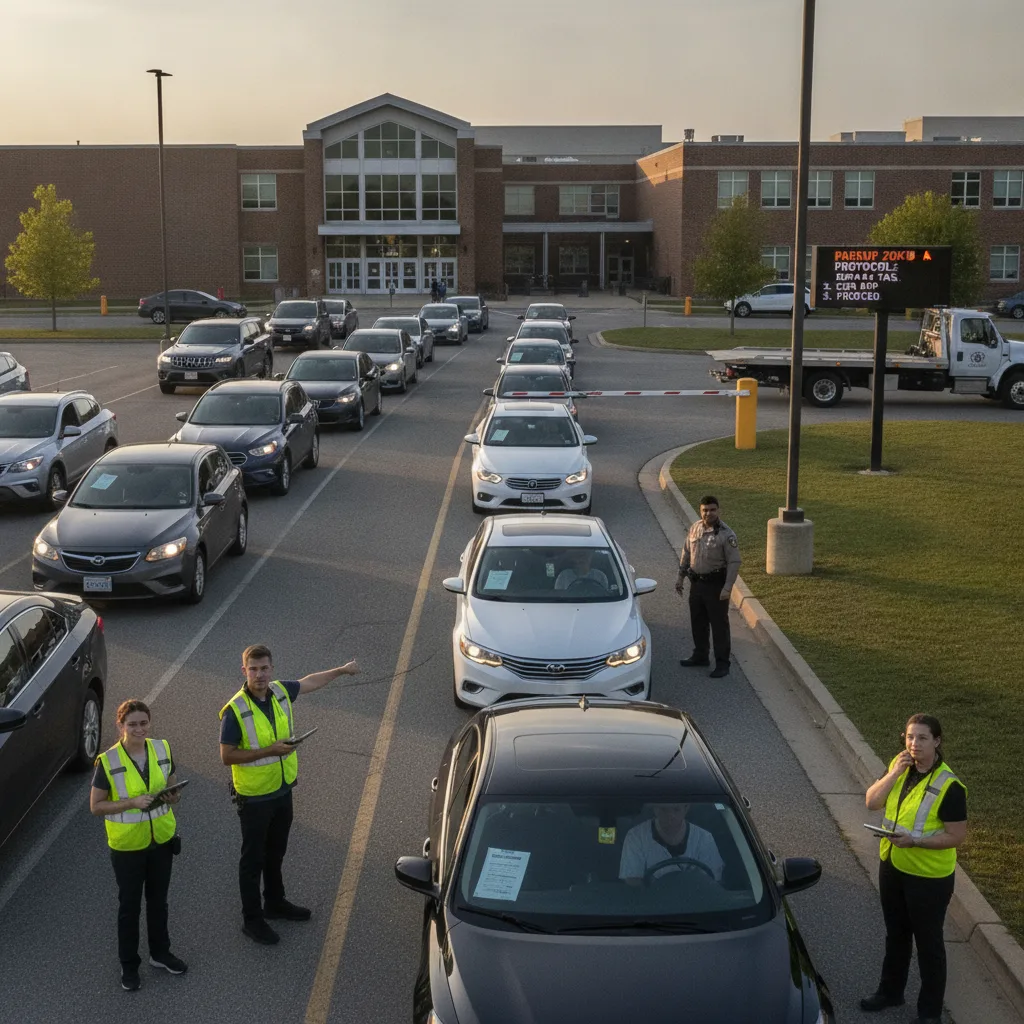
Direct answer: Parent car-tag confusion becomes a district liability problem the moment two campuses handle the same situation two different ways – one office honors a phoned-in same-day change, another requires a written note, and a parent who gets turned away at one school and waved through at another has grounds to say the district’s process is arbitrary. Fix it with one district-level policy for what counts as proof of a same-day driver change, a shared minimum evidence standard every campus front office follows, and a way for you to pull the record for any single release if a parent, an attorney, or your own risk office asks for it later. Let each campus keep its own staffing and layout – do not let each campus invent its own definition of “authorized.”
This guide is for district operations directors, transportation coordinators, risk and safety officers, and the assistant superintendents who own dismissal policy across multiple campuses. It focuses on the part of car-tag confusion that is invisible at any single school but becomes obvious – and expensive – the moment you compare two campuses side by side.
The real risk isn’t a duplicate tag – it’s inconsistent proof
Any single elementary or middle school can absorb a duplicate tag or a confused volunteer with a quiet correction. What a district cannot absorb is twelve campuses each defining “proof of authorization” differently: one front office accepts a text message from a parent, another insists on a same-day phone call logged in a binder, a third has no documented standard at all and leaves it to staff judgment. When an incident review happens – a custody dispute, a near-miss, a parent complaint escalated to the board – the district needs to produce a consistent answer for what standard was followed, not eleven different answers from eleven different front offices.
Example: A parent at Campus A calls the front office to authorize a rideshare driver for one afternoon; staff log it and release the student without incident. The same week, a parent at Campus B makes an identical request, and a substitute front-office aide who has never seen the informal local process turns the driver away, triggering a complaint that the district treats families inconsistently. Both staff members followed what they understood to be the rule – because there was no written district rule, only local habit.
What belongs at the district level versus the campus level
| Decision | Set once, district-wide | Left to each campus |
|---|---|---|
| What counts as proof of a same-day change | Minimum evidence standard (who can call it in, what gets logged) | – |
| Who can approve an exception | Role-based authority (front office, admin, not “whoever is available”) | Named individuals filling those roles |
| Curb layout and staffing | – | Lane count, staffing levels, physical site plan |
| Record retention and audit access | Retention period, who can pull a record after the fact | Day-to-day data entry |
Build a standard every campus can actually follow
A district policy that only large, well-staffed campuses can execute is not a policy – it is a liability gap disguised as a rule. The standard has to work at the two-person front office of a small elementary school and the fully staffed office of a comprehensive high school alike: a defined minimum evidence bar (name, relationship, vehicle, and a logged timestamp), a same-day expiry so nothing becomes a standing exception by accident, and a single system of record rather than campus-specific spreadsheets that a district office cannot see into. Districts still running this on paper car tags or campus-by-campus spreadsheets tend to discover the inconsistency only during an incident review – see why paper car tags fall short for modern dismissal for the specific gaps that surface first at multi-campus scale. Standardizing the underlying record is also the foundation for standardizing dismissal across every campus, not just the car-tag piece of it.
Give yourself an answer before you need one
The test of a district-level policy is not whether dismissal runs smoothly on an ordinary Tuesday – it is whether you can reconstruct exactly what happened, who approved it, and against what standard, when a parent disputes a release six weeks later. That means every campus feeding into the same auditable record, not eleven local logs you would have to physically collect from eleven front offices. A consistent, centrally visible license-plate match at every campus curb gives operations one place to pull that answer instead of a round of phone calls to principals, and it shows the same evidence standard was applied everywhere – which is exactly what a risk review is going to ask for first.
What to measure before expanding the process
- campuses following the same documented evidence standard
- same-day changes logged with a timestamp and named approver
- records retrievable across campuses within a defined window
- inconsistent-handling complaints, campus by campus
- exceptions still open past their expiry
Owner sign-off
- State the purpose and non-goals for the district-wide car-tag policy.
- Name who owns the standard, who can grant a district-level exception, and who has final say in a dispute.
- Test the standard at your smallest and least-staffed campus, not only your largest.
- Confirm contracts, pricing, integrations, data handling, and governing requirements independently for a multi-campus rollout.
- Retain evidence in a form your risk office can actually retrieve, not just a form each campus can generate locally.
Related PLACA.AI planning resources
Decision questions
What should be settled before this rolls out district-wide?
The minimum evidence standard every campus must follow, who can grant a district-level exception, and how a record gets retrieved when an incident review asks for one.
What belongs in the pilot?
Two or three campuses of different sizes and staffing levels, run long enough to surface at least one inconsistent-handling complaint and one records-retrieval request.
When should rollout pause?
If a campus cannot meet the minimum evidence standard with its current staffing, if records cannot be retrieved consistently across campuses, or if the standard conflicts with local safety needs a campus has already documented.
Plan a limited workflow review
Bring the current rule, process, exceptions, and success criteria for reducing parent car-tag confusion across your district. PLACA.AI can help evaluate a bounded pilot without assuming one campus’s workflow is the right answer for every campus.
Editorial refresh: September 18, 2026. Independently confirm current product capabilities, third-party features, pricing, contracts, governing requirements, and local rules before acting.
Internal Resources
- How School Transportation Directors Can Prevent Late Dismissal Bottlenecks With Better Vehicle-Based Workflows
- How Front Office Staff Can Separate Bus And Carline Traffic With Better Vehicle-Based Workflows
- How Campus Safety Teams Can Avoid Substitute Teacher Dismissal Gaps With Better Vehicle-Based Workflows
- How District Operations Teams Can Verify Grandparent Pickup Permissions With Better Vehicle-Based Workflows
- How District Safety Teams Can Prove Every Student Release Was Staff-Approved Using a Tamper-Evident Audit Log
Data source: National Center for Education Statistics