
Hardware-flexible mobile LPR deployment
Solar trailer LPR helps properties that need temporary, mobile, or fast-deployed vehicle recognition without permanent infrastructure.
This article supports the broader Placa.ai mobile license plate recognition security pillar and explains how solar trailers, fixed cameras, gate cameras, cloud VMS, and guard workflows can fit into a practical vehicle recognition deployment.
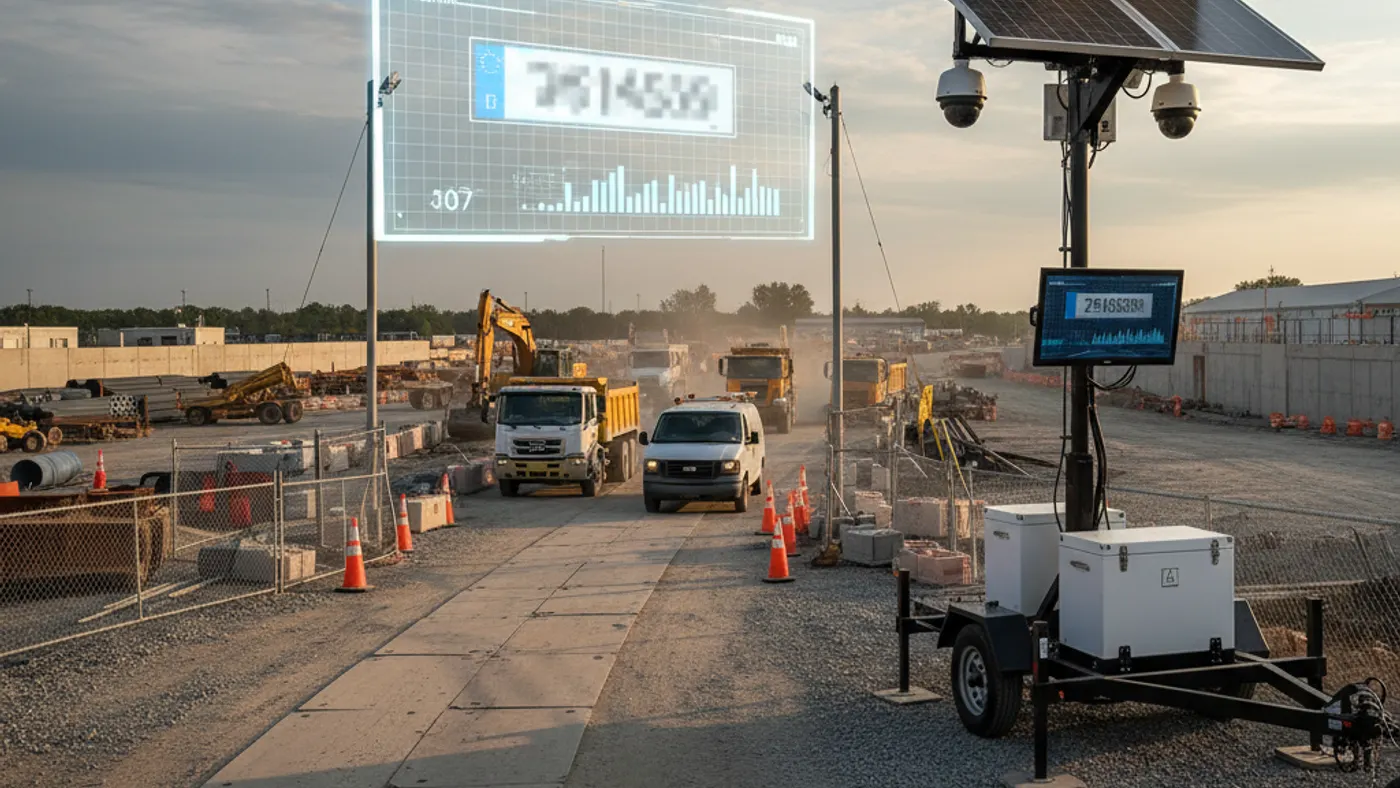
When does solar trailer LPR make sense?
Solar trailer LPR makes sense when a site needs temporary, mobile, or fast-deployed vehicle recognition without permanent camera infrastructure. It can support parking lots, construction entrances, event parking, temporary gated access, school overflow traffic, storage yards, and enforcement areas when the camera configuration is LPR-ready.
Placa.ai is built to adapt to many deployment environments, including solar trailer camera systems, fixed parking lot cameras, gate cameras, and compatible IP camera networks. The system is designed around flexible integration rather than a single required hardware stack. For best results, Placa.ai evaluates stream access, plate visibility, camera angle, lighting, distance, resolution, lens selection, and network conditions before recommending the final configuration.
How the Workflow Comes Together
| Step | What Happens |
|---|---|
| Deploy the solar trailer near the vehicle decision point | Position the trailer where plates are visible and vehicles move predictably. |
| Connect the camera stream for LPR evaluation | Confirm network reliability, angle, distance, lens, lighting, and resolution. |
| Log vehicle events in Placa.ai | Create searchable records for plates, times, locations, and workflow context. |
| Use cloud video monitoring where needed | iFovea can support live or recorded video review for guards or operators. |
Use Cases for Temporary Vehicle Recognition
Solar trailer LPR can support parking lots, construction entrances, event parking, temporary gated access, school overflow traffic, storage yards, enforcement areas, and remote sites where trenching or permanent poles are not practical.
Flexible Deployment Without Overstating Compatibility
Placa.ai is designed to adapt to and integrate with virtually any properly configured solar trailer camera system, but compatibility and performance depend on stream access, plate visibility, camera angle, lighting, resolution, lens selection, distance, bandwidth, network reliability, trailer configuration, and deployment environment.
Deployment and Monitoring Partners
Solar trailer security camera deployment can be supported through 2M Technology, while remote security guard monitoring platform iFovea can support live or recorded cloud video visibility.
Camera and Trailer Readiness Checklist
Plate Visibility
The plate should be large enough, well-lit, and captured at a usable angle without glare, blur, or obstruction.
Reliable Video Access
The deployment should provide stable stream access, bandwidth, and network reliability for cloud LPR evaluation.
Workflow Fit
The project should define whether the goal is parking security, access control, guard monitoring, enforcement, or event review.
Important Compatibility Qualification
Placa.ai has been successfully tested with multiple solar trailer camera system configurations and is designed to adapt to virtually any properly configured solar trailer camera system. Compatibility and performance may depend on video stream access, plate visibility, camera angle, lighting, resolution, lens selection, distance, bandwidth, network reliability, trailer configuration, and deployment environment.
When a camera is not LPR-ready, Placa.ai can recommend camera, angle, lighting, network, or deployment improvements. For purpose-built camera planning, start with the Placa.ai camera recommendation page or review options such as RoadCam, RoadCam Pro, RadarCam Lite, RadarCam, and EnforcementCam.
Plan the Deployment
Bring your camera model, trailer configuration, gate layout, parking lot geometry, or monitoring workflow. Placa.ai can help assess whether the current setup is LPR-ready and where a solar trailer, fixed camera, gate camera, cloud VMS, or guard review workflow fits.
Frequently Asked Questions
When does solar trailer LPR make sense?
Solar trailer LPR makes sense when a site needs temporary, mobile, or fast-deployed vehicle recognition without permanent camera infrastructure. It can support parking lots, construction entrances, event parking, temporary gated access, school overflow traffic, storage yards, and enforcement areas when the camera configuration is LPR-ready.
Can Placa.ai work with solar trailer camera systems?
Placa.ai has been successfully tested with multiple solar trailer camera system configurations. It is designed to adapt to and integrate with virtually any properly configured solar trailer camera system, subject to stream access, plate visibility, camera angle, lighting, resolution, lens selection, distance, bandwidth, and network reliability.
Can license plate recognition work with existing cameras?
Yes, Placa.ai can be evaluated with many compatible IP cameras, fixed parking lot cameras, gate cameras, and mobile camera deployments. Existing cameras work best when they provide clear plate visibility, reliable stream access, suitable resolution, and a camera angle designed for plate capture.
What makes a camera not LPR-ready?
A camera may not be LPR-ready if the plate is too small, angled, blurry, overexposed, too dark, blocked, or moving too fast for the camera view. Network instability, low resolution, wrong lens selection, and poor trailer position can also reduce performance.
Why use cloud LPR instead of only local recording?
Cloud LPR helps teams search vehicle events, review audit logs, connect plates to access or parking workflows, and support multi-site visibility. Local recording can preserve video, but it often requires more manual review when operators need plate-specific answers.
Does Placa.ai replace security guards?
No. Placa.ai does not eliminate the need for guards. It can help guards and operators prioritize vehicle events, review context, and document activity when combined with appropriate monitoring workflows and camera visibility.
How do 2M Technology and iFovea fit?
2M Technology can support solar trailer camera systems, field deployment, networking, and security integration. iFovea can serve as a cloud VMS platform for live monitoring, recorded video access, and remote guard review workflows.