

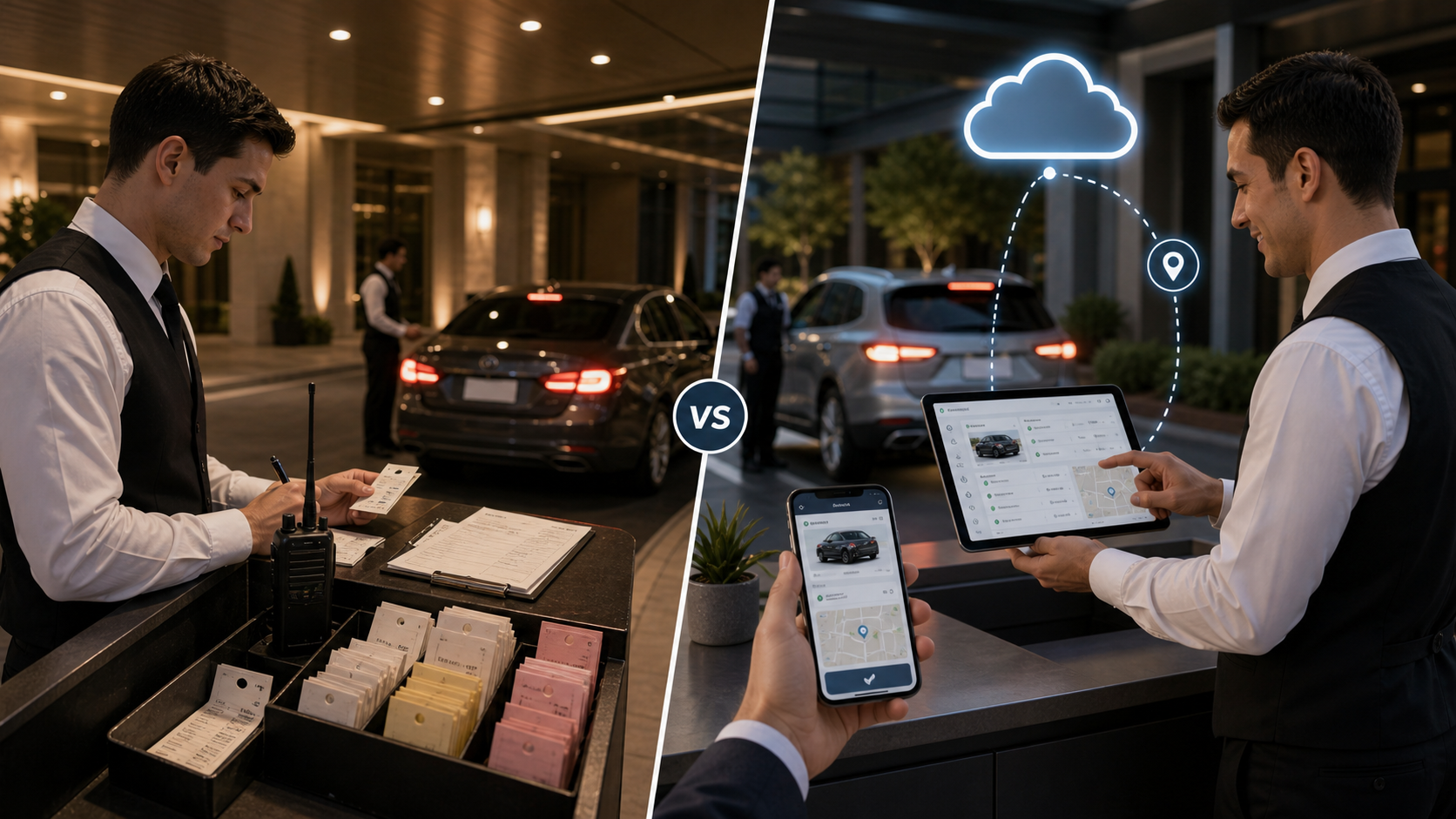
cloud valet vs traditional valet
Valet operator guide
Cloud valet connects check-in, vehicle records, pickup requests, dispatch, ready notifications, and tips in one system. Traditional valet often relies on paper tickets, radios, and memory.
Short Answer
Cloud valet connects check-in, vehicle records, pickup requests, dispatch, ready notifications, and tips in one system. Traditional valet often relies on paper tickets, radios, and memory.
Why This Matters for Revenue
Cloud valet helps operators standardize service, scale accounts, and compete against manual valet companies in the same region.
PLACA.AI helps valet companies increase revenue potential by improving guest experience, reducing slow handoffs, keeping pickup requests organized, and creating more digital tip moments.
Valet Revenue Analysis
Use this planning model: monthly cars x tip participation x average tip. Example: 3,120 cars/month at 35% participation and average tip equals ,368/month. If better service and digital tipping move participation to 55% at average, estimated tips become ,296/month. Possible lift: ,928/month.
This is an example model, not a guaranteed result. Actual outcome depends on location, staff quality, guest mix, event volume, and tip policy.
How PLACA.AI Helps
- Phone-based plate scan check-in.
- Returning guest recognition.
- SMS pickup request link.
- GPS parked location for runners.
- Ready SMS notification.
- Digital tipping.
Related
Read next guide or visit Valet Parking Knowledge Hub.
Internal Resources
- How Casino Parking Teams Can Handle Liability Questions Using Ticketless Vehicle Recognition
- How Luxury Residential Valet Teams Can Reduce Lost Valet Ticket Problems Using Ticketless Vehicle Recognition
- How Event Valet Companies Can Manage Peak Arrival Surges Using Ticketless Vehicle Recognition
- How Hospitality Groups Can Improve SMS Valet Communication Using Ticketless Vehicle Recognition
- How Venue Parking Managers Can Reduce Guest Wait Time Complaints Using Ticketless Vehicle Recognition
- Is Valet Parking Safe? What Customers and Operators Need to Know
- Who Is Responsible for Damage in Valet Parking?
- How Much Does Valet Parking Cost?
Related Resources
Cloud Valet vs Traditional Valet: What Is the Difference?
What is a cloud-based valet management system?
Cloud valet management stores all ticket records, vehicle logs, and retrieval requests on a remote server rather than locally on a device at the podium. Attendants use a mobile app to issue tickets, log plates, and receive retrieval requests in real time. Supervisors can view operational metrics from any device without being on-site. If a device fails or is replaced, all data remains available from the cloud. LPR cameras integrated with cloud platforms upload plate photos automatically, creating a real-time digital log accessible from anywhere with an internet connection.
How does cloud valet compare to traditional paper-based operations?
Traditional valet uses pre-numbered paper tickets, physical key cabinets, and manual plate notation. The process is familiar and requires no technology investment, but creates documentation gaps – plates are not always recorded accurately, disputes are harder to resolve without photographic evidence, and end-of-shift reconciliation is labor-intensive. Cloud valet with integrated LPR addresses all three weaknesses: every plate is logged photographically, disputes have timestamped photographic evidence, and reconciliation is automated. The switch from paper to cloud valet typically requires a short training session for staff and a one-time camera installation at the intake zone.
About Placa.ai
Placa.ai is a license plate recognition platform for parking operators, valet companies, and property managers who need automated vehicle identification. The platform pairs LPR cameras with cloud software delivering real-time plate reads, vehicle logs, and alert notifications. Valet operations using Placa.ai gain a digital record of every vehicle with timestamped photos, eliminating manual ticket logging and speeding retrieval. Visit placa.ai to learn more.
Industry reference: International Parking and Mobility Institute