

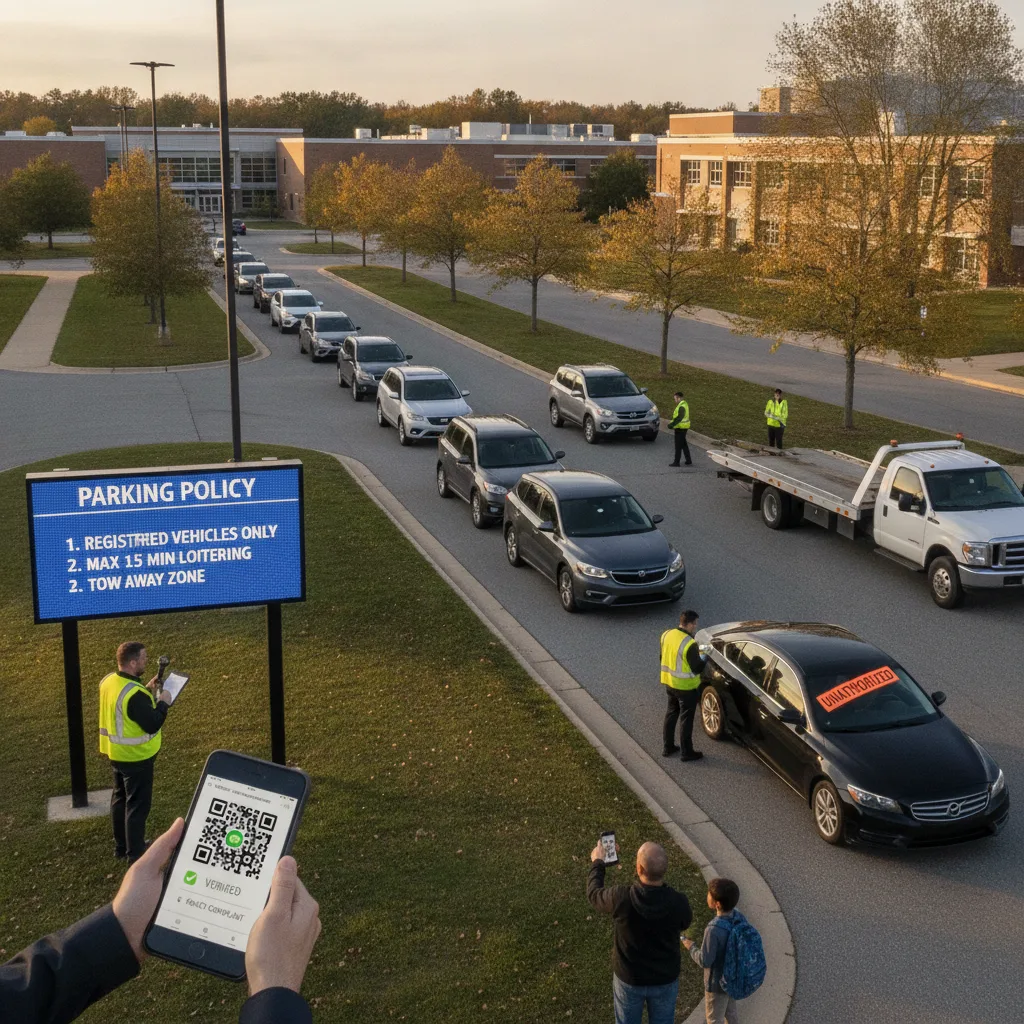
Direct answer: The mechanics of QR-and-plate payment automation are the same everywhere — a driver scans, enters a plate, and pays, while license plate recognition confirms the vehicle against that record for enforcement. What changes by property type is why compliance breaks and who has to fix it. Apartment communities need to trace a guest back to a resident; downtown lots need to compensate for drivers who will never return; hotels need the plate tied to a folio, not just a payment; event lots need to handle vehicles that leave and come back the same day. Pick the fix that matches your property’s actual failure pattern, not a generic checklist.
This is a comparison guide, not a repeat of any single property’s playbook. If you manage one property type, the deep-dive guides linked below cover your specific edge cases in more detail. If you manage a mixed portfolio — which is increasingly common for property management groups and parking operators — this page is meant to help you see which lessons from one property type actually transfer to another, and which don’t.
What drives noncompliance, by property type
| Property type | Main compliance driver | What matters most in the fix |
|---|---|---|
| Apartment & multifamily | Guests aren’t known to the property; a violation has to trace back to a resident sponsor | Require a unit or resident match at checkout, not just a plate |
| Downtown & mixed-use lots | Nearly every driver is a first-time or one-time user with no repeat relationship | Prevent the mistake at arrival — signage and lot identity confirmation, not after-the-fact correction |
| Hotels & hospitality | Parking is one line item inside a longer guest stay, often billed to a room | Tie the plate to the folio, not a standalone payment, and handle mid-stay vehicle changes |
| Event lots | Vehicles leave and re-enter the same day; queues form fast at gates | Let the plate itself carry the paid credential so re-entry doesn’t require re-scanning |
| Private & general lots | Varies — often a mix of the above at smaller scale | Diagnose the actual failure pattern before choosing a fix from another property type |
Where the mechanics are genuinely identical
Regardless of property type, the same four stages have to work: the driver has to find and understand the correct rate and zone, the checkout has to capture a usable plate and payment, that payment has to reach enforcement fast enough to matter, and there has to be a real correction path for the inevitable mismatch. Every property-type guide below covers those four stages — the difference is which one tends to break first, and what a realistic edge case looks like on the ground.
Where the fixes diverge — and why copying across property types backfires
The most common mistake in a multi-property rollout is treating one site’s fix as the default for all of them. A signage-first fix that solves a downtown lot’s wrong-lot payments does very little for an apartment community, where the guest already found the right lot but nobody knows which resident to bill. Conversely, an apartment-style sponsorship field — asking a downtown driver to enter a unit number that doesn’t exist — just adds friction with no payoff. Start each property’s diagnosis from its actual failure pattern rather than assuming last quarter’s fix will transfer.
Worked example: a property group runs both a downtown pay lot and an apartment community two miles away. The downtown lot’s compliance issue turns out to be almost entirely wrong-lot payments at one entrance next to a nearly identical competitor lot — a signage fix. The apartment community’s issue is unrelated: guests are paying correctly, but when a vehicle overstays, nobody can tell which resident invited them. Same parent company, same underlying QR-and-plate system, two completely different root causes and two completely different fixes.
How to choose where to start
- Pull a sample of flagged or disputed vehicles from each property in the portfolio.
- Sort them by which of the four stages broke — discovery, checkout, entitlement sync, or correction — rather than by property type.
- Match the dominant failure to the property-type guide below that addresses it in depth.
- Pilot the fix at the single worst-performing site before rolling it across similar properties.
- Re-check after 30 days; a fix that works at one downtown lot may not transfer to another with a different street layout.
Apartment & multifamily
- Combining LPR with QR auto-pay for guest parking
- Improving self-parking compliance without new hardware
Private & mixed-use lots
- Private lot owners: combining LPR with QR auto-pay
- Private lot owners: improving self-parking compliance
- Mixed-use properties: combining LPR with QR auto-pay
- Mixed-use properties: improving self-parking compliance
Downtown, event & hospitality lots
- Downtown lot operators: combining LPR with QR auto-pay
- Downtown lot operators: improving self-parking compliance
- Event lot managers: combining LPR with QR auto-pay
- Hotel parking teams: combining LPR with QR auto-pay
- General parking operators: combining LPR with QR auto-pay
Each guide above walks through the same underlying mechanics — plate capture, QR session matching, payment reconciliation, and enforcement handoff — worked through for that property type’s specific edge cases rather than repeated generically.
Not sure which fix applies to your portfolio?
Bring a sample of flagged or disputed sessions from each property. PLACA.AI can help sort them by root cause before you commit to a rollout plan across a mixed portfolio.
Data source: U.S. Department of Transportation